



Table of Contents
- Why the Espresso Floats: Temperature and Density
- Gear and Ingredients You'll Need
- Step-by-Step Layering Method
- Latte or Macchiato: Why the Order Matters
- What the Finished Drink Should Look and Taste Like
- Common Mistakes and How to Fix Them
- Variations Using the Same Order
- Frequently Asked Questions
- Why does the espresso sit on top of the milk?
- Can I layer an iced latte with cold brew or instant coffee?
- Do I put milk or espresso in first for an iced latte?
- How long do the layers last?
- Which milk layers best?
To layer an iced latte at home, put the cold milk in the glass first, pack the glass with ice, and pour freshly brewed hot espresso slowly onto the ice so it settles on top of the milk instead of plunging into it. The espresso stays on top because it is warmer, and therefore lighter, than the cold milk below it. A firm layer of ice softens the pour.
Starbucks’ own at-home iced caramel macchiato recipe uses this order, with syrup in the glass first, and it is the simplest model to copy. This guide explains why the order works, gives that published recipe as a starting point, and shows how to fix layers that blend too soon.
Why the Espresso Floats: Temperature and Density
A liquid that is less dense sits on top of a denser one. Two things change how dense a coffee-drink ingredient is: its temperature and what is dissolved in it. The U.S. Geological Survey notes that water’s density changes with temperature or if there are substances dissolved in it.
The USGS water-density table shows the temperature effect. Water at 4°C has a density of 1.00000 g/cm³; at 60°C it is 0.98338 g/cm³, and at 93.3°C it is 0.96333 g/cm³. Milk and espresso are not pure water, so those figures show the direction of the effect rather than the exact values for your glass.
That small difference is what a layered iced latte relies on. Tasting Table puts it plainly: in a traditional iced latte, the espresso is much hotter than the milk and is basically guaranteed to float once its pour has been buffered by the ice. Its rule of thumb is that whatever you want on the bottom needs to be either colder or heavier than the top layer.
Sugar is the “heavier” half of that rule. Dissolved substances change density, and Tasting Table suggests mixing sweetener into the milk to help keep it at the bottom. It gives that tip for cold coffee, which lacks the temperature difference; with hot espresso, it says a packed layer of ice is enough.
Gear and Ingredients You’ll Need
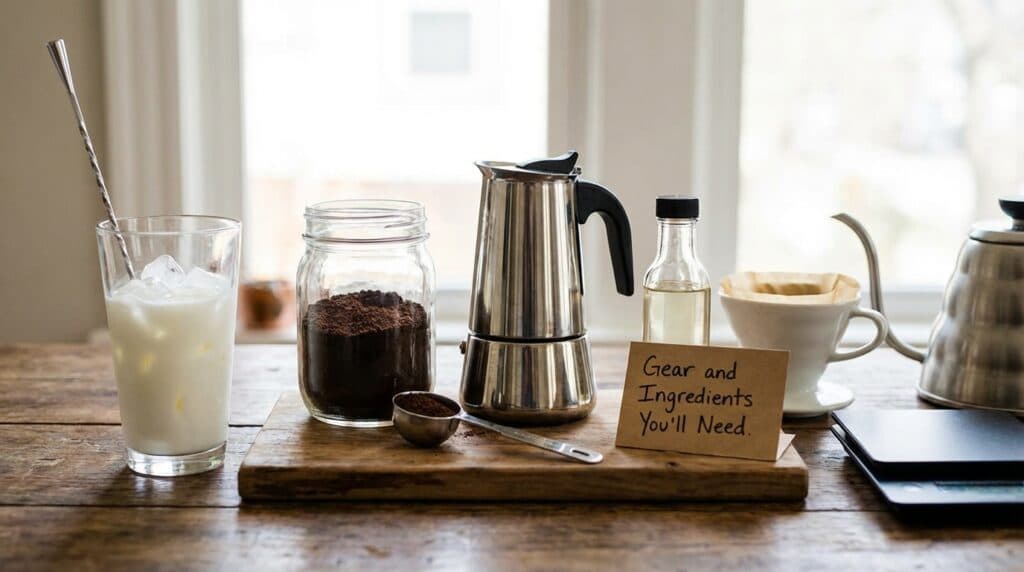
The Starbucks at Home iced caramel macchiato recipe for one serving is a well-documented template for a layered iced latte:
- Espresso: 2 shots. Starbucks recommends an espresso machine and says a stove-top moka pot can make espresso-like coffee if you do not have one.
- Vanilla syrup: 1 oz, homemade or store-bought.
- Milk: 0.75 cup of cold 2% milk.
- Ice: enough to fill the glass to ½ inch below the rim.
- Caramel sauce: for the topping, optional if you only want a layered iced latte.
For the glass, Tasting Table recommends a tall, narrow one because it helps hold the ice together as a sturdy surface. A clear glass also lets you see whether the layers are holding.
If you do not have an espresso machine, the moka pot latte guide covers brewing a strong moka base. Brew it just before you pour, because the method depends on the coffee being hot.
Step-by-Step Layering Method
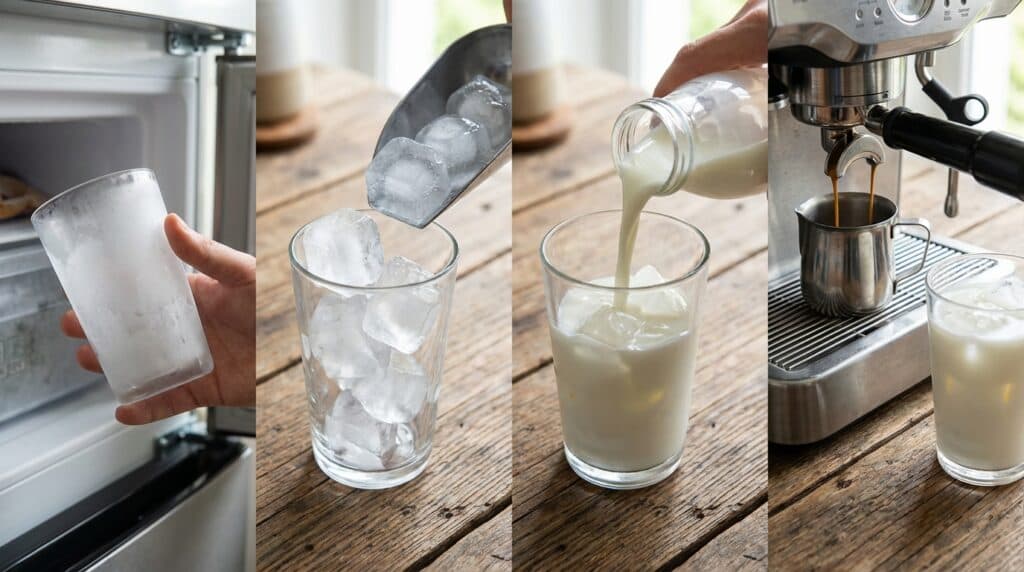
- Add the syrup. Pour the vanilla syrup into the bottom of the glass. Leave it out for an unsweetened version.
- Add the cold milk. Pour the milk straight from the refrigerator over the syrup. Starbucks specifies cold milk at this step.
- Fill with ice. Fill the glass to about ½ inch below the rim. Tasting Table’s advice is a generous, firmly packed layer of ice at the top of the milk, not a few cubes floating loose; it calls this layer a tray that dampens the pour and gives the coffee a stable place to sit.
- Brew the espresso last. Pull the shots, or brew the moka coffee, after the glass is ready, so the coffee is still hot when it goes in.
- Pour slowly onto the ice. Pour in a thin stream onto the top of the ice rather than straight down the middle. The ice breaks the fall of the coffee; a fast pour drives it down into the milk.
- Top and serve. Add the caramel sauce if you are making the caramel version, and serve unstirred.
Wikipedia’s latte macchiato entry notes that espresso brewed into a specialized espresso brew pitcher makes pouring easier, particularly for layering. A small jug with a spout gives you more control over the stream than pouring from a wide cup.
Latte or Macchiato: Why the Order Matters
The difference between the two drinks is the order of the ingredients. Wikipedia describes a latte as espresso to which hot steamed milk is added, while a latte macchiato is made the other way round, with the espresso added to the glass after the steamed milk. The name means “stained milk”. A layered iced latte follows the same order with cold milk, so it is in effect an iced take on the latte macchiato.
Starbucks’ recipe page describes the result the same way: two espresso shots layered over vanilla syrup, milk and ice, giving a sweet drink with a layered appearance. If you want the small espresso drink with a spoonful of foam instead, the espresso macchiato recipe covers that separate drink.
What the Finished Drink Should Look and Taste Like
A layered glass shows pale milk at the bottom, a mixed band where the two meet, and dark coffee at the top. The layers are a temporary arrangement. The coffee cools on contact with the ice, and the temperature difference that kept it on top starts to disappear.
Because the coffee sits at the top, the first sips from the rim of an unstirred glass are coffee-heavy and the milk is underneath; a straw draws from the bottom first. Stir before drinking if you want an even taste from start to finish.
Common Mistakes and How to Fix Them

| Problem | Likely cause | Fix |
|---|---|---|
| Coffee bleeds straight into the milk | Too little ice, or loose floating cubes | Pack a firm layer of ice above the milk before pouring |
| Layers blend as you pour | Pouring fast, so the stream hits hard | Pour a thin stream onto the ice, from a small jug if you have one |
| Coffee sinks even with a slow pour | The coffee is not much warmer than the milk | Brew the coffee last and pour it while hot |
| Cold brew or instant will not stay on top | No temperature difference to work with | Sweeten the milk so it is heavier than the coffee |
The last row comes from Tasting Table’s notes on adapting the method. It points out that cold brew, coffee concentrate and cold-mixed instant coffee do not have enough temperature difference to reliably stay on top. For that case it adds that thinner liquids such as skim milk and rice milk need much more added weight to stabilize the layering.
Variations Using the Same Order
Every variation keeps the rule: the heavier, colder ingredient goes in first, and the hot coffee goes in last.
- Iced caramel macchiato: the Starbucks recipe above, finished with caramel sauce on top.
- Plain layered iced latte: skip the vanilla syrup and caramel. Rely on cold milk, packed ice and a slow pour of hot coffee.
- Other flavored syrups: any syrup can replace the vanilla at the bottom of the glass. Tasting Table’s tip of sweetening the milk is aimed at cold coffee, where there is no temperature difference to rely on.
- Moka pot version: use hot moka coffee in place of espresso, as Starbucks suggests for readers without an espresso machine.
Frequently Asked Questions
Why does the espresso sit on top of the milk?
It is hotter and therefore less dense than the cold milk. The USGS density table shows the same effect for water: warmer water is lighter than cold water. A layer of ice slows the pour so the coffee can settle rather than mix.
Can I layer an iced latte with cold brew or instant coffee?
It is harder. Tasting Table notes that cold brew, concentrate and cold-mixed instant coffee lack the temperature difference that keeps hot espresso floating. Sweetening the milk makes it denser, which can help keep it at the bottom.
Do I put milk or espresso in first for an iced latte?
For a layered drink, milk first. Starbucks’ iced caramel macchiato starts with syrup and cold milk, adds ice, and finishes with the espresso. Putting the espresso in first and adding milk makes a mixed iced latte.
How long do the layers last?
Not long, and it varies with the temperature of each ingredient and how much ice is in the glass. As the coffee cools against the ice, the difference that kept it on top shrinks. Serve the drink as soon as it is poured if the look matters.
Which milk layers best?
The Starbucks recipe uses cold 2% milk. With hot espresso, Tasting Table says a packed layer of ice is enough for cold milk. Whatever you use, start with it cold.



Comments