


Table of Contents
- Why Most Homemade Iced Coffee Tastes Bitter
- Cold Brew: The Smoothest Path to Less Bitter Iced Coffee
- What You Need
- The Method
- How Long Cold Brew Keeps
- Japanese Iced Coffee: Bright Flavor in Minutes
- What You Need
- The Method
- If It Still Tastes Bitter
- Choosing the Right Beans
- Add-Ins That Reduce Perceived Bitterness
- Troubleshooting: Still Bitter?
- Frequently Asked Questions
- Is cold brew less bitter than iced coffee?
- How long should cold brew steep?
- How long can I keep cold brew in the fridge?
- Which roast is best if I dislike bitterness?
- Putting It Together
If ordinary iced coffee tastes too bitter to you, change how it is brewed before you reach for more sugar. Two methods are worth trying. Cold brew steeps coarse grounds in room-temperature or cold water, and the National Coffee Association (NCA) says it “offers a less bitter, smoother taste” than iced coffee. Brewing a pour-over straight onto ice is the quicker option if you want a brighter cup. After that, a coarser grind, a less dark roast and a sweetener that dissolves in a cold drink deal with most of the bitterness that remains.
Daily Home Coffee does not test products. The recipes and figures below come from the named sources, or from the arithmetic of a stated ratio.
Why Most Homemade Iced Coffee Tastes Bitter
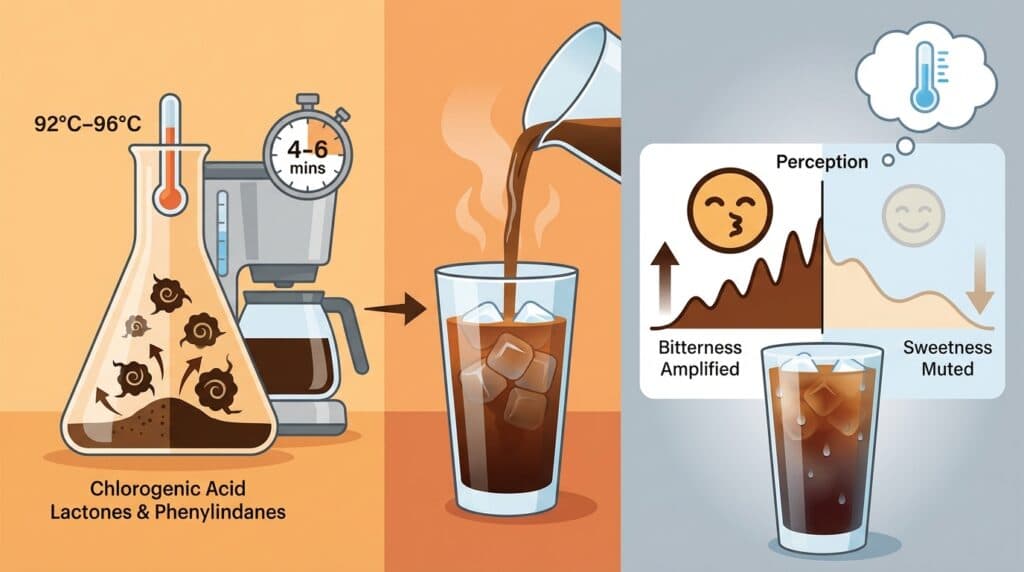
The NCA defines iced coffee as “coffee that has been brewed hot using a standard method, then cooled down to serve”, and cold brew as coffee brewed with room-temperature or cooler water. The two have different flavour profiles, and the NCA describes cold brew as the less bitter of the two. Beyond the brewing method, the usual causes of a bitter or dull glass come from the same few places as in hot coffee:
- The grind is too fine. The NCA lists a grind that is too fine, which over-extracts the coffee, as one cause of bitterness, and suggests a coarser grind.
- The roast is very dark. The NCA describes dark roast as producing “shiny black beans with an oily surface and a pronounced bitterness.”
- The brewer is not clean. The NCA advises washing a pour-over brewer with hot, soapy water after each use so there is no build-up of coffee oil, “which can make your next cup taste bitter.”
- The beans are past their best. The NCA notes that coffee “begins to lose freshness almost immediately after roasting” and suggests buying enough for one or two weeks at a time.
Cold Brew: The Smoothest Path to Less Bitter Iced Coffee
Cold brew takes the heat out of brewing. The NCA says brewing without heat over a longer time “affects the coffee grounds differently, giving you a smoother, more mellow cup”, and that the method lets you make a concentrate “designed to be diluted with water or enjoyed with ice, even as it melts.”
What You Need
- Coarsely ground coffee (the NCA lists cold brew as a coarse grind)
- Cold, filtered water; the NCA advises avoiding distilled or softened water
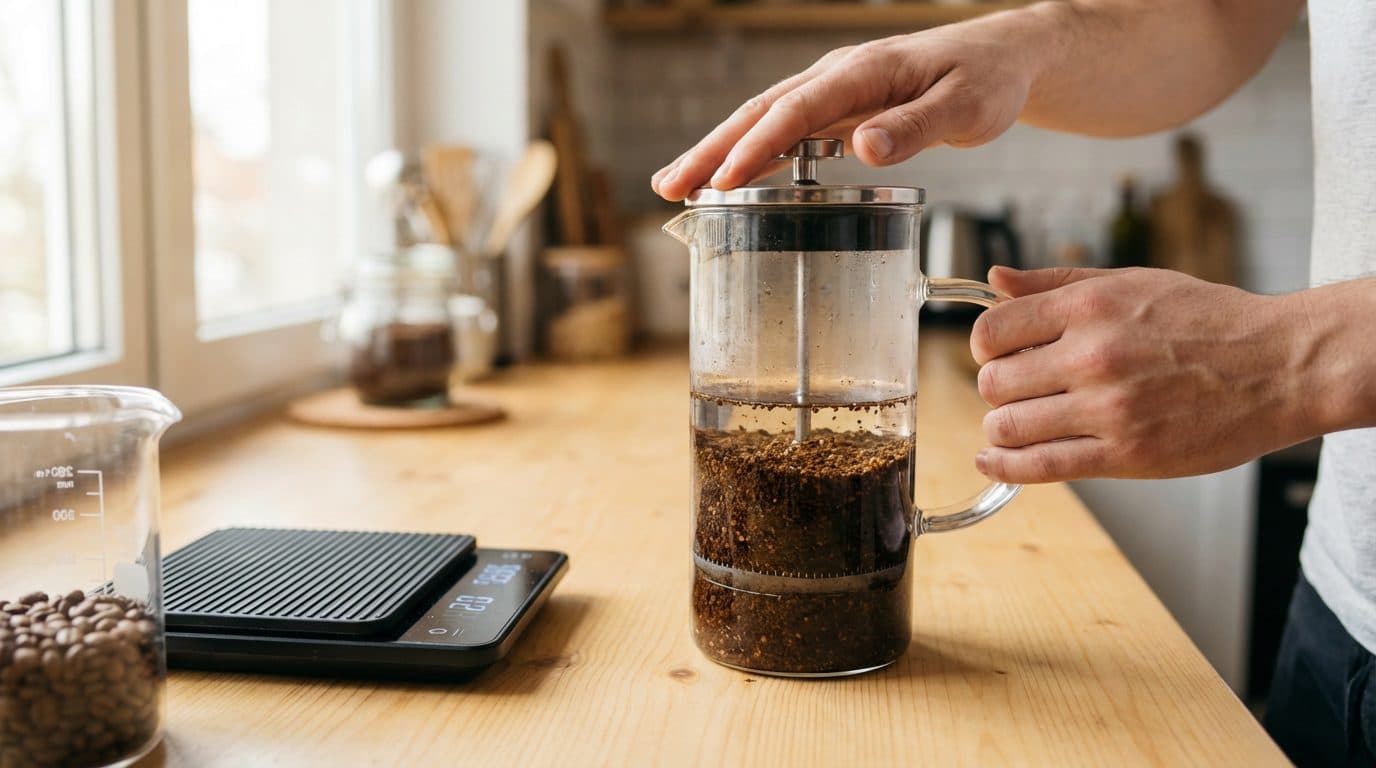
- A jar, pitcher or French press with a cover
- A coffee filter, or a fine-mesh sieve lined with cheesecloth
- A kitchen scale
The Method
- Weigh the coffee and water. The NCA’s cold brew ratio is 1 gram of coffee to 4-5 grams of water. For example, 100 g of coffee takes 400-500 g of water.
- Combine and stir. Put the grounds in the container, add the water gradually and stir gently until all the grounds are wet.
- Cover and steep in the fridge for about 12 hours. The NCA’s hands-on method allows the refrigerator or room temperature, for 12 hours or overnight. This guide uses the fridge, because the storage guidance below covers cold brew that is brewed and kept at 41°F or below from the start.
- Strain. Pour through a coffee filter, or a fine-mesh sieve lined with cheesecloth, into a covered container. Strain a second time if needed.
- Dilute by the glass. Keep the concentrate undiluted in the fridge and thin each glass with water or milk to taste. The site’s sweet cold brew guide starts at 1 part concentrate to 2 parts water or milk and adjusts from there.
How Long Cold Brew Keeps
Treat seven days as the ceiling. Wisconsin’s Department of Agriculture, Trade and Consumer Protection treats cold brew made without a heat step as a food that needs refrigeration for safety. Its guidance covers cold brew that is brewed, held and served at 41°F or below and date-marked for no more than seven days from production; brewing above 41°F falls outside that simple case. That fact sheet is written for retail food businesses, but the reason applies at home too: the coffee is never heated. So steep in the fridge, keep the jar there, and use it within seven days.
Japanese Iced Coffee: Bright Flavor in Minutes
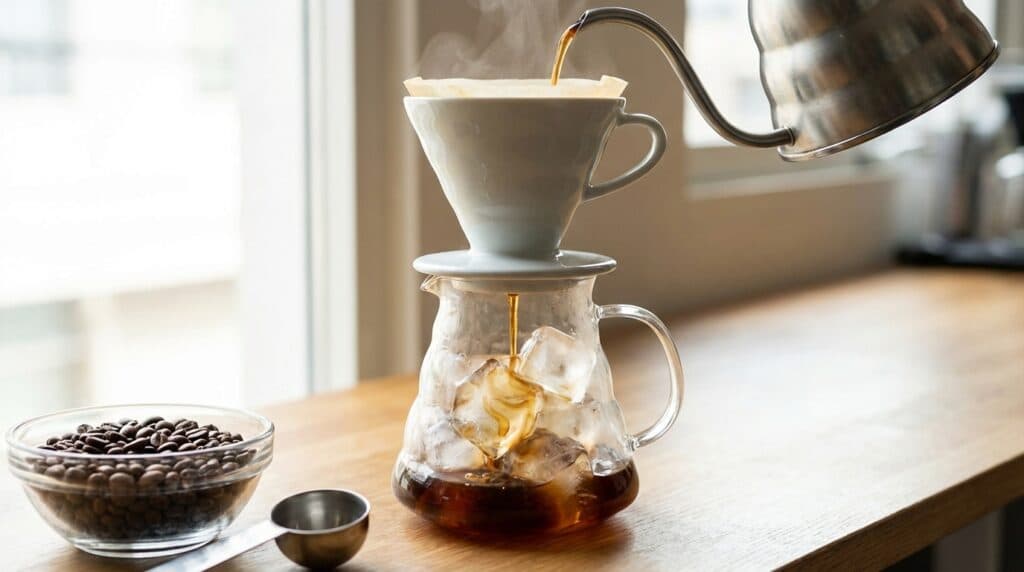
Japanese-style iced coffee is a pour-over brewed with hot water directly into a server that already holds ice. The hot water extracts the coffee, and the ice melts into the brew as it drips through. It keeps more of the brightness of a hot pour-over than cold brew does. That makes it a good fit for light and medium roasts, and less of one if acidity is also something you dislike.
What You Need
Kurasu, a coffee roaster and shop in Kyoto, publishes this recipe for a light roast on a Hario V60:
- 16 g of coffee, ground medium fine
- 150 g of hot water at 91℃
- 70 g of ice cubes in the server
- A cone dripper, a paper filter, a kettle and a scale
The Method
- Put the 70 g of ice in the server before brewing and set the dripper on top.
- First pour at 0:00: 40 g of water.
- Second pour at 0:40: 60 g, for 100 g in total.
- Third pour at 1:10: 50 g, for 150 g in total. Kurasu says to make this pour “nice and gentle” and that pours from this point on adjust the concentration.
- The brew finishes at about 2:10. Kurasu suggests trying to finish each pour in 10 seconds.
- Make sure all the ice in the server has melted, then serve over more ice.
If It Still Tastes Bitter
Use the same grind rule as for hot coffee. If the glass is bitter, grind coarser for the next brew; if it tastes flat or watery, the NCA suggests a finer grind. Change one thing at a time so you can tell which change helped.
Sourness is a separate problem. The NCA notes that the lighter the roast, the more acidic the brew, so some brightness is part of a light roast. If a light roast tastes unpleasantly sour, the site’s roast guide suggests the opposite of the bitterness fix: grind finer, brew slightly hotter or extend the contact time.
Choosing the Right Beans
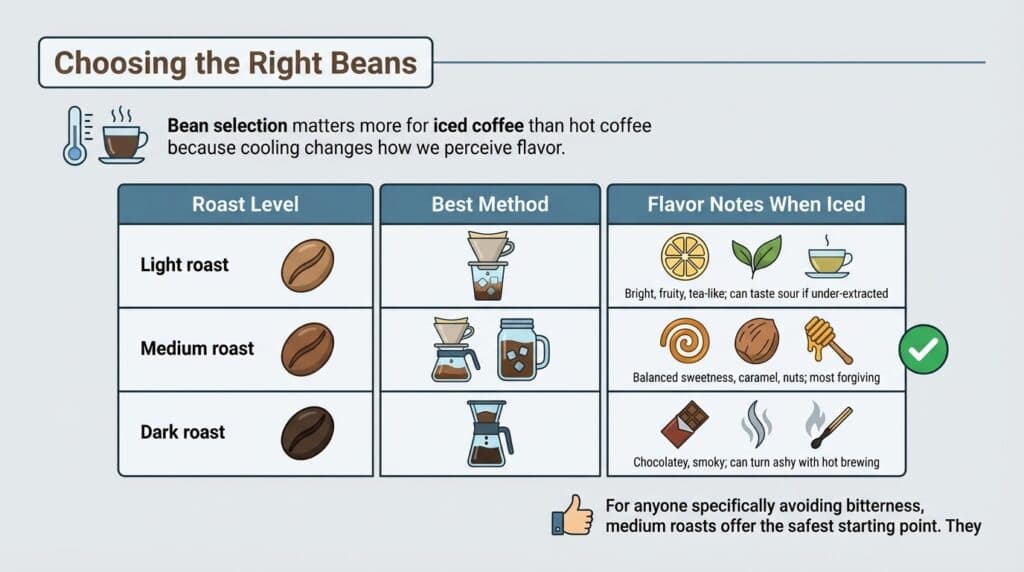
Roast level shifts the balance between acidity and bitterness. The NCA’s descriptions:
| Roast | NCA description | For a bitter-averse drinker |
|---|---|---|
| Light | Subtle “roasted” taste; the lighter the roast, the more acidic the brew | Least roast bitterness, but the most acidity |
| Medium | Medium brown, stronger flavour than light, non-oily surface | A middle ground to try first |
| Dark | Oily surface and a pronounced bitterness; less acidic | Usually the roast to move away from |
Roast names are not standard. The NCA points out that one roaster’s dark coffee may be different from another’s, so judge a bag by how it tastes rather than by its label alone. For more detail on how each level brews, see the roast level guide.
Freshness matters as well. The NCA suggests buying smaller batches, enough for one or two weeks, keeping beans in an airtight, opaque container in a cool, dark place, and grinding just before brewing.
Add-Ins That Reduce Perceived Bitterness
Once the brewing is right, add-ins can round off what bitterness is left:
- Simple syrup. Wikipedia’s entry on syrup notes that “Granulated sugar does not dissolve easily in cold drinks.” Standard simple syrup is sugar and water at 1:1 by volume. Dissolve the sugar in warm water, let it cool, and stir it into the glass.
- Flavoured syrups. The same entry describes these as simple syrups infused with flavourings, the kind commonly used at coffee bars. They mix into a cold drink the same way.
- A very small pinch of salt. Breslin and Beauchamp, writing in Nature in 1997, proposed that salts suppress unpleasant tastes such as bitterness more than palatable ones such as sweetness. The abstract does not mention coffee or give a dose, so treat salt as something to try: use the smallest pinch you can manage in a whole glass and stop before it tastes salty.
- Milk or a dairy-free alternative. Cold brew concentrate is made to be diluted, and milk can be the diluting liquid. How much is a matter of taste.
Troubleshooting: Still Bitter?
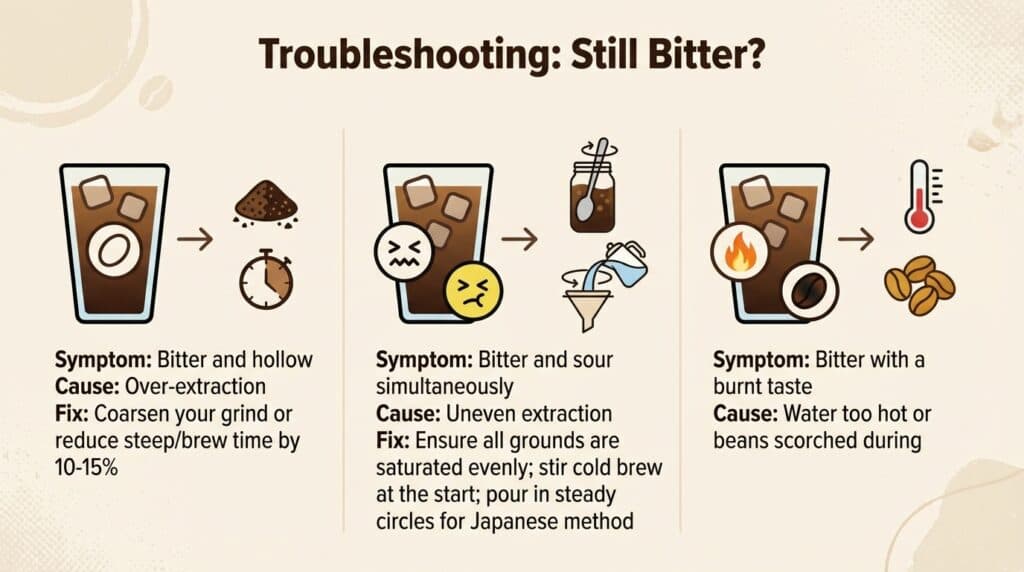
| What you taste | Likely cause | What to change |
|---|---|---|
| Bitter | Grind too fine (NCA) | Grind coarser next time |
| Unpleasantly sour (light roast) | Possible under-extraction | Grind finer or extend contact time |
| Flat or watery | Grind too coarse (NCA) | Grind finer; for cold brew, dilute less |
| Bitter with a heavy roast taste | A very dark roast | Try a medium roast |
| Bitter from the same brewer each time | Coffee oil left in the brewer | Wash the brewer with hot, soapy water after each use |
| Flat and dull | Beans past their best | Buy enough for one or two weeks |
| Sugar left at the bottom | Granulated sugar in a cold drink | Use simple syrup |
Frequently Asked Questions
Is cold brew less bitter than iced coffee?
The NCA says so: iced coffee is brewed hot and then cooled, while cold brew is brewed with room-temperature or cooler water, and “cold brew offers a less bitter, smoother taste.”
How long should cold brew steep?
The NCA’s quick numbers give about 12 hours of contact between coffee and water, at a ratio of 1:4 to 1:5. Its method allows the fridge or room temperature, for 12 hours or overnight; steep in the fridge if you plan to keep the batch.
How long can I keep cold brew in the fridge?
Use seven days as the limit, for a batch brewed and kept in the fridge. That is the date-marking ceiling in Wisconsin’s guidance for cold brew made without heat and brewed, held and served at 41°F or below.
Which roast is best if I dislike bitterness?
Start with a medium roast. The NCA describes dark roasts as having a pronounced bitterness and light roasts as more acidic, so a medium roast sits between the two. Then adjust to taste.
Putting It Together
For the smoothest glass, make cold brew at 1:4 to 1:5, steep it for about 12 hours in the fridge, and dilute each glass as you pour it. For a quicker, brighter cup, brew a pour-over directly onto ice using Kurasu’s recipe. In either case, grind coarser if the coffee tastes bitter, move away from the darkest roasts, keep the brewer clean, and sweeten with syrup rather than granulated sugar.

Comments