


Table of Contents
- Understanding the Golden Ratio in Coffee Brewing
- Why Does This Ratio Matter?
- The Golden Ratio for Different Brewing Methods
- Drip Coffee Maker
- Pour-Over (V60, Chemex, Kalita)
- French Press
- Cold Brew
- How to Measure and Apply the Golden Ratio at Home
- Using a Kitchen Scale (Recommended)
- Using Tablespoons and Cups
- Fine-Tuning Your Ratio Based on Taste
- Signs You Need to Adjust
- Variables Beyond the Ratio
- Practical Examples: Golden Ratio in Action
- Morning Rush: Quick Drip Coffee for Two
- Weekend Pour-Over Ritual
- Batch Cold Brew for the Week
- Frequently Asked Questions
- Is the golden ratio the same for all types of coffee beans?
- Can I use the golden ratio for espresso?
- Why does my coffee still taste bad even with the right ratio?
- Do I need an expensive scale to measure accurately?
- How do I adjust the ratio if I like stronger or weaker coffee?
- Conclusion: Start Brewing Better Coffee Today
Use 60 grams of coffee per liter of water, about 1:16.7, as a repeatable filter-coffee starting point. Ratio controls beverage concentration; grind, temperature, contact time, agitation, and flow still determine extraction and flavor.
In this guide, you’ll learn exactly what the golden ratio means, why it matters for your daily brew, and how to apply it using the equipment you already have in your kitchen. Whether you’re using a French press, pour-over, or drip machine, understanding this fundamental principle will give you consistent, great-tasting coffee every single time.
Understanding the Golden Ratio in Coffee Brewing
The coffee-to-water ratio controls beverage concentration and provides a repeatable starting point. For filter coffee, begin around 55-60 grams per liter (roughly 1:18 to 1:16.7), then adjust grind and recipe from the tasted result.
For those who prefer measuring in tablespoons, this translates to roughly 1 to 2 tablespoons of ground coffee for every 6 ounces of water. However, using a kitchen scale gives you much more precise and repeatable results.
Why Does This Ratio Matter?

Coffee extraction is a delicate chemical process. When hot water passes through ground coffee, it dissolves various compounds including acids, sugars, and oils. The golden ratio ensures you extract the right amount of these compounds:
- Less coffee for the same water: Produces a less concentrated drink. Extraction can still be low or high depending on grind, temperature, time, agitation, and flow.
- More coffee for the same water: Produces a more concentrated drink. A strong ratio does not by itself prove under-extraction.
- Just right (1:15 to 1:18): You get balanced extraction with sweetness, pleasant acidity, and full body.
Think of it like making soup. Too much water makes it bland; too little makes it overly salty and intense. The golden ratio is your recipe for balance.
The Golden Ratio for Different Brewing Methods
While 1:18 serves as a general guideline, different brewing methods work better with slight variations. Here’s a breakdown to help you dial in your perfect cup.
Drip Coffee Maker
Standard drip machines work well with the classic 1:17 to 1:18 ratio. For a typical 12-cup pot (which usually holds about 60 ounces or 1.7 liters), you’d use approximately 100 grams of ground coffee. Start here and adjust based on your taste preferences.
A common mistake is following the markings on your coffee maker’s carafe, which often don’t correspond to standard cup sizes. Always measure your water separately for accuracy.
Pour-Over (V60, Chemex, Kalita)
Pour-over enthusiasts often prefer a slightly stronger ratio of 1:15 to 1:17. This compensates for the faster brewing time and produces a cleaner, more nuanced cup. For a single serving of 300ml, try starting with 18-20 grams of medium-fine ground coffee.
French Press
French press brewing calls for a coarser grind and full immersion, so the golden ratio shifts to about 1:15. The longer steep time (typically 4 minutes) allows for thorough extraction even with fewer passes of water through the grounds. For a standard 34-ounce French press, use about 56 grams of coarsely ground coffee.
Cold Brew

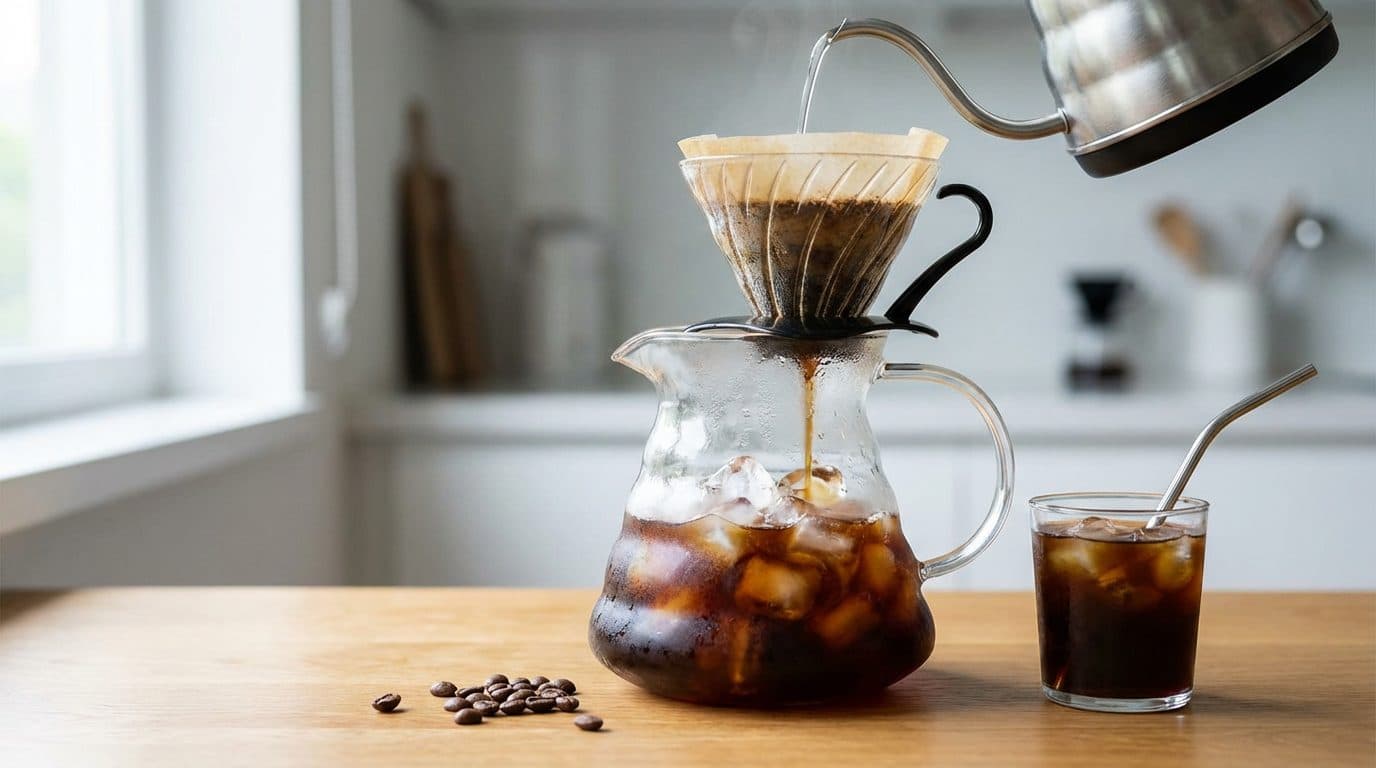
Cold brew is the exception to the rule. Because cold water extracts compounds much more slowly, you need a concentrate ratio of about 1:8 or even 1:5. This strong concentrate is then diluted with water or milk before drinking. For one liter of water, use 125-200 grams of coarsely ground coffee and steep for 12-24 hours.
How to Measure and Apply the Golden Ratio at Home
Putting the golden ratio into practice doesn’t require expensive equipment. Here’s how to get started with tools you probably already own.
Using a Kitchen Scale (Recommended)
A digital kitchen scale that measures whole grams is sufficient for repeatable filter-coffee recipes. Compare current local prices and capacity rather than relying on a fixed price estimate:
- Place your empty brewing vessel or filter holder on the scale and press “tare” to zero it out.
- Add your ground coffee and note the weight (for example, 20 grams).
- Multiply by your desired ratio (20 × 17 = 340 grams of water for a 1:17 ratio).
- Measure your water by weight, since 1 gram of water equals 1 milliliter.
This method removes all guesswork and lets you replicate your favorite brew every time.
Using Tablespoons and Cups
If you don’t have a scale, you can still get decent results with volume measurements. The general guideline is 2 tablespoons of ground coffee per 6 ounces of water. Keep in mind that different coffee beans have different densities, so this method is less precise.
A typical “cup” in coffee maker terms is only 5-6 ounces, not the 8-ounce measuring cup you’d use for baking. This confusion leads many people to use too little coffee. When in doubt, add an extra scoop.
Fine-Tuning Your Ratio Based on Taste

The golden ratio is a starting point, not a rigid rule. Your perfect ratio depends on several factors including personal preference, bean origin, roast level, and even water quality.
Signs You Need to Adjust
Pay attention to what your coffee is telling you:
- Tastes sour or acidic: Your coffee might be under-extracted. Try a finer grind, hotter water, or a slightly weaker ratio (more water).
- Tastes bitter or harsh: This often means over-extraction. Use a coarser grind, slightly cooler water, or a stronger ratio (more coffee).
- Tastes weak or watery: Simply add more coffee grounds next time.
- Tastes too intense: Reduce the amount of coffee or add more water.
Variables Beyond the Ratio
Remember that the coffee-to-water ratio works together with other brewing variables:
- Grind size: Finer grinds extract faster; coarser grinds extract slower.
- Water temperature: Use 195-205°F (90-96°C) as a practical starting range. Water does not literally scorch wet coffee grounds; change temperature together with grind and contact time based on taste.
- Brew time: Longer contact time means more extraction.
- Water quality: Filtered water often produces cleaner, more balanced flavors than hard tap water.
In short, the ratio is one piece of the puzzle. Mastering it gives you a solid foundation to experiment with other variables.
Practical Examples: Golden Ratio in Action
Let’s walk through some real-world scenarios to make this more concrete.
Morning Rush: Quick Drip Coffee for Two

You want to make 500ml (about 17 ounces) of coffee for you and your partner. Using a 1:17 ratio: 500 ÷ 17 = 29.4 grams of coffee. Round up to 30 grams for easy measuring. Set your drip machine, add the grounds, pour in 500ml of water, and brew.
Weekend Pour-Over Ritual
You’re making a single cup for yourself and want something special. For 250ml of coffee at a 1:16 ratio: 250 ÷ 16 = 15.6 grams. Use 16 grams of freshly ground coffee with a medium-fine setting. Bloom the grounds with 30-40ml of water for 30 seconds, then slowly pour the remaining water in circular motions over 2-3 minutes.
Batch Cold Brew for the Week
You want to prepare cold brew concentrate to last several days. For 1 liter of water at a 1:8 ratio: 1000 ÷ 8 = 125 grams of coarsely ground coffee. Combine in a jar, refrigerate for 16-20 hours, then strain. Dilute the concentrate 1:1 with water or milk when serving.
Frequently Asked Questions
Is the golden ratio the same for all types of coffee beans?
A ratio is a starting point rather than a roast-level rule. Different beans can work across the range; keep the ratio stable first, adjust grind and temperature from taste, then change dose in small steps and record the result.
Can I use the golden ratio for espresso?
Espresso uses a completely different ratio, typically around 1:2 (for example, 18 grams of coffee yielding 36 grams of liquid espresso). The golden ratio discussed here applies to filter and immersion brewing methods, not pressurized espresso extraction.
Why does my coffee still taste bad even with the right ratio?

The ratio is only one variable. Roast development, storage, grind size, water, temperature, and contact time can all change flavor. Prefer a visible roast date, store coffee sealed away from heat and moisture, and adjust one brewing variable at a time.
Do I need an expensive scale to measure accurately?
No. For filter coffee, choose a digital scale with enough capacity and whole-gram resolution. Finer resolution can be useful for small espresso doses, but compare current specifications and local prices instead of using a fixed cost estimate.
How do I adjust the ratio if I like stronger or weaker coffee?
For stronger coffee, increase the amount of grounds (try 1:15 or 1:14). For milder coffee, decrease the grounds (try 1:18 or 1:19). Make small adjustments—changing by just 1-2 grams of coffee makes a noticeable difference in a single cup.
Conclusion: Start Brewing Better Coffee Today
The golden ratio in coffee brewing is your key to consistently delicious coffee at home. By maintaining the right proportion of coffee grounds to water—generally around 1:15 to 1:18 depending on your method—you set yourself up for balanced extraction every time. Combine this knowledge with attention to grind size, water temperature, and fresh beans, and you’ll be brewing coffee that rivals your favorite café.
Start with the standard ratio, taste the results, and adjust based on your preferences. Keep a simple log of what works and what doesn’t. Within a few days of experimenting, you’ll develop an intuition for exactly how much coffee to use for your perfect cup. Grab your scale, measure your next brew, and taste the difference that precision makes.


Comments