


Table of Contents
- The French Press Coffee Ratio Explained
- Why Weight Matters More Than Volume
- Adjusting the Ratio to Your Taste
- Step-by-Step French Press Brewing
- Grind Size: The Secret Variable
- Common Mistakes (And How to Fix Them)
- What Your French Press Coffee Should Taste Like
- Quick Reference: Coffee-to-Water Ratios
- Record the Recipe That Works
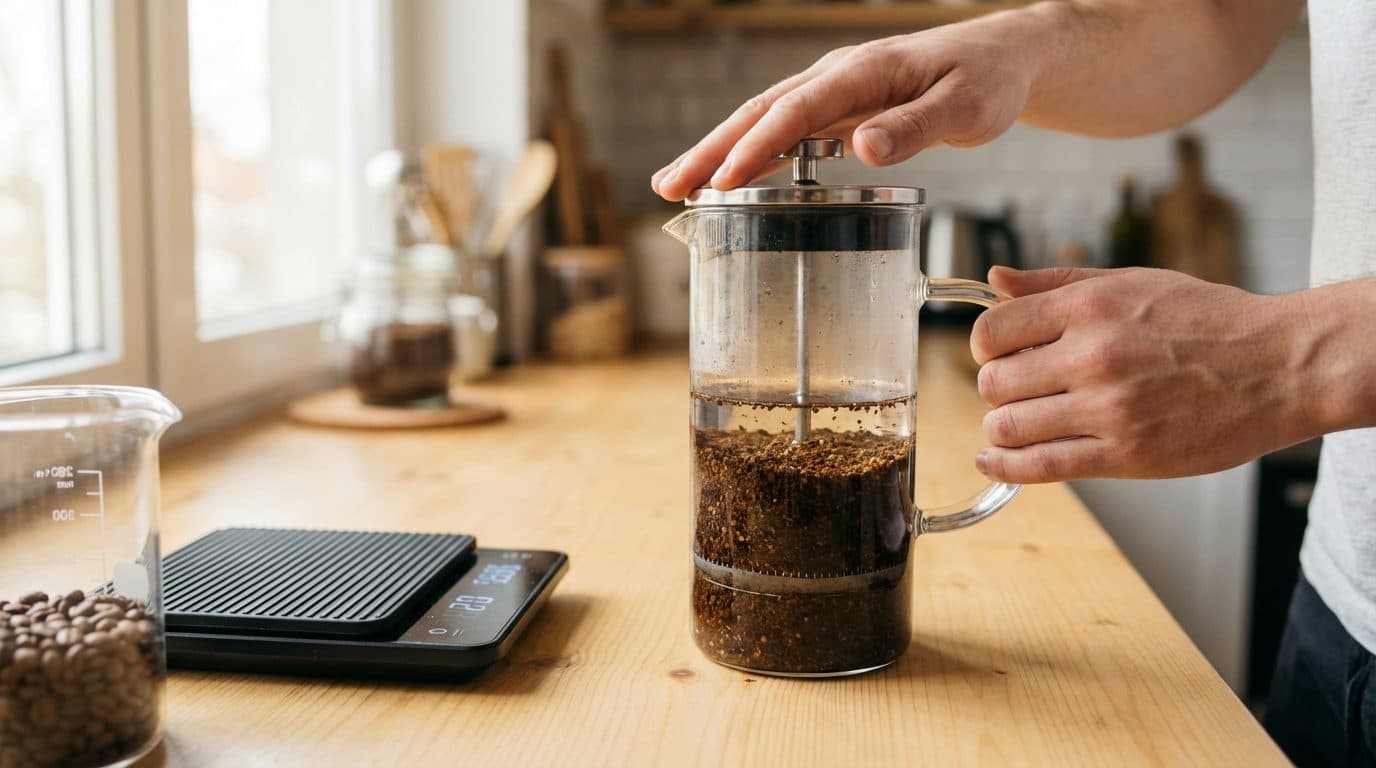
For French press, start with a 1:15 coffee-to-water ratio by weight: 30 grams of coffee for 450 grams (or milliliters) of water. Use a coarse, even grind and a four-minute steep, then change one variable at a time if the cup needs adjustment.
Estimating coffee by eye produces inconsistent doses. Weighing both coffee and water makes the ratio repeatable and gives you a reliable baseline for later adjustments.
The French Press Coffee Ratio Explained
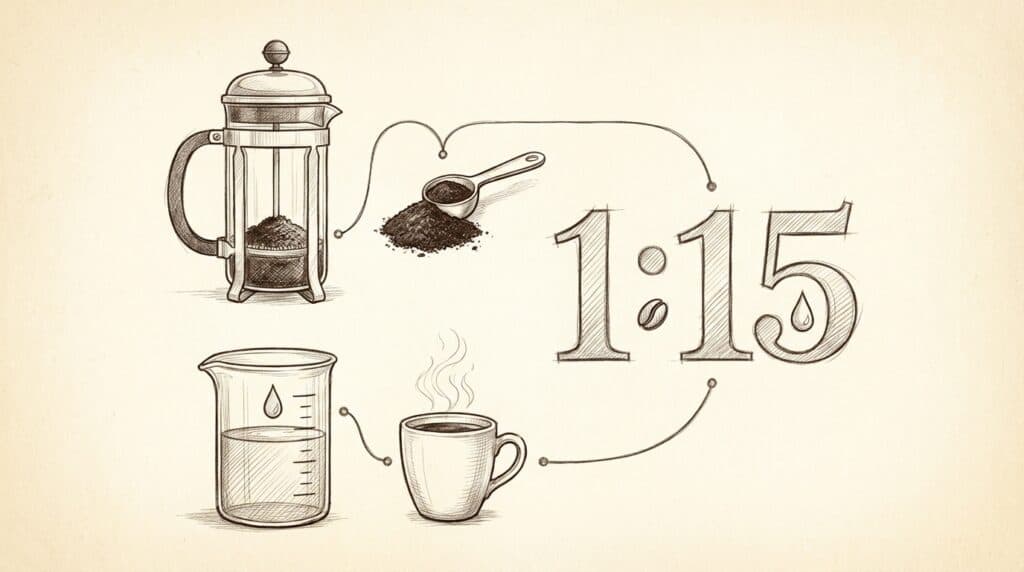
Let’s break this down without overcomplicating it.
French press recipes commonly range from 1:12 (stronger) to 1:17 (lighter). This guide uses 1:15 as a full-bodied, practical starting point. Here’s what that looks like in practice:
| Cups | Coffee (grams) | Water (grams/ml) | Ratio |
|---|---|---|---|
| 1 small (8 oz) | 15g | 225g | 1:15 |
| 2 cups (16 oz) | 30g | 450g | 1:15 |
| 4 cups (32 oz) | 60g | 900g | 1:15 |
| 8 cups (1 liter) | 66g | 1000g | 1:15 |
A basic kitchen scale makes the recipe repeatable and is more reliable than measuring ground coffee by volume.
If a scale is unavailable, use roughly 2 tablespoons of ground coffee per 6 ounces of water. Volume is less accurate because grind size and roast density change how much coffee fits in a spoon.
Why Weight Matters More Than Volume
Here’s the ugly truth about measuring coffee by scoops: it’s wildly inconsistent.
A tablespoon of finely ground coffee weighs more than a tablespoon of coarse ground coffee. Different roast levels have different densities too—light roasts are denser than dark roasts. So that “one scoop” you’re using? It could be 7 grams one day and 10 grams the next.
The same scoop can hold different coffee weights when roast level or grind size changes. Measuring grams removes that source of variation.
Grams don’t lie. Your taste buds will thank you.
Adjusting the Ratio to Your Taste
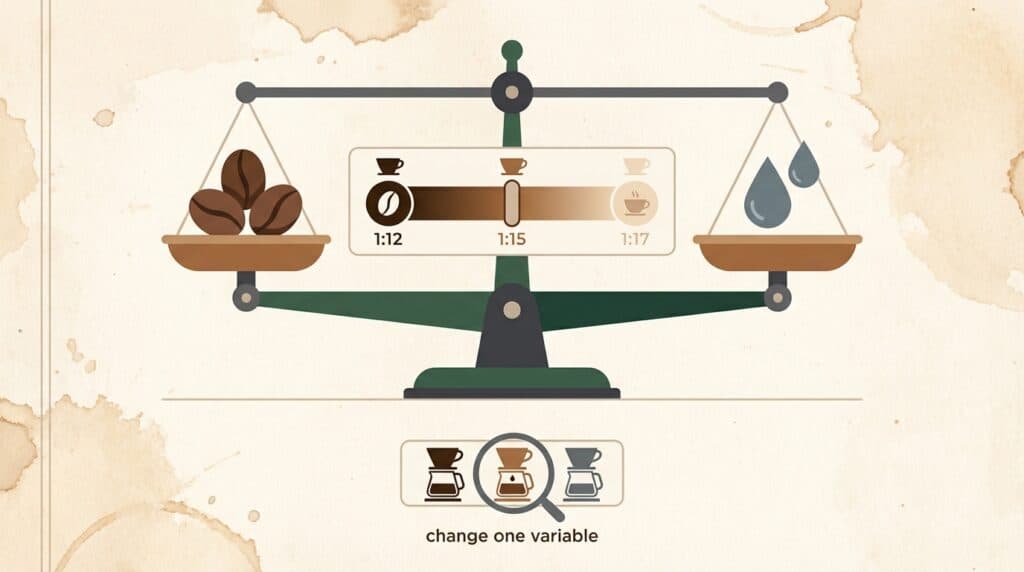
The 1:15 ratio is a starting point. Not a rule carved in stone.
Want a more concentrated drink? Try a lower ratio such as 1:12 or 1:13, then adjust from taste. Roast level and milk do not guarantee the same result.
Prefer something lighter? Try 1:16 or 1:17. The lower dose can make a delicate coffee easier to taste without increasing extraction time.
Controlled adjustment: When testing a new ratio, change only one variable at a time. Adjust the coffee amount while keeping water, grind size, and steep time the same.
Changing several variables together makes it impossible to identify which adjustment improved or harmed the cup.
Step-by-Step French Press Brewing
Now that you’ve got your ratio sorted, here’s how to actually brew a great cup.
What You’ll Need:
- French press (any size)
- Coarse ground coffee (30g for a standard 2-cup brew)
- Hot water at 93°C–96°C (200°F–205°F)
- Kitchen scale
- Timer
- Wooden spoon or paddle
The Method:
- Heat your water. Use 92–96°C as a practical starting range, then adjust for roast level and taste.
- Weigh your coffee. Add 30g of coarse ground coffee to your French press.
- Add water. Pour 450g of hot water over the grounds. Start your timer.
- Stir gently. After 30 seconds, give it a gentle stir to make sure all grounds are saturated. No aggressive swirling—just a few calm passes.
- Steep for 4 minutes total. Put the lid on (plunger up) to retain heat.
- Plunge slowly. Press down with steady, even pressure. Takes about 15–20 seconds. If it’s too hard to push, your grind is too fine.
- Pour immediately. Don’t let it sit in the press. The coffee keeps extracting and turns bitter fast.
Pour all brewed coffee out of the press immediately, using a separate carafe if needed. Coffee left on the grounds continues extracting and can become harsh.
Grind Size: The Secret Variable
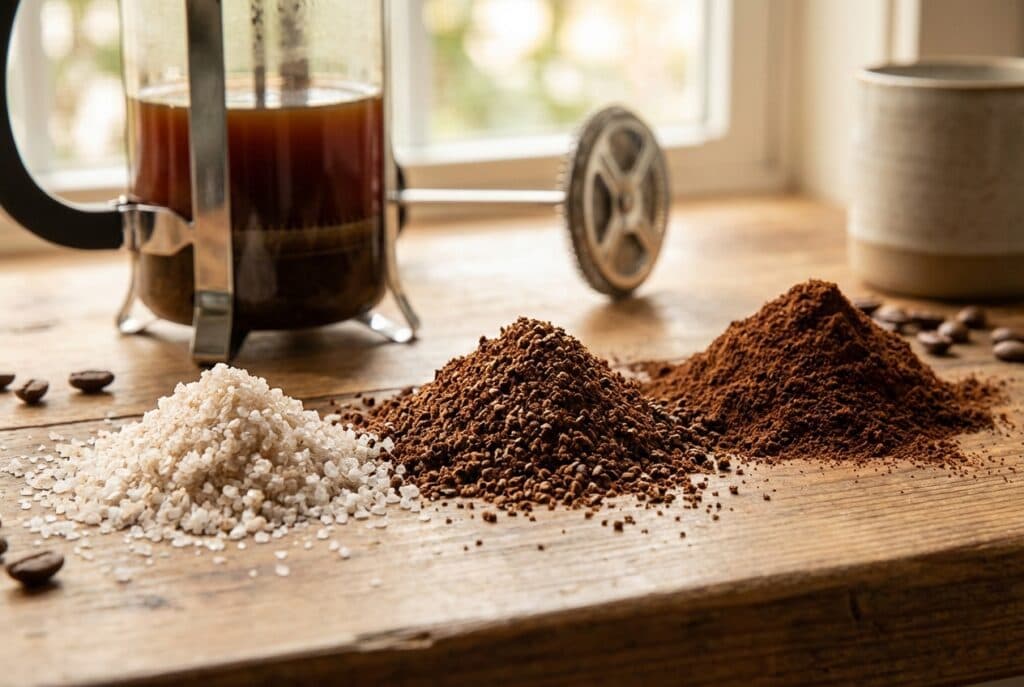
Your ratio can be perfect and your coffee can still taste terrible. The culprit? Grind size.
French press needs a coarse grind—think sea salt or raw sugar. Here’s why:
- Too fine: Over-extraction. Bitter, harsh, and you’ll get sludge at the bottom of your cup. The plunger will also fight you.
- Too coarse: Under-extraction. Weak, sour, watery. Disappointing.
- Just right: Full-bodied, smooth, with a clean finish (well, as clean as French press gets).
Use a coarse, even grind as the starting point. Grinder numbers are not standardized, so judge the particle size and cup result rather than copying one machine’s setting.
Espresso-fine grounds can make the plunger difficult to press and produce a silty, over-extracted cup.
Common Mistakes (And How to Fix Them)
Even with the right ratio, grind, temperature, steep time, and pouring technique can still change the result:
Problem: Coffee tastes weak and watery.
- Use more coffee (try 1:13 ratio)
- Grind finer (but not too fine)
- Steep longer (try 5 minutes instead of 4)
Problem: Coffee tastes bitter and harsh.
- Use less coffee (try 1:16 ratio)
- Grind coarser
- Steep shorter (try 3:30)
- Check your water temperature—too hot extracts bitterness
Problem: Too much sediment in the cup.
- Grind coarser
- Don’t press the plunger all the way to the bottom
- Let the cup sit for a minute before drinking so fines settle
Frankly, some sediment is just part of French press life. If you want crystal-clear coffee, pour-over is your friend. French press gives you body and oils that paper filters remove. It’s a trade-off.
What Your French Press Coffee Should Taste Like
When you nail the ratio and technique, French press delivers a cup that’s:
- Full-bodied: Rich, almost velvety mouthfeel from the oils that pass through the metal mesh
- Aromatic: You’ll smell chocolate, nuts, fruit, or whatever your beans offer
- Balanced: Not too bitter, not too sour—just smooth
- Slightly textured: A tiny bit of fine sediment is normal and adds character
If your coffee hits these notes, you’ve done it right. If not, tweak one variable and try again tomorrow. That’s the fun part.
Quick Reference: Coffee-to-Water Ratios
Bookmark this for easy reference:
- Strong brew (1:12): 30g coffee → 360g water
- Standard brew (1:15): 30g coffee → 450g water
- Light brew (1:17): 30g coffee → 510g water
Start at 1:15. Adjust from there. Write down what works for you—future you will be grateful.
Record the Recipe That Works
Getting your French press ratio right isn’t complicated, but it does require a little intention. Weigh your coffee. Use coarse grounds. Keep your water just off the boil. Steep for four minutes. Pour immediately.
Record the final ratio and grind setting once the cup tastes balanced so the recipe can be repeated consistently.
Grab your scale, pick a ratio, and brew one tomorrow. Then adjust. That’s how you find your perfect cup.


Comments