


Table of Contents
- Why Unsweetened Coffee Tastes Harsh, and What Sugar Does and Does Not Fix
- Brewing Variables That Change the Taste
- Water Temperature
- Grind Size: Coarser Than You Think
- Brew Ratio
- Brew Time and the French Press Trap
- Clean Equipment
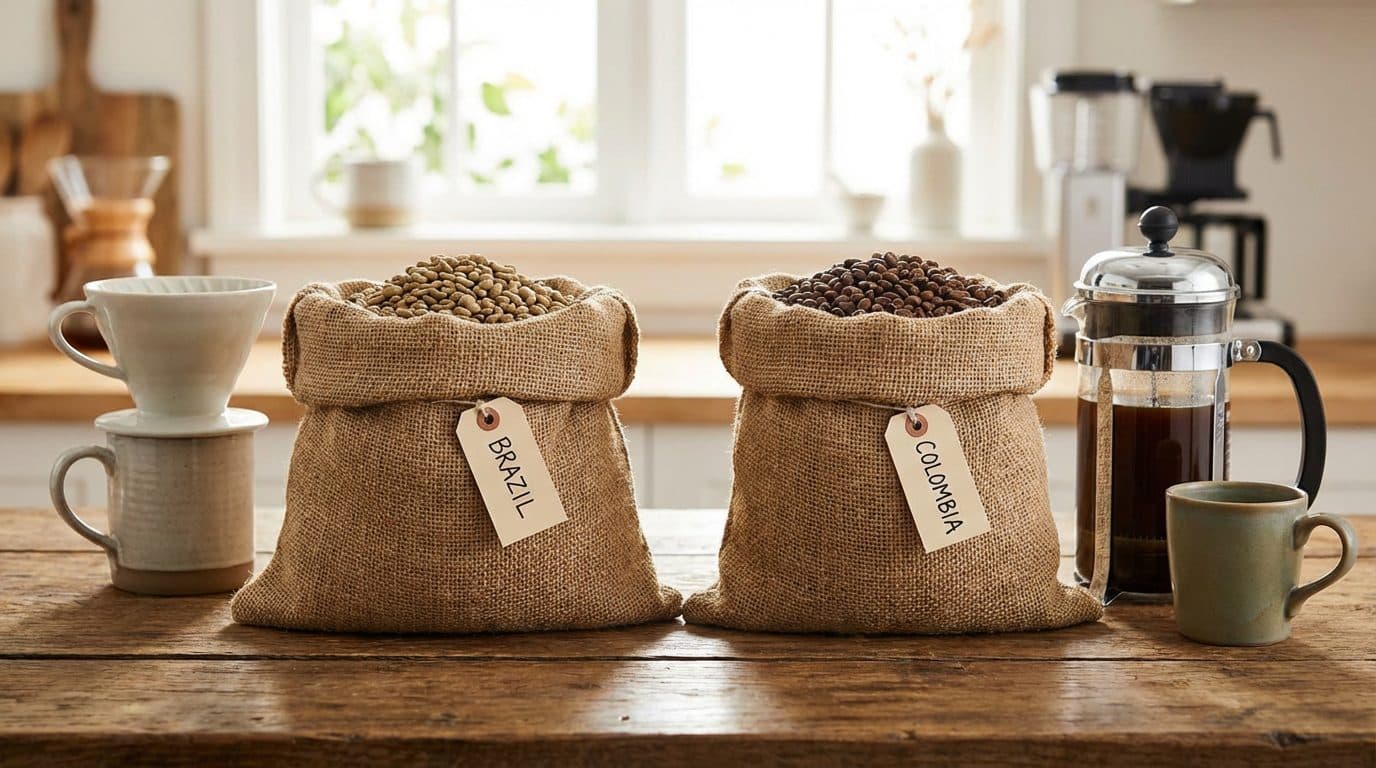
- Bean Selection
- Roast Level
- Freshness
- Water Quality
- Common Myths About Drinking Coffee Without Sugar
- Flavor Additions That Aren't Sugar
- Cutting Down Gradually
- Frequently Asked Questions
- How do I make coffee without sugar that still tastes good?
- Why does my French press coffee get more bitter as it sits?
- Does salt really take the bitterness out of coffee?
- What can I add to coffee instead of sugar?
How to make coffee without sugar starts with the brew, not a substitute. The National Coffee Association (NCA) brewing guides name several causes of a bitter cup: grounds that are too fine, coffee left sitting on its grounds in a French press, and old coffee oil left on the equipment. Its storage guide adds that stale beans make coffee that lacks flavor. Correct those, and if you still want something extra, a small amount of vanilla extract or cinnamon adds flavor in place of sugar.
This guide works through the brew variables first, then the beans and water, then the non-sugar additions, with each figure taken from a named source.
Why Unsweetened Coffee Tastes Harsh, and What Sugar Does and Does Not Fix
Sugar adds sweetness on top of the cup; it does not change what the water pulled out of the grounds. The NCA’s grind guidance names the extraction problem directly: if your coffee tastes bitter or sour, it may be ground too fine (over-extracted), so try a larger, coarser grind. If it tastes flat or watery, it may be ground too coarse (under-extracted), so try a finer grind.
That gives a practical rule for anyone giving up sugar: taste the cup black first and name the problem. The NCA links a bitter or sour cup to a grind that is too fine and a flat or watery cup to a grind that is too coarse; a stale taste points to old beans. Only after those are right is it worth deciding whether you want an addition at all.
Brewing Variables That Change the Taste
The NCA publishes “quick numbers” for each method. These are the ones for the two most common home brewers:
| Variable | Pour-over (NCA) | French press (NCA) |
|---|---|---|
| Coffee-to-water ratio | 1:13 to 1:16 | 1:10 to 1:16 |
| Water temperature | 93 ± 3°C | 93 ± 3°C |
| Contact time | 2 to 4 minutes | About 4 minutes |
| Starting grind | Medium | Coarse (like rock salt) |
Water Temperature
Both NCA guides give 93 ± 3°C, which is 90 to 96°C. Their step-by-step instructions also let just-boiled water rest briefly before brewing: about 30 seconds in the French press guide, which then says to confirm the temperature with a thermometer, and about a minute in the pour-over guide.
Grind Size: Coarser Than You Think
The NCA’s grind chart is the reference point:
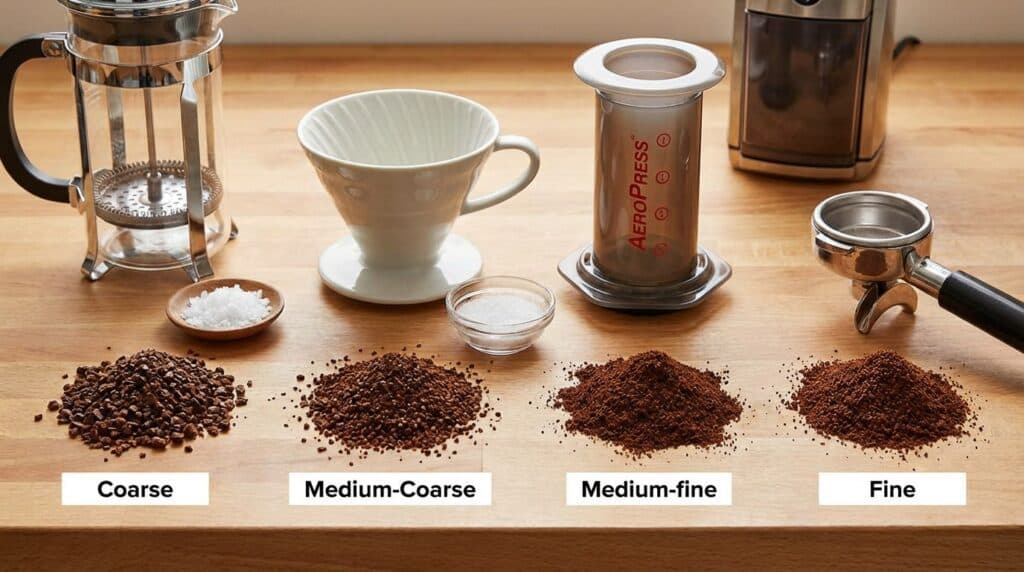
- French press: coarse, like rock salt
- Cold brew: coarse
- Drip: medium, like kosher salt
- Pour-over: medium
- Espresso: fine, like table salt
The general rule the NCA gives is that the longer coffee is in contact with water, the coarser the grind should be. If your unsweetened cup tastes bitter or sour, the NCA suggests trying a larger, coarser grind. Change one thing at a time so you can tell what made the difference.
Brew Ratio
Within the NCA’s ranges, 1:16 is the shared upper end for both methods, and the more dilute end of each range. As arithmetic, 15 g of coffee at 1:16 is 240 g of water; at 1:13 the same 15 g would take 195 g. If a cup tastes thin and watery, move toward the stronger end of the range; if it tastes heavy, move the other way. Weighing both coffee and water, as the NCA recommends, is what makes these adjustments repeatable.
Brew Time and the French Press Trap
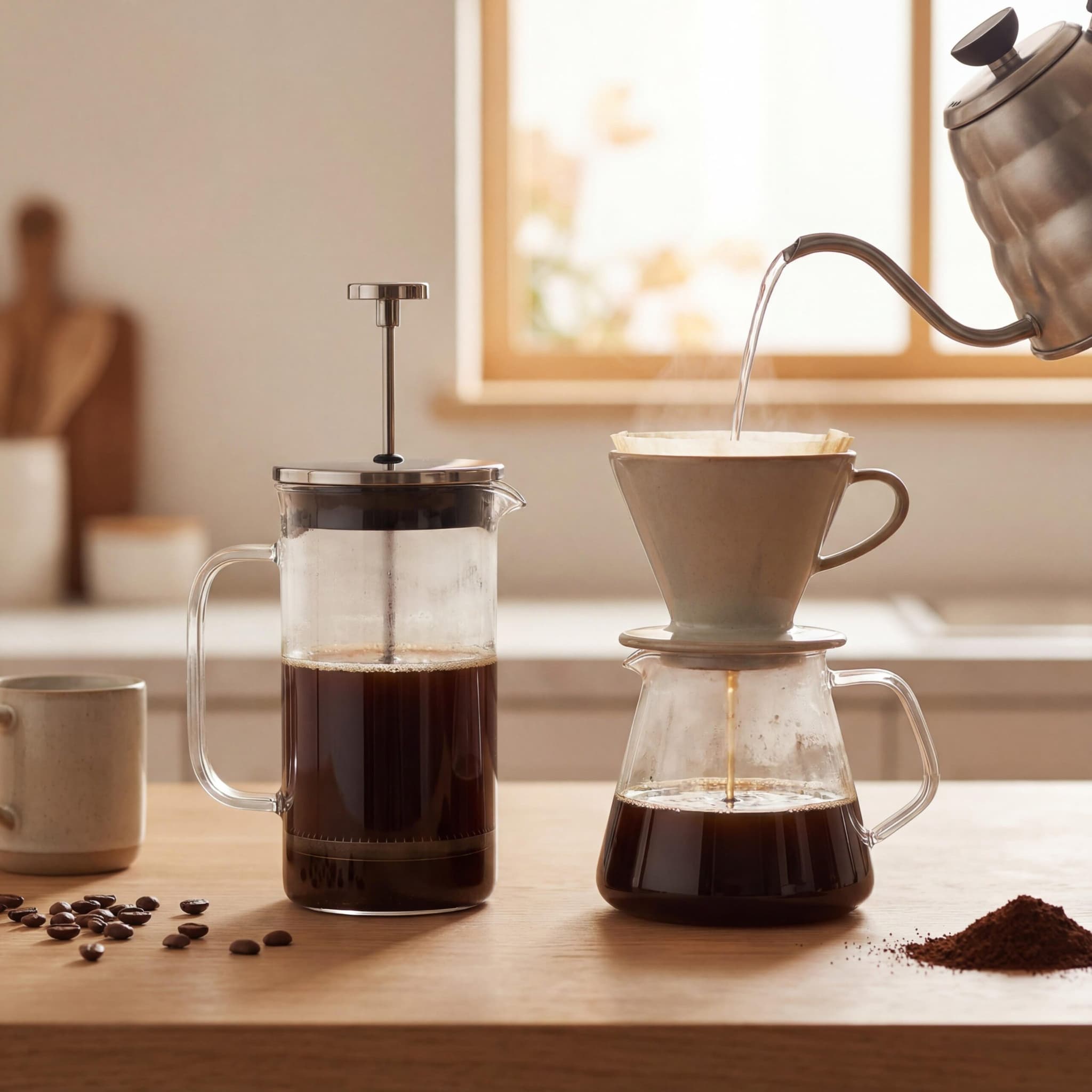
The NCA’s pour-over guide gives 2 to 4 minutes of contact; its French press guide gives about four minutes, then says to serve immediately or transfer the coffee to another container, because coffee left in a French press will continue to brew and turn bitter. That one habit, decanting instead of leaving the coffee on its grounds, is one of the simplest fixes for a press that tastes harsh by the second cup.
Clean Equipment
Both NCA guides make the same point about cleanup: grounds and coffee oil (caffeol) left on the brewer can make your next cup taste bitter. Wash the press filter or pour-over brewer after each use, following the maker’s instructions.
Bean Selection
Roast Level
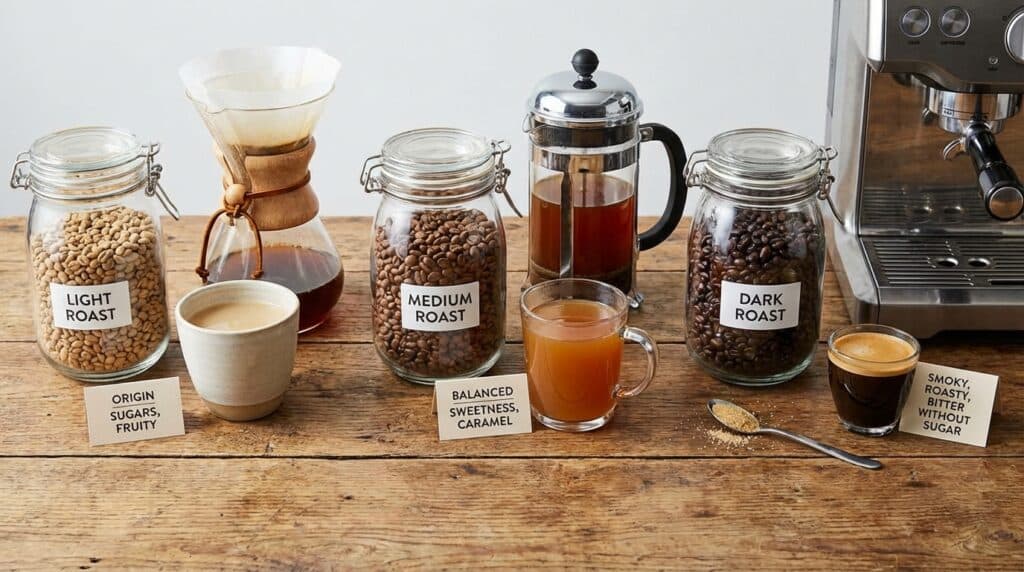
Roast level changes flavor, but none of the sources used here ranks one roast as sweeter than another when drunk black, so treat it as something to test rather than a rule. The NCA notes that medium to dark roasts tend to work well in a French press, while adding that you can experiment with different roasts. If one bag tastes harsh black even after the grind and timing are right, try a different roast level or a coffee whose roaster’s tasting notes describe the flavors you like, and compare them brewed the same way.
Freshness
Stale coffee is a separate problem from bitter coffee. The NCA says roasted beans do not usually become unsafe to brew, but they decline in quality: they lose aroma, and the brewed coffee will lack flavor and may taste stale. Its storage guidance:
- Buy smaller batches, enough for one or two weeks.
- Move the coffee into an airtight, opaque container in a dark, cool place.
- Grind just before brewing.
- Expect roasted beans at room temperature to keep their freshness for 1 to 3 weeks, and ground coffee for 1 to 2 weeks, once opened and stored airtight.
Water Quality
The NCA’s brewing guides say to use cold water, filtered if possible, and to avoid distilled or softened water. The Specialty Coffee Association’s water standard sets the targets for brewing water more precisely: clean and odor-free, no chlorine, calcium hardness of 50 to 175 ppm as CaCO3, alkalinity of 40 ppm, and a pH of 7.0. You do not need to test your tap water to start; if it smells or tastes of chlorine, filtering it is the simple first step.
Common Myths About Drinking Coffee Without Sugar
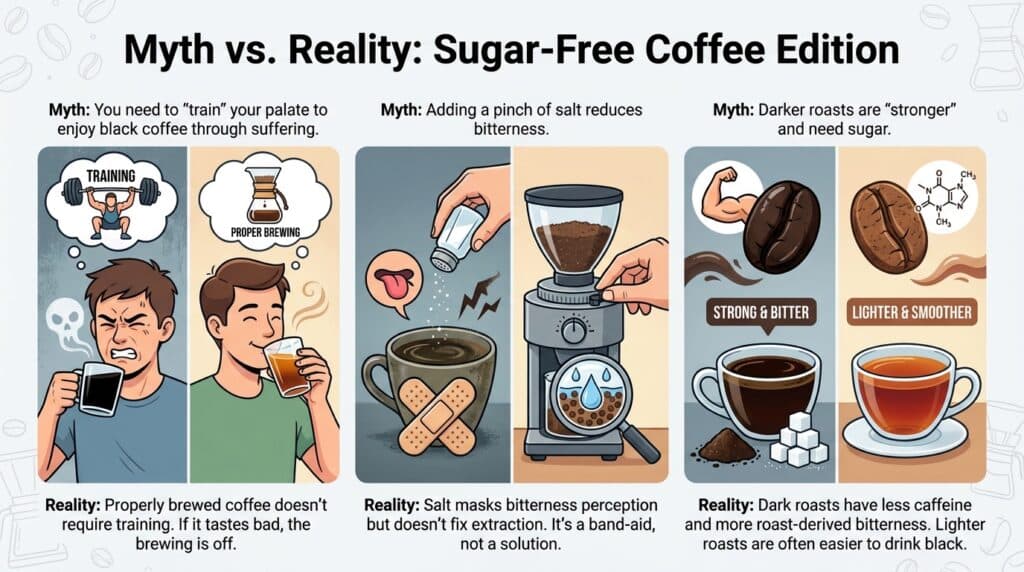
- “Black coffee is supposed to be bitter.” The NCA treats a bitter or sour cup as a sign to adjust, starting with a coarser grind, not as the expected result.
- “A pinch of salt fixes it.” A 1997 study by Breslin and Beauchamp at the Monell Chemical Senses Center reported evidence that salts suppress unpleasant tastes such as bitterness more than palatable ones such as sweetness. The abstract does not mention coffee or give an amount, so salt is at most a masking trick, and it leaves the extraction problem in place.
- “Stale coffee just needs more sweetener.” The NCA describes stale beans as lacking flavor; the fix is fresher coffee stored airtight, not more sugar.
Flavor Additions That Aren’t Sugar
If the brewed cup is right and you still want something extra, two pantry options add flavor without sugar:
- Vanilla extract. McCormick’s usage note for its pure vanilla extract is to start with 1/4 teaspoon to one cup of coffee, and 2 teaspoons for a pot. McCormick also describes vanilla as softening the bitterness in chocolate and coffee desserts. The vanilla extract guide covers label types and when to add it.
- Cinnamon. The US National Center for Complementary and Integrative Health (NCCIH) says cinnamon is likely safe in the amounts commonly used in foods as a spice or flavoring. It also notes that some cassia cinnamon products contain high levels of coumarin, which could be an issue with prolonged use for sensitive people, such as those with liver disease. If you plan to use it daily, the cinnamon in coffee guide explains the difference between Ceylon and cassia.
Start small with either and adjust by taste on the next cup.
Cutting Down Gradually
If you take sugar in every cup now, there is no need to stop in one day. A simple sequence is to fix one brew variable at a time while reducing the sugar in steps: first the grind and contact time, then the freshness of the beans, then the water. Taste each change black before you sweeten it, so you know whether the coffee or the sugar is doing the work. The pace is personal; none of the sources here set a schedule.
Frequently Asked Questions
How do I make coffee without sugar that still tastes good?
Start with the brew: a grind that matches your method, water around 93°C, the NCA’s contact time, and fresh beans in a clean brewer. If the cup is bitter or sour, the NCA suggests trying a coarser grind.
Why does my French press coffee get more bitter as it sits?
The NCA says coffee left in a French press continues to brew and turns bitter. Pour it into a mug or carafe once brewing is done.
Does salt really take the bitterness out of coffee?
Salt can suppress bitterness, according to the 1997 Breslin and Beauchamp study, but its abstract does not mention coffee or give an amount. At most it masks the taste rather than fixing the brew.
What can I add to coffee instead of sugar?
A measured amount of vanilla extract (McCormick suggests starting at 1/4 teaspoon per cup) or a small amount of cinnamon. Neither adds sugar the way a sweetened syrup does.


Comments