


Table of Contents
- What Coffee Processing Actually Means
- Washed, Natural, and Honey at a Glance
- Washed Coffee: Fruit Removed Before Drying
- When washed coffee may suit you
- Natural Coffee: The Whole Cherry Dries Around the Seed
- When natural coffee may suit you
- Honey Coffee: Some Mucilage Stays During Drying
- What Fermentation Changes
- Processing Is One Part of Flavor, Not the Whole Story
- How to Read a Coffee Bag
- A Fair Home Tasting
- Which Process Should You Buy?
- Frequently Asked Questions
- Does natural coffee contain more sugar?
- Is washed coffee always more acidic?
- Is honey-processed coffee made with honey?
- Is anaerobic coffee a fourth main process?
- Which process is best for espresso?
- Bottom Line
- Sources and Further Reading
A coffee’s process is the route from ripe cherry to dry green bean. Washed, natural, and honey describe how much fruit remains around the seed along the way. The method can influence sweetness, acidity, body, aroma, and the risk of fermentation defects, while variety, ripeness, growing conditions, drying, storage, roasting, water, and brewing still shape the cup.
For a useful first comparison, washed lots are often described as highlighting origin- and variety-associated notes, while naturals may be more fruit-forward and full-bodied. Honey coffee sits in a broad middle category. Those are tendencies, not promises printed on a bag.
What Coffee Processing Actually Means
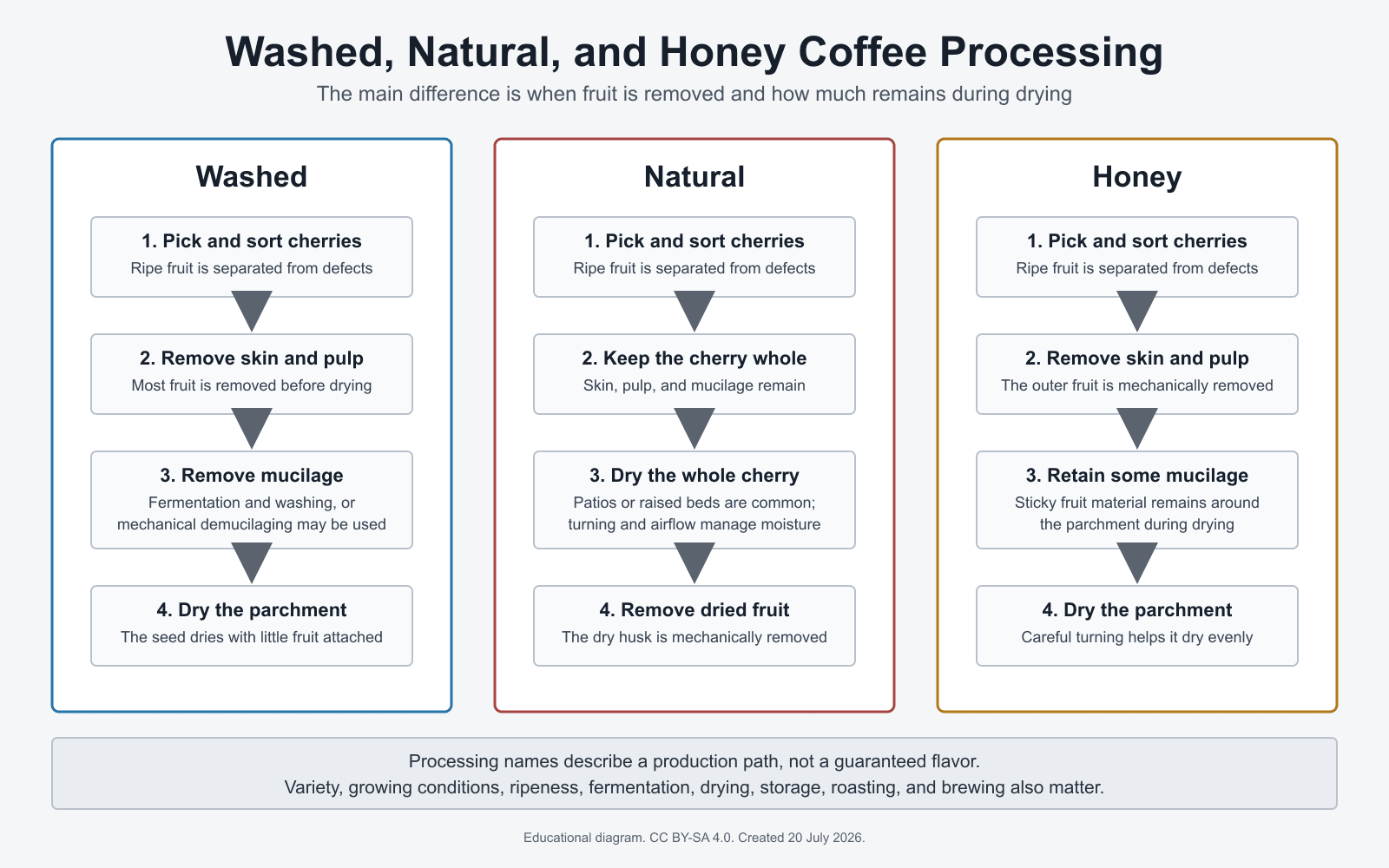
A coffee bean is the seed inside a fruit commonly called a coffee cherry. After ripe cherries are picked and sorted, producers need to remove the fruit layers and dry the seeds to a stable moisture level. The main categories are defined chiefly by when the skin and sticky mucilage are removed and how much remains during drying. Fermentation protocol is a separate variable that can cross those categories.
The names can be confusing because producers use different equipment, fermentation times, drying surfaces, and local terminology. Even two coffees labeled “natural” may have been handled very differently. Processing labels are best treated as clues about the production path, not as standardized tasting notes.
Washed, Natural, and Honey at a Glance
| Method | What happens after harvest | Common cup tendency | Main production risk |
|---|---|---|---|
| Washed | Skin and most fruit material are removed before drying; fermentation and washing commonly remove remaining mucilage | Often associated with clearer flavor separation, defined acidity, and a cleaner finish | Over-fermentation, poor washing, or excessive water use |
| Natural | The whole cherry dries around the seed before the dried fruit is removed | Often associated with fruit-forward aroma, perceived sweetness, heavier body, and sometimes wine-like notes | Uneven drying, unwanted fermentation, mold, or overripe flavors |
| Honey | The skin is removed, but some mucilage remains on the seed during drying | Often associated with rounded sweetness and body, sometimes with a clean finish | Sticky parchment dries unevenly without careful turning and airflow |
Research has found measurable chemical and sensory differences among coffees processed in different ways, including a 2023 comparison of several Arabica post-harvest methods. The experiments apply to their specific coffees and conditions, so simple rules such as “washed is always acidic” or “natural is always sweeter” still go too far.
Washed Coffee: Fruit Removed Before Drying
In a conventional washed process, ripe cherries are sorted and pulped. Fermentation helps break down the mucilage clinging to the parchment-covered seed, after which the coffee is washed and dried. Some mills use mechanical demucilaging, and soaking or fermentation details vary by region.
Removing most of the fruit before drying reduces the time the seed spends in contact with sugary cherry material. In the cup, a well-handled washed coffee often presents a cleaner finish and may make some origin- and variety-associated notes easier to perceive. This profile particularly appeals to drinkers who enjoy citrus, floral, tea-like, or clearly separated flavor notes.
“Clean” does not mean mild, and washed does not automatically mean sour. A washed Kenyan coffee and a washed Colombian coffee can still taste very different because their varieties, soils, climates, fermentation protocols, roast profiles, and brew recipes differ.
When washed coffee may suit you
- You drink coffee black and value a clean finish.
- You enjoy comparing origins or varieties.
- You use a paper-filtered pour-over or drip brewer.
- You prefer defined acidity over heavy fermented-fruit character.
Natural Coffee: The Whole Cherry Dries Around the Seed
Natural processing, also called dry processing, leaves the coffee seed inside the whole cherry while it dries. Producers spread cherries on patios or raised beds and turn them regularly to manage airflow and moisture. Once drying is complete, the dried fruit layers are mechanically removed.
The long contact between seed and fruit, together with microbial activity during drying, is associated with fruit-forward aromas, more perceived sweetness, and a rounder body. Good examples may suggest ripe fruit, jam, or wine; that character can feel vivid in one coffee and heavy in another.
A carefully dried natural can taste clean and precise; a poorly managed lot can taste boozy, vinegary, musty, or indistinct. Traditional patio- or raised-bed naturals typically need regular turning, protection from rain and re-wetting, and enough time for moisture to leave the cherry evenly.
When natural coffee may suit you
- You enjoy ripe-fruit aromas and a fuller texture.
- You enjoy fruit-forward profiles in immersion brews.
- You are curious about fermentation character.
- You do not mind a cup that can feel less restrained than a classic washed coffee.
Honey Coffee: Some Mucilage Stays During Drying
Honey processing removes the cherry skin but leaves some sticky mucilage around the parchment as the coffee dries. No honey is added. In contemporary coffee use, the name generally refers to the honey-like, tacky mucilage, though terminology varies by origin.
Terms such as white, yellow, red, and black honey are often used to suggest how much mucilage remains or how the coffee is dried. Their exact meanings are not universal. A “red honey” from one producer may not follow the same protocol as a red honey from another.
Honey lots are often marketed as a middle ground, though clarity and fruit intensity depend on execution. They can be a logical next taste for someone who usually buys washed coffee but wants more texture without starting with an intensely fermented lot.
What Fermentation Changes
Fermentation is not limited to experimental coffee. Microbial activity may occur in all three families, but an intentional fermentation step is not required in every workflow. Producers can manage oxygen, temperature, time, and available fruit material in different ways.
In one 2019 Catimor wet-processing experiment in Yunnan, fermentation conditions were associated with measurable shifts in microbial communities, metabolites, and cup quality. A separate 2023 study of yeast-inoculated Arabica fermentations linked method and fermentation time to distinct sensory and microbial profiles. These findings show why a broad process name is an incomplete flavor predictor.
Anaerobic coffee fermentation and carbonic maceration describe controlled fermentation conditions; thermal-shock labels usually describe a temperature intervention within a producer-specific protocol. None necessarily identifies the final drying method. A coffee can undergo anaerobic fermentation and later be finished as a washed or natural coffee.
Processing Is One Part of Flavor, Not the Whole Story
When two bags taste different, it is tempting to credit the most visible word on the label. A better explanation considers several connected variables:
- Species and variety: Coffea arabica, Coffea canephora, and individual cultivars or varieties have different chemical and sensory potential.
- Cherry ripeness: Unripe, ripe, and overripe fruit behave differently during processing.
- Growing environment: Temperature, rainfall, soil, shade, and farm management affect seed development. Elevation is useful context because it often correlates with temperature and maturation conditions.
- Processing details: Sorting, fermentation, washing, drying speed, airflow, and storage all influence quality.
- Roast profile: A dark roast may obscure distinctions that remain obvious in a light or medium roast.
- Brewing: Grind, ratio, water, temperature, and contact time shape what reaches the cup.
This is also why country-level flavor stereotypes need caution. The Brazilian vs Colombian coffee comparison can help you understand common market patterns, but neither country produces one uniform style. Always read the farm, variety, process, and roast information together.
How to Read a Coffee Bag
Start with the process, then look for the details that make the label meaningful:
- Process: Washed, natural, honey, wet-hulled, or another named method.
- Producer or farm: Traceability gives the process claim context.
- Variety: Bourbon, Caturra, Gesha, SL28, or another variety can be as important as process.
- Region and elevation: Useful context, but not a flavor guarantee.
- Roast date and roast level: These affect what you can actually taste at home.
- Fermentation detail: When disclosed alongside origin, variety, and drying details, time, vessel, oxygen exposure, starter culture, and temperature make the label more useful.
If a bag lists only “anaerobic,” important details are still missing: who produced it, which coffee was used, how long it fermented, and how it was dried. A label with both production and producer information is usually more useful.
A Fair Home Tasting
The most useful way to learn processing differences is to compare coffees side by side. Choose two coffees from the same origin and similar roast level if possible, one washed and one natural. Matching the variety and producer makes the comparison stronger, though those pairs can be hard to find.
- Use the same water and let both coffees rest for a similar time after roasting.
- Grind immediately before brewing.
- Start with 15 grams of coffee and 250 grams of water for each sample.
- Keep water temperature and total brew time as close as practical.
- Taste hot, warm, and cool; fruit and other process-related notes may become clearer as coffee cools.
- Write down aroma, acidity, sweetness, body, finish, and any off-flavors before reading the bag’s tasting notes again.
This is a brewed side-by-side comparison, not a formal cupping. The cupping guide below uses a different, more standardized method.
The beginner home cupping guide gives you a method that removes many brewer variables. If one coffee extracts too quickly or slowly, use the grind and ratio adjustment guide rather than changing several settings at once.
Which Process Should You Buy?
For your next bag, do not make the process name the only deciding factor. Producer information, roast freshness, and the way you like to brew will help you make a better choice.
If you are new to specialty coffee, buy small bags rather than committing to a large order. A process that sounds ideal on paper may not fit your palate, and the same label can cover a wide range of results.
Frequently Asked Questions
Does natural coffee contain more sugar?
Natural coffees can taste sweeter, but perceived sweetness is not the same as adding sugar to the drink. Processing can alter chemical composition and fermentation-related metabolites; roast and brewing also affect sweetness in the cup.
Is washed coffee always more acidic?
No. Some washed coffees are perceived as more acid-forward, but variety, origin, roast, and extraction influence both the type and intensity of acidity.
Is honey-processed coffee made with honey?
No. The name refers to the sticky fruit mucilage left on the parchment during drying.
Is anaerobic coffee a fourth main process?
Anaerobic usually names a low-oxygen fermentation condition rather than specifying how the coffee is dried. After fermentation, the coffee may still be finished as washed, honey, or natural.
Which process is best for espresso?
There is no universal winner. Naturals may add fruit and body, washed coffees may offer clarity, and honey coffees may sit between the two. Roast profile and dial-in also materially affect the espresso result.
Bottom Line
Post-harvest processing changes the conditions around a coffee seed before roasting, so it can meaningfully influence chemistry and flavor. Washed, natural, and honey are useful starting categories, but they are not fixed taste recipes. Use the process label to form a hypothesis, then judge the producer’s execution and the coffee in your cup.
Sources and Further Reading
- De Bruyn et al., influence of wet-processing parameters on microbial communities, metabolites, and cup quality, Frontiers in Microbiology (2019).
- Relationship between sensory and microbial profiles of fermented coffee by dry and washed methods, Food Chemistry Advances (2023).
- Influence of post-harvest processing on functional properties of Arabica coffee, Molecules (2023).
- FAO Arabica coffee manual: harvesting and processing.



Comments