


Table of Contents
- What's Actually Happening Inside Your Machine
- Single Boiler Machines: The Honest Truth
- Heat Exchanger Machines: Powerful but Fussy
- One maker's answer to HX overheating
- Dual Boiler Machines: The "Just Works" Option
- Dual Boiler vs Heat Exchanger: The Practical Difference
- Side-by-Side Comparison
- So Which Boiler Type Should You Actually Choose?
- Frequently Asked Questions
- Is a dual boiler better than a heat exchanger?
- What is a cooling flush?
- Can a single boiler machine make lattes?
- Does "dual boiler" always mean two boilers?
The three designs differ in one thing: how many places the machine heats water, and at what temperature. A single boiler machine uses one boiler for both brewing and steaming, so it does one job at a time. A heat exchanger (HX) machine keeps one boiler at steaming temperature and heats the brew water as it passes through a tube inside that boiler, so it can brew and steam at once but usually needs a cooling flush first. A dual boiler machine has a separate boiler for each job, so brew temperature and steam are controlled independently. If you mostly drink straight espresso, a single boiler is enough; if you steam milk for several drinks in a row, the choice is between an HX and a dual boiler, and the rest of this guide explains that trade-off.
This guide is built from manufacturer manuals and product pages for representative machines (Gaggia Classic Evo Pro, Lelit MaraX, Breville Dual Boiler) and from the Wikipedia overview of espresso machine designs. Daily Home Coffee has not tested these machines, and no prices are given here because they change often; check current retailer listings.
What’s Actually Happening Inside Your Machine
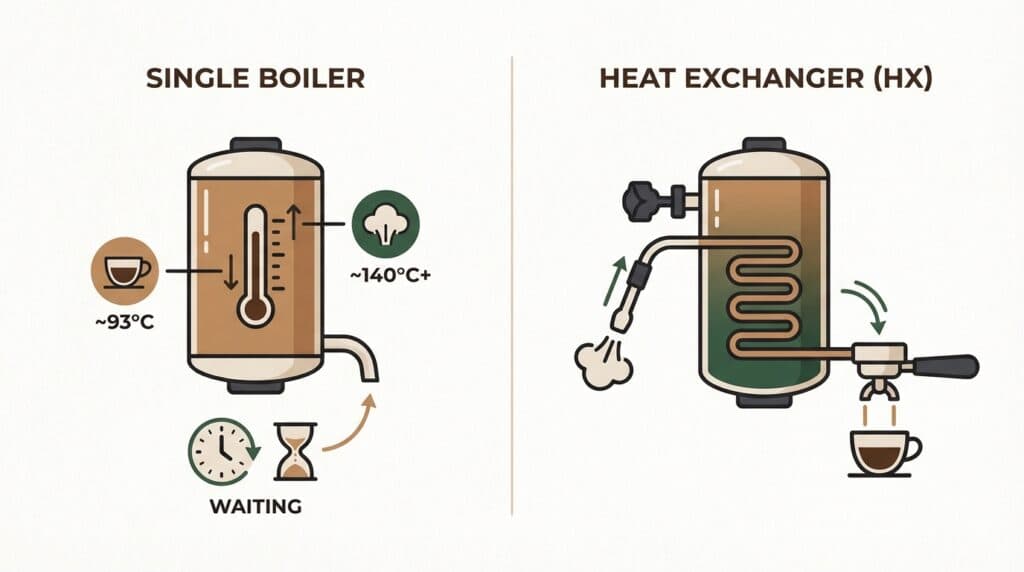
Espresso and milk steaming need water at two different temperatures. Brewing needs hot water below boiling; steaming needs water above boiling so that the boiler builds steam pressure. Every home machine design is an answer to the question of how to get both from one appliance.
- Single boiler, dual use: one chamber is heated to brewing temperature, then raised to steaming temperature when you switch modes. Because brewing temperature is lower than steaming temperature, the machine needs time to move from one mode to the other, and it can only do one operation at a time.
- Heat exchanger: one boiler is held at steaming temperature. Fresh water for brewing runs through a heat exchanger inside it and picks up heat on the way to the group head without reaching the full steam temperature.
- Dual boiler: brew water is heated in its own boiler, separate from the steam boiler, so each can be held at its own temperature.
The Wikipedia overview of espresso machines also notes a related design, sometimes sold under the “dual boiler” label: a boiler for brewing plus a separate thermoblock for steam. Check the spec sheet for the words “steam boiler” if the distinction matters to you.
Single Boiler Machines: The Honest Truth
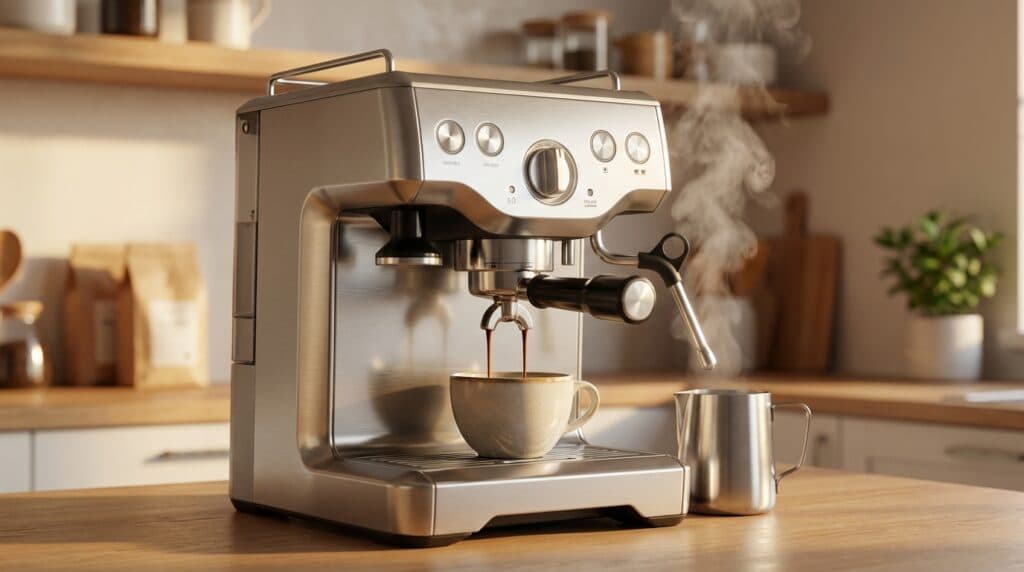
A single boiler machine is the simplest design, and the Gaggia Classic Evo Pro manual shows what using one looks like in practice. The steps for a cappuccino run in a fixed order:
- Brew the espresso first, with the steam button off.
- Press the steam button. The manual says to wait 15-20 seconds, until the steam temperature light turns on.
- Open the steam knob briefly to clear condensation from the wand, then close it and start steaming.
- Steam for no longer than 60 seconds. The manual warns that dispensing steam continuously for more than 60 seconds can empty the boiler, after which the circuit has to be reloaded.
- Switch the steam button off. To brew another coffee straight away, lower the boiler temperature first: with no filter holder fitted, run the brew button until a cup fills with water. Gaggia says that otherwise the coffee may taste burnt, and warns that brewing without this step can cause burns. The steam wand also stays very hot after use.
One drink is straightforward. Several milk drinks in a row mean repeating the heat-up, steam and cool-down cycle for each one.
Strengths:
- Fewest components of the three designs
- No compromise for straight espresso, where steam is not needed
Limits:
- Brewing and steaming cannot happen at the same time
- A wait when switching to steam, and a cooling step before the next shot
- Steam time per cycle is limited by the boiler (60 seconds per the Gaggia manual)
Who it suits: people who drink mostly espresso or Americanos, and people who make one milk drink at a time and do not mind the extra steps.
Heat Exchanger Machines: Powerful but Fussy
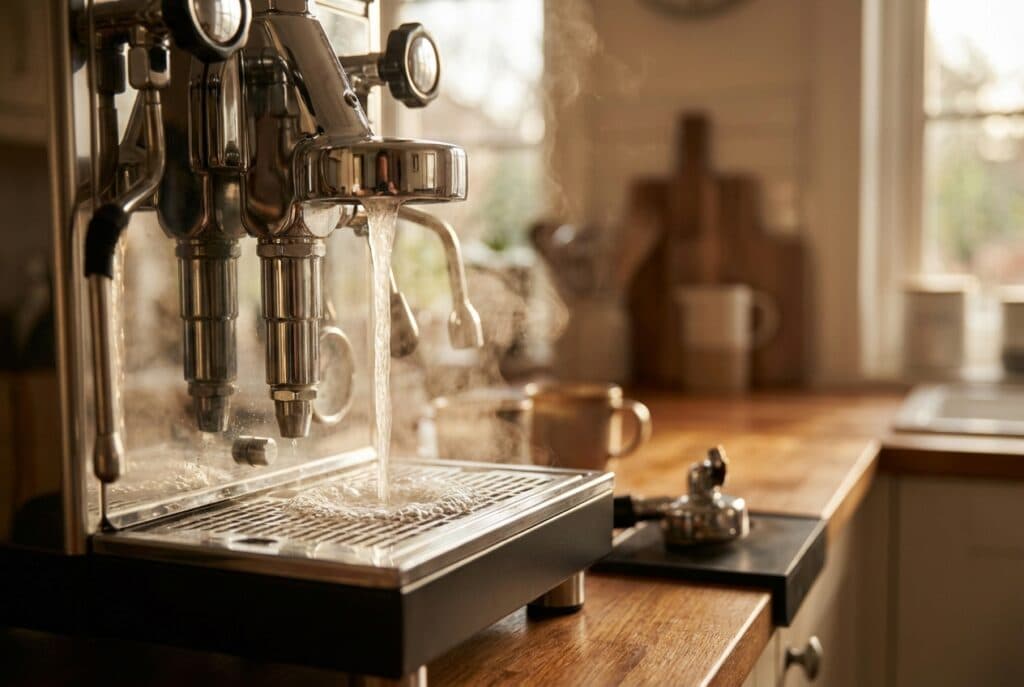
An HX machine solves the single boiler’s waiting problem by keeping the whole boiler at steaming temperature all the time. Steam is ready whenever the machine is, and brewing can happen at the same moment because the brew water travels through its own tube.
The catch is temperature. Water sitting in the heat exchanger between shots is surrounded by a boiler at steam temperature. The Wikipedia overview describes the brew water as still too hot for proper extraction without first cooling, so a classic HX needs a cooling flush of 4-6 seconds before the first shot, and the flush has to be repeated if the machine sits idle again. It also notes that temperature stability is debated, because brew temperature is reached indirectly rather than held directly. One advantage it lists: brew water is always fresh from the tank or water line rather than water that has been sitting in a boiler.
The Faema E61 of 1961 was the first HX machine, according to the same overview, and the overview describes it as a design nearly ubiquitous across the semi-automatic market segment.
One maker’s answer to HX overheating
Lelit’s MaraX PL62X is one example of an HX machine built to address that problem. Lelit describes a 1.8 l boiler with an AISI316L stainless steel heat exchanger and a patent-pending double probe HX system. According to Lelit, it keeps the brewing temperature constant and avoids “the overheating typical of classical HX systems”. It has a mode button (Xmode coffee or Xmode steam), a three-step temperature setting (Warm, Hot, Extra Hot) and a steam boost. Lelit says the machine reaches the right temperature in 24 minutes. Those are the maker’s own claims; this site has not measured them.
Strengths:
- Brew and steam at the same time
- The boiler is held at steam temperature, so steam is ready without switching modes
- Brew water comes fresh from the tank or line rather than from a boiler
Limits:
- A classic HX needs a cooling flush before brewing, repeated after idle periods
- Brew temperature is controlled indirectly, through the steam boiler
Who it suits: people who make milk drinks often and are willing to learn a flushing routine, or who choose a model whose maker addresses HX overheating, such as the MaraX.
Dual Boiler Machines: The “Just Works” Option
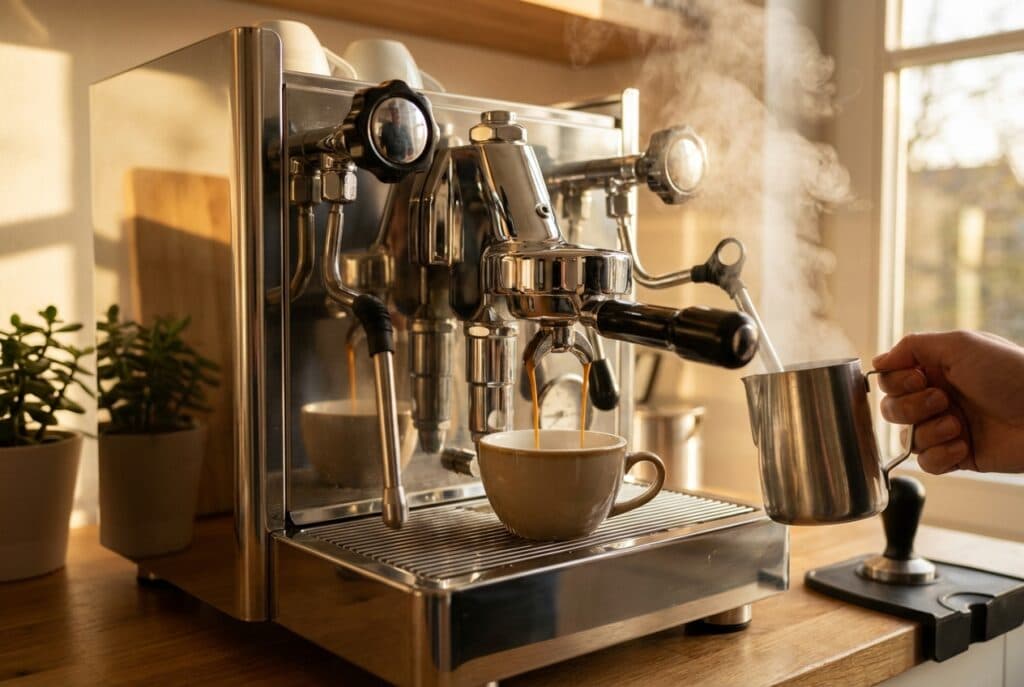
A dual boiler machine gives each job its own boiler, so the brew side can be held at a set temperature while the steam side stays hot. Breville’s instruction book for the Dual Boiler (BES920) describes “dedicated espresso and steam boilers for simultaneous milk texturing and espresso extraction”, electronic PID temperature control, a programmable shot temperature and a dedicated 950 ml steam boiler. Rancilio’s Silvia Pro X takes the same approach with two PID controllers, one in each boiler; the Rancilio Silvia Pro X review covers its specifications.
The Wikipedia overview sums up the trade-off: true dual boiler machines provide stable brew temperatures and fast steaming, but are larger and more expensive. It also lists a downside: the brew boiler holds mostly stagnant water with little turnover, which is the opposite of the HX design’s fresh-water advantage.
Strengths:
- Brew temperature set directly in its own boiler (by PID on the Breville and Rancilio examples)
- Brew and steam at the same time, with no cooling flush needed to bring brew water down from steam temperature
- Suits several milk drinks in a row
Limits:
- Larger and more expensive than the other two designs
- Two boilers to heat, fill and eventually maintain
- Brew water sits in a boiler rather than coming fresh from the tank
- Paying for a steam boiler makes little sense if you rarely steam milk
Who it suits: people who make milk drinks regularly, often more than one at a time, and want to set a brew temperature without managing it by hand.
Dual Boiler vs Heat Exchanger: The Practical Difference
This is the comparison most buyers end up making, because both designs brew and steam at the same time. The practical difference is how brew temperature is reached.
- Heat exchanger: brew water is heated on the way through a boiler held at steam temperature. A classic HX needs a cooling flush before brewing and after idle periods. Lelit says the double probe system on its MaraX keeps brewing temperature constant and avoids the overheating typical of classical HX systems.
- Dual boiler: brew water is heated in its own boiler to a set temperature (PID-controlled on the Breville Dual Boiler and Rancilio Silvia Pro X), so there is no steam-temperature water to flush out first.
If a listing says dual boiler but mentions a thermoblock for steam, it is the dual-heater variant described above.
Side-by-Side Comparison
| Feature | Single Boiler | Heat Exchanger | Dual Boiler |
|---|---|---|---|
| Boilers | One, switched between brew and steam temperature | One, held at steam temperature | Two: brew and steam |
| Brew and steam at the same time | No | Yes | Yes |
| Extra step before brewing | Cool the boiler after steaming | Cooling flush on a classic HX | None needed for temperature |
| How brew temperature is set | In the one boiler, switched to brew mode | Indirectly, through the steam boiler | Directly, in the brew boiler |
| Brew water | From the boiler | Fresh from tank or line | From the brew boiler |
| Best for | Espresso, occasional milk drinks | Frequent milk drinks, hands-on users | Frequent milk drinks, set-and-forget |
So Which Boiler Type Should You Actually Choose?
Start with how you drink coffee, not with the machine.
Choose a single boiler if: you mostly drink espresso or Americanos, or make one milk drink at a time and accept the switch-and-cool routine described in the Gaggia manual. The Gaggia Classic gasket guide covers one maintenance job on that machine.
Choose a heat exchanger if: you make milk drinks often, want brewing and steaming at the same time, and are happy to learn a cooling flush or to follow the routine of a model like the MaraX.
Choose a dual boiler if: you make several milk drinks in a row and want to set the brew temperature directly, and the larger size and higher cost fit your kitchen and budget.
Whichever design you choose, boiler machines are affected by scale. The Urnex Dezcal review covers one descaler option; follow your own machine’s manual for descaling, since the procedure differs by model.
Frequently Asked Questions
Is a dual boiler better than a heat exchanger?
Not for everyone. A dual boiler sets brew temperature directly and needs no cooling flush, but it is larger and more expensive. An HX brews and steams at the same time too and uses fresh brew water, at the cost of a flushing routine on classic designs.
What is a cooling flush?
On a classic HX machine, water left in the heat exchanger gets too hot for brewing. Running water through the group head for a few seconds before the shot (4-6 seconds, per the Wikipedia overview) replaces it with cooler water.
Can a single boiler machine make lattes?
Yes, one step at a time: brew, switch to steam, wait for the steam light, steam, then cool the boiler before the next shot. The Gaggia Classic Evo Pro manual limits steaming to 60 seconds per cycle.
Does “dual boiler” always mean two boilers?
Not always. The Wikipedia overview notes that the term is used narrowly for machines with two separate boilers and more broadly for machines with a brew boiler plus a separate thermoblock. Check the specifications for a steam boiler.



Comments