


Table of Contents
- Quick Verdict: Strictly Hard Bean (SHB)
- What Do Hard Bean and Strictly Hard Bean Actually Mean?
- The Altitude Factor
- Why Density Equals Quality
- Hard Bean vs. Strictly Hard Bean: A Side-by-Side Comparison
- Flavor Profiles: What to Expect in Your Cup
- Hard Bean Flavor Profile
- Strictly Hard Bean Flavor Profile
- Who Is Each Grade Best For?
- Hard Bean (HB) Is For You If:
- Strictly Hard Bean (SHB) Is For You If:
- Who Should Skip Each?
- Hard Bean and Strictly Hard Bean: Pros and Cons
- Hard Bean (HB)
- Strictly Hard Bean (SHB)
- Key Takeaway: Altitude Is Your Flavor Roadmap
- Brewing Tips for Each Grade
- Brewing Hard Bean Coffee
- Brewing Strictly Hard Bean Coffee
- Common Misconceptions About Coffee Grading
- Conclusion and Recommendations
Quick Verdict: Strictly Hard Bean (SHB)
If you’re chasing the most complex, nuanced flavors in your cup, Strictly Hard Bean (SHB) coffee gets my vote. Grown at the highest altitudes, SHB beans develop more slowly, resulting in denser beans packed with sugars and flavor compounds. That said, Hard Bean (HB) coffee is no slouch—it offers excellent quality at a slightly friendlier price point and can surprise you with its balanced, approachable character.
Ever picked up a bag of specialty coffee and noticed the letters “HB” or “SHB” on the label? You’re not alone if you’ve wondered what those cryptic abbreviations actually mean. These aren’t just fancy marketing terms—they’re altitude-based grading systems that tell you a lot about the beans inside. Understanding the difference between Hard Bean and Strictly Hard Bean can help you make smarter choices and, ultimately, brew better coffee at home. In this guide, I’ll break down what these grades mean, why altitude matters so much, and which one might be perfect for your morning ritual.
What Do Hard Bean and Strictly Hard Bean Actually Mean?
Hard Bean (HB) and Strictly Hard Bean (SHB) are coffee grading terms primarily used in Central American countries like Guatemala, Costa Rica, and Honduras. They refer to the altitude at which the coffee was grown—and that altitude has a massive impact on the final cup.
The Altitude Factor
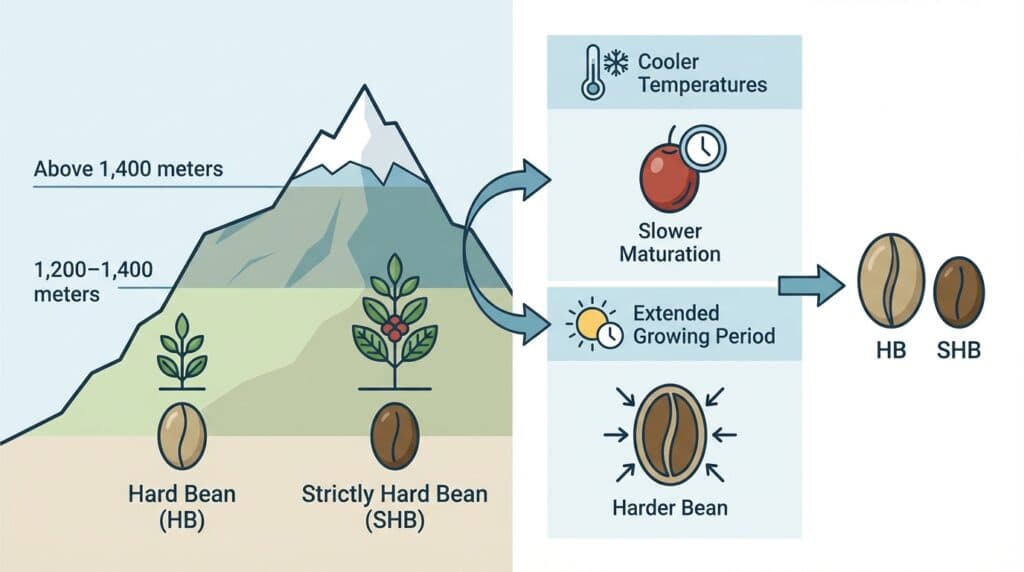
Here’s the basic breakdown:
- Hard Bean (HB): Typically grown between 1,200and 1,400 meters (approximately 4,000–4,600 feet) above sea level.
- Strictly Hard Bean (SHB): Grown above 1,400 meters (4,600+ feet), often reaching 1,600 meters or higher.
In short, the higher the altitude, the “harder” the bean. But why does hardness matter? At higher elevations, cooler temperatures slow down the maturation process of the coffee cherry. This extended growing period allows the beans to develop more complex sugars and organic compounds, resulting in denser, harder beans.
Why Density Equals Quality
Denser beans aren’t just a physical characteristic—they’re a flavor advantage. Adenser bean holds more of the good stuff: sugars, acids, and aromatic compounds. When you roast these beans, they respond more evenly to heat and produce a cup with greater depth, brightness, and complexity. In my experience, reaching for an SHB coffee when you want something special rarely disappoints.
Hard Bean vs. Strictly Hard Bean: A Side-by-Side Comparison
Let’s put these two grades head-to-head so you can see exactly how they stack up.
| Characteristic | Hard Bean (HB) | Strictly Hard Bean (SHB) |
|---|---|---|
| Altitude | 1,200–1,400 meters | 1,400+ meters |
| Bean Density | Dense | Very dense |
| Flavor Complexity | Good, balanced | High, nuanced |
| Acidity | Medium, pleasant | Bright, lively |
| Body | Medium | Medium to full |
| Price Point | Moderate | Premium |
| Roasting Behavior | Predictable | Requires precision |
As you can see, both grades offer quality coffee, but SHB edges ahead in terms of flavor complexity and acidity. HB beans, however, provide a more approachable cup that many coffee drinkers find perfectly satisfying for daily brewing.
Flavor Profiles: What to Expect in Your Cup
Understanding these grades helps you predict what your coffee will taste like before you even grind it. Here’s what I’ve found over years of brewing both types.
Hard Bean Flavor Profile
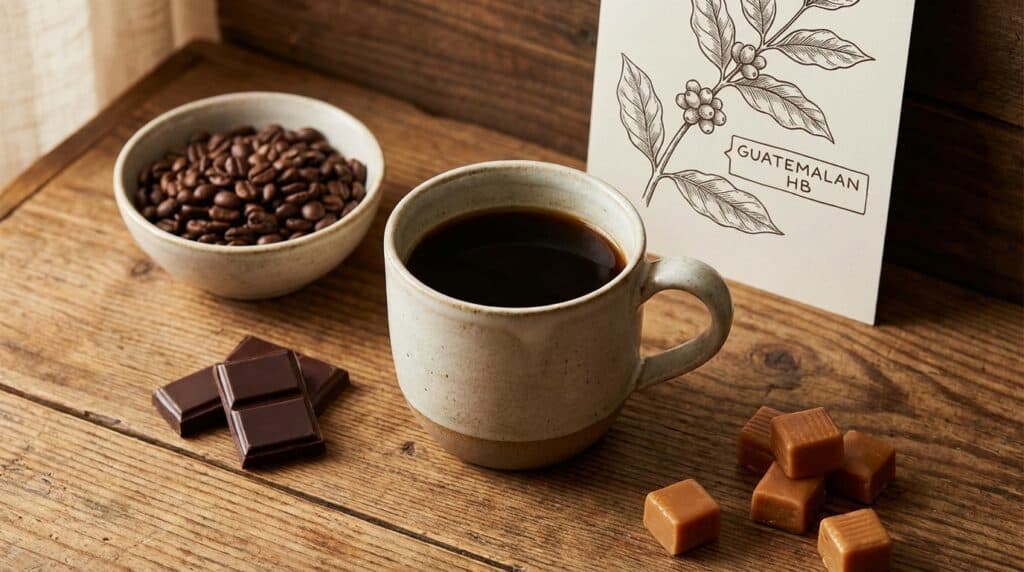
Hard Bean coffees tend to offer a well-rounded, balanced experience. You’ll often notice:
- Medium acidity that’s present but not overwhelming
- Nutty, chocolatey, or caramel notes
- A smooth, approachable body
- Clean finish without too many surprises
Think of HB coffee as your reliable daily driver. It’s the friend who always shows up on time with exactly what you need. A Guatemalan HB, for example, might greet you with notes of cocoa and a hint of citrus—pleasant, consistent, and easy to enjoy without overthinking.
Strictly Hard Bean Flavor Profile
Strictly Hard Bean coffee is where things get exciting. These beans often deliver:
- Bright, vibrant acidity (think citrus, berry, or wine-like qualities)
- Complex flavor layers that evolve as the coffee cools
- Floral or fruity notes alongside deeper chocolate or spice undertones
- A fuller body with a lingering, memorable finish
SHB coffees reward attention. I’ve had cups that started with bright lemon notes, shifted to honey sweetness mid-sip, and finished with a whisper of dark chocolate. Life is too short for boring coffee, and SHB beans understand that assignment.
Who Is Each Grade Best For?
Not every coffee is right for every drinker. Here’s my honest take on who should reach for which grade.
Hard Bean (HB) Is For You If:

- You prefer a mellow, easy-drinking cup without sharp acidity
- You’re brewing for a crowd with varied taste preferences
- You want quality coffee at a reasonable price point
- You primarily use drip brewing, French press, or cold brew methods
- You add milk or cream to your coffee (the balanced profile holds up well)
Strictly Hard Bean (SHB) Is For You If:
- You love bright, complex coffees with lots of flavor layers
- You drink your coffee black and want to taste every nuance
- You use pour-over, AeroPress, or other precision brewing methods
- You’re willing to pay a premium for exceptional quality
- You enjoy experimenting and discovering new flavor notes
Who Should Skip Each?
If you find acidic coffees too intense or “sour,” SHB’s bright character might not be your thing. On the flip side, if you’re chasing fruit-forward, tea-like complexity, HB coffee might feel a bit too safe and predictable.
Hard Bean and Strictly Hard Bean: Pros and Cons
Let me break this down even further with clear advantages and disadvantages for each grade.
Hard Bean (HB)
Pros:
- More affordable than SHB without sacrificing quality
- Balanced flavor that appeals to most palates
- Forgiving during brewing—harder to mess up
- Excellent for milk-based drinks and everyday brewing
- Widely available from multiple origins
Cons:
- Less complexity compared to higher-altitude beans
- May lack the vibrant acidity specialty coffee lovers crave
- Flavor profile can feel one-dimensional to experienced drinkers
Strictly Hard Bean (SHB)

Pros:
- Superior flavor complexity and depth
- Bright, lively acidity that’s prized in specialty coffee
- Denser beans roast more evenly
- Often showcases unique origin characteristics
- Ideal for black coffee enthusiasts and pour-over brewing
Cons:
- Higher price point
- Acidity may be too intense for somedrinkers
- Requires more attention during brewing to bring out best qualities
- Can be overpowered if paired with heavy milk or sweeteners
Key Takeaway: Altitude Is Your Flavor Roadmap
Here’s something I wish someone had told me earlier in my coffee journey: altitude grades like HB and SHB are one of the most reliable predictors of flavor character. While roast level, processing method, and origin all matter, altitude gives you a quick shortcut to understanding what you’re about to brew. Higher altitude generally means brighter acidity and more complexity. Lower altitude (even within the “hard bean” category) tends toward smoother, mellower cups.
The next time you’re shopping for coffee, look for these designations on the bag. They’re not just marketing fluff—they’re genuinely useful information.
Brewing Tips for Each Grade
Getting the most out of your beans means adjusting your approach based on what you’re working with.
Brewing Hard Bean Coffee
HB coffee is forgiving, but you can still optimize your brew:
- Use a medium grind for drip or pour-over
- Water temperature around 200°F (93°C) works well
- These beans shine in immersion methods like French press
- Don’t overthink it—HB rewards consistency over precision
Barista Tip: HB coffees make excellent cold brew. Their smooth, chocolatey notes concentrate beautifully during the long extraction process.
Brewing Strictly Hard Bean Coffee
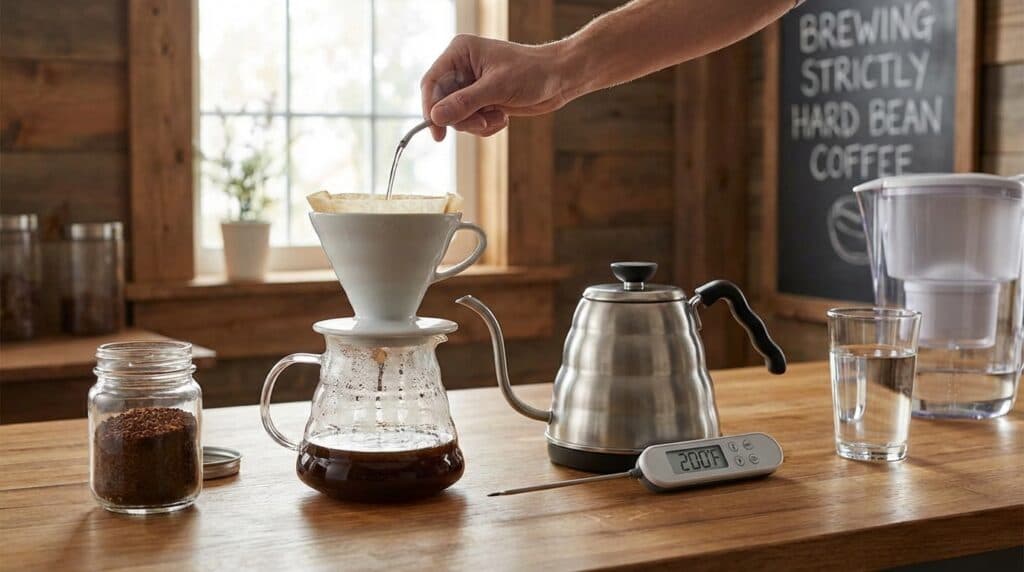
SHB beans deserve a bit more care to unlock their potential:
- Use a slightly coarser grind than you might expect—this prevents over-extraction of those abundant acids
- Water temperature between 195–205°F (90–96°C) helps highlight complexity
- Pour-over methods let you control extraction and showcase bright notes
- Taste as the coffee cools—SHB beans often reveal new flavors at different temperatures
Barista Tip: When brewing SHB, I’ve found that using filtered water makes a noticeable difference. The cleaner water lets those delicate floral and fruit notes shine through without interference.
Common Misconceptions About Coffee Grading
Let’s bust a few myths I hear all the time.
“SHB is always better than HB.” Not necessarily. Better depends on your personal taste preferences. If you prefer smooth, mellow coffee, HB might actually be your ideal match. Quality is about fit, not just grade.
“These grades apply everywhere.” Actually, HB and SHB are primarily Central American classifications. Other regions use different systems—Colombia uses Supremo and Excelso (based on bean size), while Ethiopia focuses on regional designations and processing methods.
“Higher altitude is the only thing that matters.” Altitude is important, but it’s one piece of the puzzle. Processing method, varietal, soil conditions, and roast profile all contribute to your final cup. Think of altitude as a strong indicator, not the whole story.
Conclusion and Recommendations
Understanding the difference between Hard Bean and Strictly Hard Bean coffee puts you ahead of most casual coffee drinkers. These altitude-based grades offer genuine insight into what you can expect from your beans. HB delivers reliable, balanced cups perfect for everyday enjoyment, while SHB rewards those seeking complexity, brightness, and memorable coffee experiences.
My suggestion? Try both side by side from the same origin if you can. Brew a Guatemalan HB and a Guatemalan SHB using identical methods, and taste them back to back. You’ll understand the altitude difference in a way no article can fully convey. Whether you land on the approachable comfort of Hard Bean or the vibrant complexity of Strictly Hard Bean, you’re now equipped to choose with confidence. Happy brewing!


Comments