


Table of Contents
- Quick Verdict: Hamilton Beach FlexBrew
- What Makes the Hamilton Beach FlexBrew Stand Out?
- Key Features at a Glance
- Hamilton Beach FlexBrew: Pros and Cons
- Pros
- Cons
- Who Is the Hamilton Beach FlexBrew For?
- Who Is This For?
- Who Is This NOT For?
- Real-World Performance: What the Manual Covers
- Carafe Side Performance
- Single-Serve Side Performance
- How Does the FlexBrew Compare to Competitors?
- Tips for Getting the Best Results
- Frequently Asked Questions
- Can you use both sides of the Hamilton Beach FlexBrew at the same time?
- Does the FlexBrew work with all K-Cup pod brands?
- How long does the Hamilton Beach FlexBrew typically last?
- Is the FlexBrew difficult to clean?
- Why does my single-serve coffee taste weak?
- Final Thoughts: Is the Hamilton Beach FlexBrew Worth Buying?
Quick Verdict: Hamilton Beach FlexBrew
The Hamilton Beach 2-Way FlexBrew puts two brewers in one housing: a 12-cup carafe side for ground coffee and a single-serve side that takes K-Cup pods or loose grounds. Its main limit is written into the manual: the unit brews on only one side at a time. It suits a household where one person wants a pot and another wants a single cup at a different moment. It does not suit two people who want coffee at the same moment.
Daily Home Coffee does not test coffee makers hands-on. This review is built from Hamilton Beach’s Use & Care guide for the 2-Way FlexBrew (models 49940, 49950, 49956 and 49976) and the maker’s product pages. Where those sources stop, this guide says so. Hamilton Beach sells several other FlexBrew machines, including the FlexBrew Trio, so check the model number on the box against the manual you read.
Who it fits: mixed pot-and-single-cup households that are happy with a carafe kept warm on a warming plate and do not need both sides at once.
What Makes the Hamilton Beach FlexBrew Stand Out?
Most homes that want both a pot and a single cup end up with two machines. The 2-Way FlexBrew puts both jobs in one housing, and each side has its own water reservoir with its own water window, so you always know which side you filled.
The single-serve side is not tied to pods. Hamilton Beach includes a pack holder for K-Cup pods and a separate brew basket for your own ground coffee, so you can brew without pods at all. The carafe side uses ground coffee in a paper filter or the included permanent gold-tone filter.
Key Features at a Glance

- Two brewers: a 12-cup carafe side and a single-serve side, each with its own reservoir.
- Pods or grounds: up to 10 oz with a K-Cup pod, or up to 14 oz into a travel mug with grounds.
- Programmable carafe: the product page says you can set the brew time up to 24 hours ahead.
- Automatic shutoff: the manual says the coffee maker shuts off two hours after the carafe brew cycle begins.
- Pause and serve: pour a cup mid-brew, then return the carafe within 20 seconds.
- Regular or bold: a brew-strength setting on both sides.
| Feature | Carafe side | Single-serve side |
|---|---|---|
| Capacity | 12 cups | Up to 10 oz with a pod, up to 14 oz with grounds |
| Programmable | Yes | No; the manual says program mode is for the carafe side only |
| Coffee | Ground coffee in a paper or gold-tone filter | K-Cup pod, or up to 3 tablespoons of grounds in the brew basket |
| Brew strength | Regular or bold | Regular or bold |
The product page for model 49950C lists the dimensions as 13.4 in high, 11.4 in wide and 12.2 in deep, and marks that model as no longer available. The manual rates the unit at 120 V, 60 Hz and 1050 W.
Hamilton Beach FlexBrew: Pros and Cons
These follow from what the manual and product page state, not from use in a test kitchen.
Pros
- No pod lock-in: the single-serve brew basket takes your own grounds, so pods are optional.
- Separate reservoirs: each side has its own water window.
- Programmable pot: set the carafe the night before.
- Dishwasher-safe parts: removable parts can go in the top rack, as long as you avoid the “SANI” setting.
- Clear brewing doses: the manual gives grounds per cup and maximums for each side.
Cons

- One side at a time: the manual says the unit only brews on one side at a time.
- Programming blocks the single cup: the single-serve side cannot be used while the carafe side is programmed.
- Warming plate: the carafe sits on a warming plate, and the machine shuts off two hours after the brew cycle begins.
- Strict water limits on the single-serve side: at least 6 oz, at most 10 oz with a pod and 14 oz with grounds.
- Warranty depends on country: the manual gives one year in the U.S. and five years in Canada.
Who Is the Hamilton Beach FlexBrew For?
The right machine depends on how your household drinks coffee, and the manual’s limits make the fit easy to judge.
Who Is This For?
- Mixed households: one person brews a pot on weekends, another brews a single cup on weekdays.
- Occasional pod users: people who want pods some days and their own grounds on others.
- Small kitchens: one appliance instead of two.
- Pot drinkers who finish within two hours: the shutoff timer suits a pot that gets poured fairly soon.
Who Is This NOT For?
- Two drinkers on the same schedule: both sides cannot brew at once.
- Slow sippers: a pot that has to stay hot all morning needs a thermal carafe instead of a warming plate with a two-hour shutoff.
- Programmed-pot households that also want a quick single cup: programming the carafe locks out the single-serve side.
- Espresso drinkers: this is a drip and pod brewer.
Real-World Performance: What the Manual Covers
Daily Home Coffee has not measured brew times or temperatures on this machine. What the manual does give is a set of operating rules, and those decide most day-to-day results.
Carafe Side Performance
Hamilton Beach’s dose is one level tablespoon of grounds for each cup of coffee, using slightly less, 3/4 tablespoon, for decaf or flavored coffee to avoid overflow. For a full 12-cup pot that works out to 12 tablespoons. Fill the carafe with up to 12 cups of cold water, pour it into the carafe reservoir and set the carafe, lid on, on the warming plate.
Bold mode, the manual notes, takes additional time to complete a brewing cycle. To pour mid-brew, lift the carafe; the flow from the filter basket stops, and the manual says to put the carafe back within 20 seconds to prevent overflow. For grind, it recommends medium ground coffee and warns that coffee ground too finely can make the basket overflow.
Single-Serve Side Performance
The single-serve side brews all the water you add, so the mug you fill the reservoir with should be the mug you brew into. With a pod, 10 oz of water is the maximum. With grounds, the brew basket holds up to 3 tablespoons, and the maximum water is 14 oz. The troubleshooting section says the machine needs 6 oz of water or more to dispense.
If grounds come through into the cup, the manual suggests a coarser grind or a #1 paper cone filter in the single-serve brew basket. If coffee tastes bad, it lists the usual causes: the wrong amount of water or grounds, stale coffee and poor water quality, with filtered or bottled water as the fix for the last one. Use cold water only; the manual says not to put hot water in the reservoir.
Weak single cup? The manual’s own troubleshooting advice is to change the amount of water to coffee grounds. The bold setting is the other option it offers.
How Does the FlexBrew Compare to Competitors?
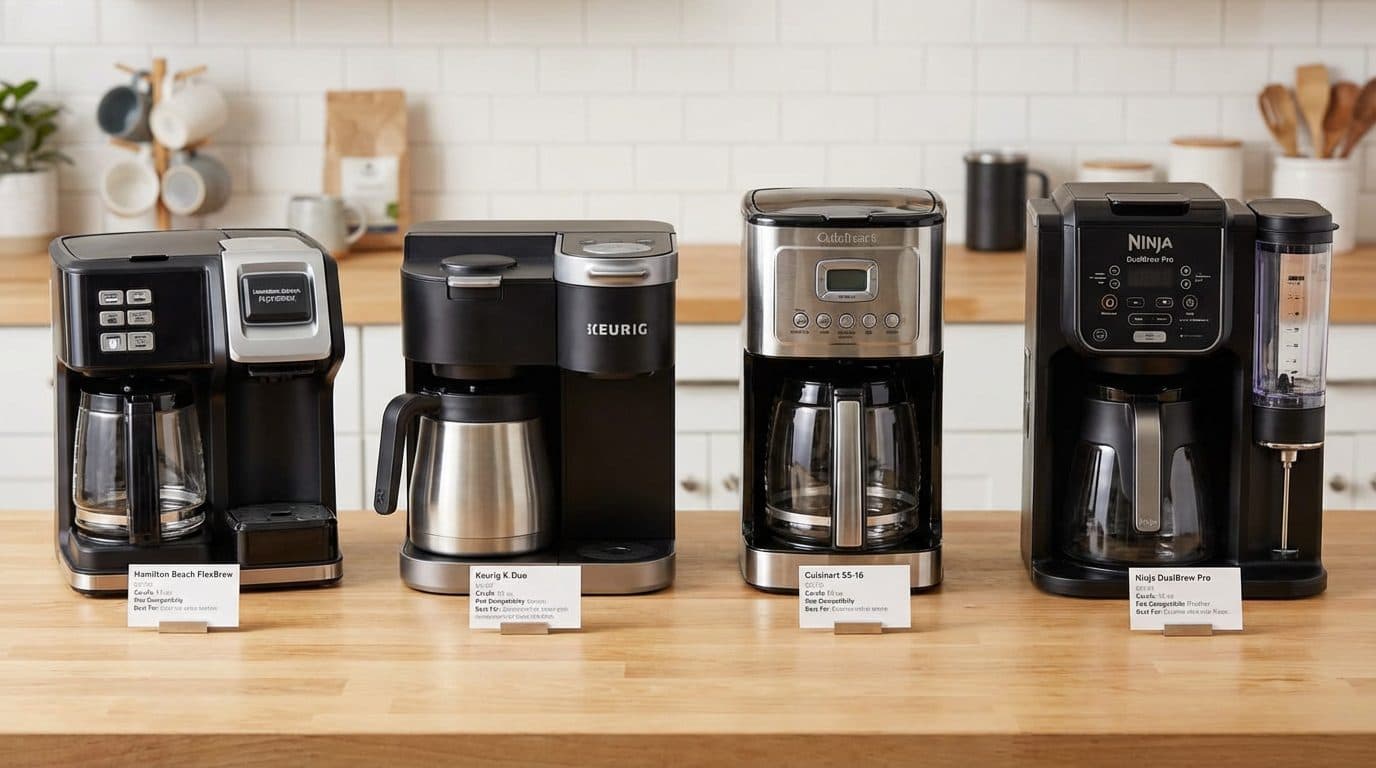
This guide does not list competitor prices or claims, because they change and Daily Home Coffee has not compared the machines side by side. Compare any dual brewer on the same four questions, using its own manual:
- Can both sides brew at once? On the 2-Way FlexBrew, no.
- What keeps the pot hot, and for how long? Here, a warming plate, with shutoff two hours after brewing begins.
- Does the single-serve side need pods? Here, no; a grounds basket is included.
- What does the warranty cover where you live? Here, one year in the U.S. and five in Canada.
Hamilton Beach’s own range is worth a look too. Its current catalogue lists a FlexBrew Trio with a 56 oz removable reservoir, a 12-cup glass carafe and five single-serve sizes, and a slim FlexBrew Dual that is 4.9 in wide. If a thermal carafe matters more than a single-serve side, the budget drip coffee maker comparison covers a glass-carafe model against a thermal one.
Tips for Getting the Best Results

Each tip below comes from Hamilton Beach’s manual.
- Use filtered or bottled water. The manual says it will yield better-tasting coffee than tap water.
- Measure the grounds. One level tablespoon per cup on the carafe side; no more than 3 tablespoons in the single-serve basket.
- Match the mug to the water. Fill the single-serve reservoir with the same mug you brew into.
- Clean monthly. The manual says to clean at least once a month, or once a week in hard-water areas.
- Use the manual’s vinegar method. One pint of plain white vinegar on the carafe side with the carafe underneath, one cup on the single-serve side with a 14 oz or larger mug underneath, a 30-minute pause mid-cycle, then 2 to 3 cycles of cold tap water. Follow the manual’s step-by-step timing. The descaler versus vinegar guide explains why the machine’s own instructions decide the method.
- Rinse after every use. The funnel, pod holder and brew basket all need a rinse.
Frequently Asked Questions
Can you use both sides of the Hamilton Beach FlexBrew at the same time?
No. The manual states that the unit will only brew on one side at a time, and that the single-serve side cannot be used while the carafe side is programmed.
Does the FlexBrew work with all K-Cup pod brands?
The product page says the single-serve side takes K-Cup pods, and the manual uses the general term “single-serve packs”. Its troubleshooting section adds that some packs are weaker at the seams, so if a pack bursts, it suggests trying a different brand. The included brew basket is the alternative to pods.
How long does the Hamilton Beach FlexBrew typically last?
Neither the manual nor the product page gives a lifespan. The manual’s warranty runs one year from purchase in the U.S. and five years in Canada, and excludes glass, filters and wear from normal use. Regular cleaning is the maintenance the manual asks for.
Is the FlexBrew difficult to clean?
Routine cleaning is a rinse of the funnel, holders and carafe after each use. Removable parts can be hand washed or put in the dishwasher’s top rack, without the “SANI” setting. Descaling is a vinegar cycle on each side, at least monthly. If the pod side stops dispensing, the manual lists a clogged needle, mineral deposits or too little water (under 6 oz) as causes. For a clogged needle, it says to unplug the machine and let it cool, remove the gray needle holder, and clear the piercing needle with a small bent paper clip. Take care: the manual warns that the needle is sharp and that hot water can spray from the piercing nozzle if the machine has not cooled.
Why does my single-serve coffee taste weak?
The manual’s troubleshooting section says to change the amount of water to coffee grounds; brewing less water with the same dose, up to the basket’s 3-tablespoon maximum, is the direct way to do that. Bold is the other brew-strength option. The manual also lists stale coffee and poor water quality as causes of bad-tasting coffee.
Final Thoughts: Is the Hamilton Beach FlexBrew Worth Buying?
The 2-Way FlexBrew is a sensible choice for a household that brews a pot and single cups at different times and wants the option to skip pods. Its limits are clear before you buy: one side at a time, a programmed carafe that blocks the single-serve side, and a carafe that the machine stops warming two hours after brewing begins.
If those limits fit your mornings, check the exact model number, read its manual, and confirm the warranty for your country before you buy.

Comments