


Table of Contents
- What Makes Vietnamese Iced Coffee Special
- Taste Profile
- What You'll Need
- Ingredients
- Gear
- How to Make Vietnamese Iced Coffee with Condensed Milk
- Step-by-Step Instructions
- Customizing Your Vietnamese Iced Coffee
- Adjusting Sweetness and Strength
- Fun Variations to Try
- Common Mistakes and How to Avoid Them
- Mistake 1: Using Pre-Ground Coffee That's Too Fine
- Mistake 2: Not Waiting for the Bloom
- Mistake 3: Adding Ice Before Mixing
- Mistake 4: Using Low-Quality Condensed Milk
- Frequently Asked Questions
- Can I use regular milk instead of condensed milk?
- What coffee beans work best for Vietnamese iced coffee?
- How long does Vietnamese iced coffee stay fresh?
- Is Vietnamese iced coffee stronger than regular coffee?
- Can I make this without a phin filter?
- Final Thoughts and Next Steps
Have you ever wondered why Vietnamese iced coffee tastes so incredibly rich and satisfying compared to your regular iced brew? The secret lies in one simple ingredient: sweetened condensed milk. This thick, creamy addition transforms ordinary coffee into something almost dessert-like, and I’ve found it to be one of the easiest ways to elevate your home coffee game. In this guide, you’ll learn exactly how to make authentic Vietnamese iced coffee with condensed milk, along with tips to customize it to your taste.
Whether you’re looking for a refreshing summer drink or simply want to try something new, the Vietnamese method offers a perfect balance of bold coffee and sweet creaminess. Let’s dive into everything you need to know to master this beloved drink at home.
What Makes Vietnamese Iced Coffee Special
Vietnamese iced coffee, known locally as cà phê sữa đá, has been a staple in Vietnam for over a century. French colonizers introduced coffee to Vietnam in the 1850s, but fresh milk was scarce. Resourceful Vietnamese coffee lovers turned to condensed milk as a substitute, and a legendary drink was born.
What sets this method apart from regular iced coffee is the combination of three key elements:
- Dark roast coffee – Typically robusta beans with a bold, slightly bitter profile
- Sweetened condensed milk – Provides both sweetness and creaminess in one ingredient
- Slow drip brewing – A traditional phin filter creates a concentrated, intense brew
The result? A drink that’s simultaneously strong, sweet, and incredibly smooth. In my experience, people who claim they don’t like black coffee often fall in love with Vietnamese iced coffee because the condensed milk balances the bitterness perfectly.
Taste Profile

Expect a bold, slightly chocolatey flavor with caramel-like sweetness. The robusta beans traditionally used add an earthy depth, while the condensed milk creates a velvety mouthfeel. It’s rich without being heavy, sweet without being cloying.
What You’ll Need
Before you start brewing, gather these essentials. The good news is you don’t need fancy equipment to make excellent Vietnamese iced coffee at home.
Ingredients
- 2-3 tablespoons coarsely ground dark roast coffee (Vietnamese brands like Trung Nguyen work great, but any dark roast will do)
- 2-3 tablespoons sweetened condensed milk
- 6-8 oz hot water (just off the boil, around 195-205°F)
- Ice cubes
Gear
- Vietnamese phin filter (highly recommended) or a French press as an alternative
- Heat-resistant glass or cup
- Tall glass for serving
- Spoon for stirring
Barista Tip: If you don’t have a phin filter yet, a French press works surprisingly well. Use a 1:4 coffee-to-water ratio and steep for 4-5 minutes to achieve similar strength.
How to Make Vietnamese Iced Coffee with Condensed Milk
Now for the fun part. Follow these steps to create an authentic Vietnamese iced coffee that rivals any café version.
Step-by-Step Instructions
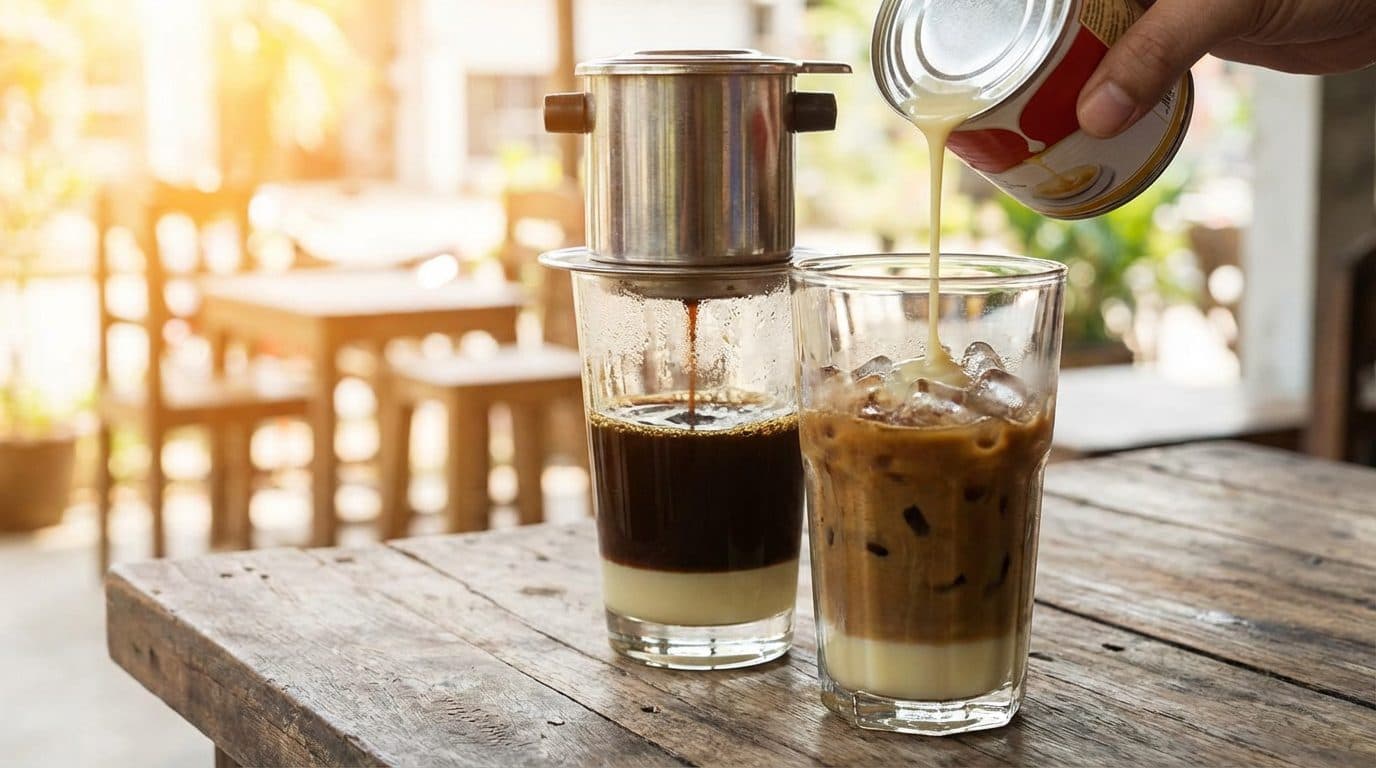
- Add condensed milk to your glass. Start with 2 tablespoons at the bottom of a heat-resistant glass. You can adjust this amount later based on your sweetness preference.
- Prepare your phin filter. Remove the lid and filter press. Add your ground coffee to the chamber and give it a gentle shake to level the grounds.
- Insert the filter press. Place it on top of the grounds and press down lightly. Don’t pack it too tight, or the water won’t drip through properly.
- Bloom the coffee. Add just enough hot water to cover the grounds (about 1 oz). Wait 20-30 seconds to let the coffee bloom and release its flavors.
- Add remaining water. Fill the phin with hot water and place the lid on top. Now comes the hardest part: waiting.
- Let it drip. The coffee should drip slowly over 4-6 minutes. If it drips too fast, your grind is too coarse. Too slow? The grind is too fine or you packed the press too tight.
- Stir and pour over ice. Once the dripping stops, remove the phin and stir the coffee and condensed milk together until fully combined. Fill a tall glass with ice and pour the mixture over it.
- Enjoy immediately. Give it one final stir and savor your creation.
Barista Tip: For an extra-cold drink without dilution, freeze some coffee in ice cube trays beforehand. Use these coffee cubes instead of regular ice.
Customizing Your Vietnamese Iced Coffee
One of the best things about making coffee at home is tailoring it to your preferences. Here are some variations I’ve experimented with over the years.
Adjusting Sweetness and Strength
| Preference | Condensed Milk | Coffee Amount |
|---|---|---|
| Less sweet, stronger | 1-1.5 tbsp | 3 tbsp |
| Balanced (traditional) | 2-3 tbsp | 2-3 tbsp |
| Sweeter, milder | 3-4 tbsp | 2 tbsp |
Fun Variations to Try
- Coconut Vietnamese coffee – Replace half the condensed milk with coconut cream for a tropical twist
- Mocha version – Add 1 teaspoon of cocoa powder to the condensed milk before brewing
- Vanilla infusion – Stir in a drop of vanilla extract for extra depth
- Dairy-free option – Use sweetened condensed coconut milk (available at most grocery stores)
I’ve found that the coconut version works particularly well on hot summer days. The combination of bold coffee and tropical creaminess is genuinely refreshing.
Common Mistakes and How to Avoid Them
Even simple recipes can go wrong. Here are the most frequent issues I see home baristas encounter with Vietnamese iced coffee.
Mistake 1: Using Pre-Ground Coffee That’s Too Fine
Espresso-grind coffee will clog your phin filter and result in over-extracted, bitter coffee. Aim for a coarse grind similar to what you’d use for French press. If you’re buying pre-ground, look for “coarse” or “French press” on the label.
Mistake 2: Not Waiting for the Bloom
Skipping the bloom step means you miss out on flavor development. Those 20-30 seconds allow CO2 to escape and help the water extract more evenly. Patience pays off here.
Mistake 3: Adding Ice Before Mixing
If you pour hot coffee over ice before stirring in the condensed milk, the milk won’t dissolve properly. You’ll end up with a sweet layer at the bottom and bitter coffee on top. Always mix first, then add ice.
Mistake 4: Using Low-Quality Condensed Milk
Not all condensed milk is created equal. Brands like Longevity or Eagle Brand tend to have a richer, more caramelized flavor. Store brands can taste overly sweet without much depth.
Key Takeaway: The quality of your two main ingredients—coffee and condensed milk—directly determines the quality of your final drink. Invest in good versions of both.
Frequently Asked Questions
Can I use regular milk instead of condensed milk?
You can, but it won’t taste the same. Regular milk lacks the thick sweetness that defines Vietnamese iced coffee. If you want to reduce sweetness, try using half condensed milk and half regular milk or cream instead of substituting entirely.
What coffee beans work best for Vietnamese iced coffee?
Traditional Vietnamese coffee uses robusta beans, which are stronger and more bitter than arabica. However, any dark roast works well. French roast, Italian roast, or espresso blends all pair nicely with condensed milk. The key is choosing something bold enough to stand up to the sweetness.
How long does Vietnamese iced coffee stay fresh?
Once mixed, it’s best enjoyed immediately. The ice will dilute the drink over time, and the coffee loses its freshness. If you want to prep ahead, you can brew the coffee and store it in the fridge for up to 24 hours, then mix with condensed milk and ice when ready to serve.
Is Vietnamese iced coffee stronger than regular coffee?
Yes, typically. The phin filter produces a concentrated brew similar to espresso strength. Combined with the caffeine-heavy robusta beans traditionally used, Vietnamese iced coffee packs a significant punch. If you’re sensitive to caffeine, consider using less coffee or switching to arabica beans.
Can I make this without a phin filter?
Absolutely. A French press, Moka pot, or even strong drip coffee can work. The phin filter creates a specific flavor profile, but the condensed milk is really the star of the show. Use whatever brewing method you have and adjust the coffee strength to taste.
Final Thoughts and Next Steps
Vietnamese iced coffee with condensed milk is one of those drinks that’s greater than the sum of its parts. Bold coffee meets sweet, creamy condensed milk, and the result is pure refreshment. Once you’ve made it a few times, you’ll understand why this drink has captivated coffee lovers worldwide.
Start with the traditional recipe, then experiment with the variations that appeal to you. Life is too short for boring coffee, and this Vietnamese method proves that sometimes the simplest combinations are the most satisfying. Grab a phin filter, pick up some quality condensed milk, and treat yourself to a café-worthy iced coffee at home.


Comments