


Table of Contents
- Caffeine Content: The Numbers
- Yerba mate caffeine per 8 oz
- Why the traditional gourd changes the total
- Why Yerba Mate Feels Different
- Hot mate, cold tereré and water temperature
- Myth vs. Reality
- Club-Mate Caffeine vs. Coffee
- Comparing the Experience: Coffee vs. Mate
- Health Considerations
- Who Should Choose What
- Frequently Asked Questions
Cup for cup, yerba mate and coffee carry similar amounts of caffeine. A 2007 scientific review of mate found about 78 mg of caffeine in a cup of mate tea of roughly 150 mL, against about 85 mg for a cup of coffee. The bigger difference is how mate is usually drunk: the traditional gourd is refilled with water again and again, and the same review says that can add up to 260 mg or more of caffeine in one session. So a single cup of mate is close to a single cup of coffee, while a full traditional mate session can hold more caffeine than one or two cups of coffee.
The figures below come from two peer-reviewed reviews of yerba mate, public-health pages on caffeine, and the maker’s label for bottled Club-Mate. Daily Home Coffee does not run lab tests, so where a number is this guide’s own arithmetic, the text says so.
Caffeine Content: The Numbers
| Drink and serving | Caffeine | Source |
|---|---|---|
| Mate tea, 1 cup (about 150 mL) | about 78 mg | Heck & de Mejia, 2007 review |
| Mate tea, 1 cup (about 150 mL) | about 80 mg | Gawron-Gzella et al., 2021 review |
| Traditional mate, around 500 mL in a session | 260 mg or more | Heck & de Mejia, 2007 review |
| Coffee, 1 cup (as compared in the same review) | about 85 mg | Heck & de Mejia, 2007 review |
| Filter coffee, 200 ml cup | 90mg | EFSA |
| Coffee, 6 ounce cup | 75 to 100 mg | MedlinePlus |
| Espresso, 60 ml | 80mg | EFSA |
| Club-Mate Original (bottled mate drink) | 20mg per 100ml | Brauerei Loscher label |
EFSA notes that its figures are approximate because caffeine content and portion sizes vary within and between countries. The mate figures vary even more, because the amount of leaf, the water temperature and the number of refills all change what ends up in the cup.
Yerba mate caffeine per 8 oz
Neither review gives an 8 oz figure, so this is arithmetic rather than a measurement. An 8 oz cup is about 240 mL. If mate were brewed at the same strength as the 150 mL cup in the 2007 review, 78 mg × 240 ÷ 150 comes to roughly 125 mg. The same scaling applied to coffee gives roughly 108 mg from EFSA’s 90mg per 200 ml, or about 100 to 133 mg from MedlinePlus’s 75 to 100 mg per 6 ounces. Those ranges overlap, which is the honest answer to “which has more caffeine per 8 oz”: it depends on how strong each one is brewed.
Why the traditional gourd changes the total
The 2007 review describes the South American way of drinking it: about 50 g of dry leaves are packed into a gourd, hot water is poured over them, and this is repeated multiple times, with as much as half to 1 L of water. The 2021 review describes filling the vessel about a quarter full of leaf, adding water at 65–80 °C and pouring again six or seven times until the leaf loses its taste. Each refill pulls out more caffeine, so the total for a session is far higher than for a single cup. The 2021 review puts typical consumption in mate-drinking countries at 12–23 g of dried leaves per day, equal to about 1 L of drink.
Mate sold in the United States often comes in individual tea bags of 1 to 2 g, according to the 2007 review. A single tea bag uses a small fraction of the leaf in a packed gourd, so a bagged cup is not a guide to what a traditional session delivers.
Why Yerba Mate Feels Different
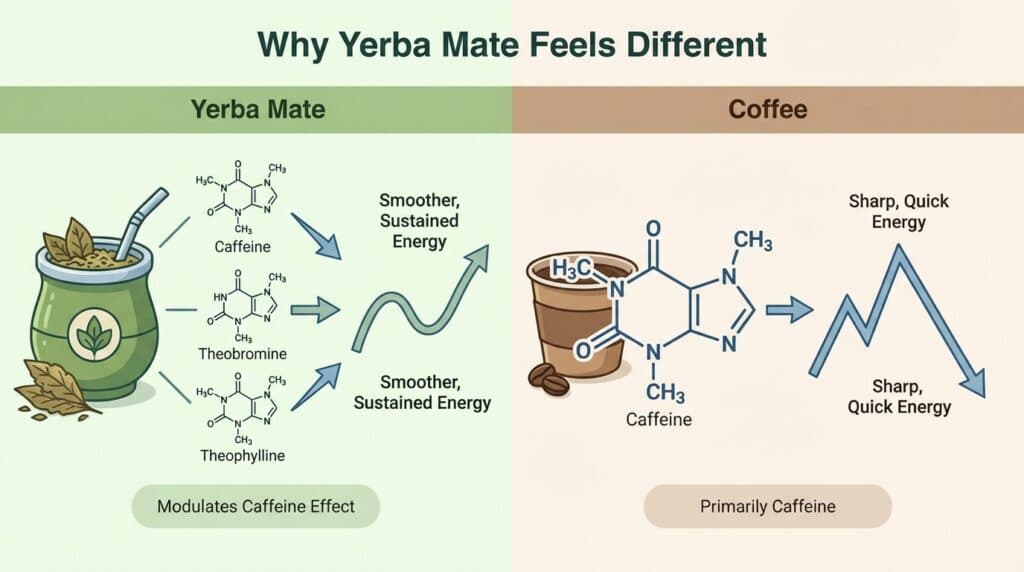
The stimulant in mate is caffeine, the same compound that is in coffee. The 2007 review lists the xanthines found in mate as theophylline, theobromine and caffeine, with caffeine at 1% to 2% of dry weight and theobromine at 0.3% to 0.9%. The 2021 review describes theophylline as present only in trace amounts.
Many people say mate feels different from coffee. The 2021 review records that regular consumers say the brew gives energy without the nervousness that sometimes follows coffee. That is a description of what drinkers report, not a measured comparison, and none of the sources here tested whether mate’s other compounds change how caffeine acts.
Hot mate, cold tereré and water temperature
The 2021 review summarises research showing that the cold-prepared drink, tereré, contained about 2.5 times more caffeine per 100 mL than hot-brewed chimarrão in that study. It also reports that brewing with boiling water was very inefficient, giving about half the caffeine concentration. Those findings come from specific lab preparations, so treat them as a sign that method matters, not as numbers to expect in your own cup.
Myth vs. Reality
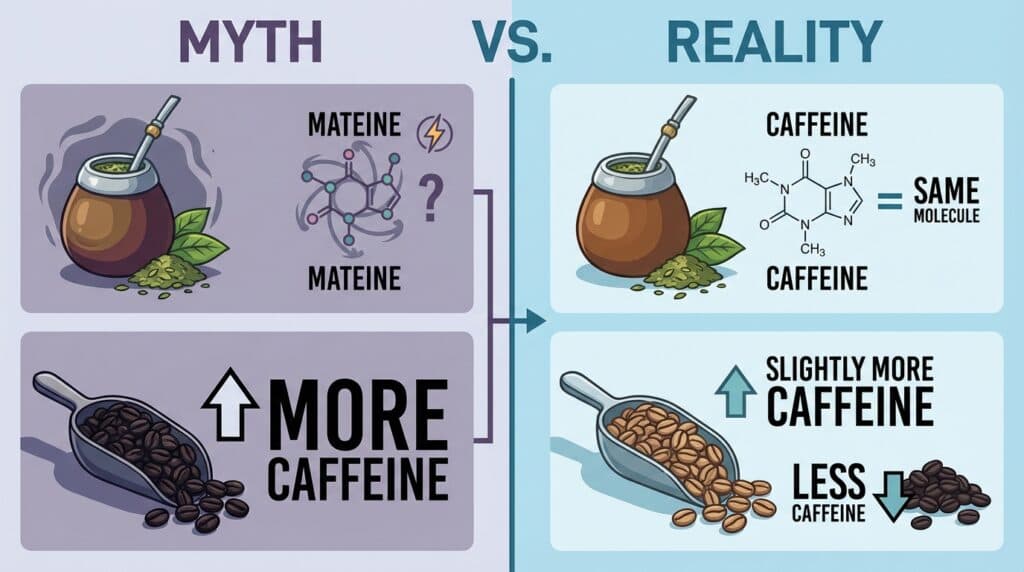
- Myth: Yerba mate is a caffeine-free herbal tea.
Reality: Both reviews put a cup of mate at roughly the caffeine of a cup of coffee. - Myth: Mate contains a different stimulant from coffee.
Reality: The main stimulant the reviews identify in mate is caffeine, alongside smaller amounts of theobromine and trace theophylline. - Myth: One cup of mate tells you how much caffeine a mate session gives.
Reality: A traditional session of around 500 mL can reach 260 mg or more, according to the 2007 review. - Myth: Bottled mate drinks are just brewed mate.
Reality: Club-Mate’s ingredient list shows both mate extract and added caffeine (“Koffein”).
Club-Mate Caffeine vs. Coffee
Club-Mate is a carbonated mate drink made by Brauerei Loscher in Germany. The maker’s label for Club-Mate Original gives 20mg of caffeine per 100ml and lists mate extract (2.9%), sugar and caffeine among the ingredients. By arithmetic, a 330 ml bottle would hold 66 mg and a 500 ml bottle 100 mg. That puts a 500 ml bottle in the same range as a cup of coffee from the table above. The label also carries a high-caffeine notice saying it is not recommended for children or for pregnant or breastfeeding women.
Comparing the Experience: Coffee vs. Mate
Mate leaves are processed differently from tea and coffee. The 2007 review explains that mate is dried very slowly, often over wood smoke, which gives it very different flavour characteristics from green tea. Mate also often contains pieces of stem. Coffee’s flavour depends on roast and brewing instead, so the two drinks are hard to compare on taste beyond saying they are not interchangeable.
The rituals differ too. Coffee is usually brewed and drunk as a single serving. Traditional mate is shared and refilled, often over a longer period, which is why serving size is the first thing to check when you compare caffeine.
Health Considerations
Total caffeine. Caffeine from mate counts the same as caffeine from coffee. The FDA has cited 400 milligrams a day as an amount not generally associated with negative effects for most adults, while noting wide variation in how sensitive people are. EFSA gives the same 400mg for healthy adults, except pregnant women, and 200mg per day for pregnant and lactating women. A full traditional mate session at 260 mg or more is about two-thirds of the 400 mg adult figure on its own, and already exceeds EFSA’s 200mg daily figure for pregnant and lactating women.
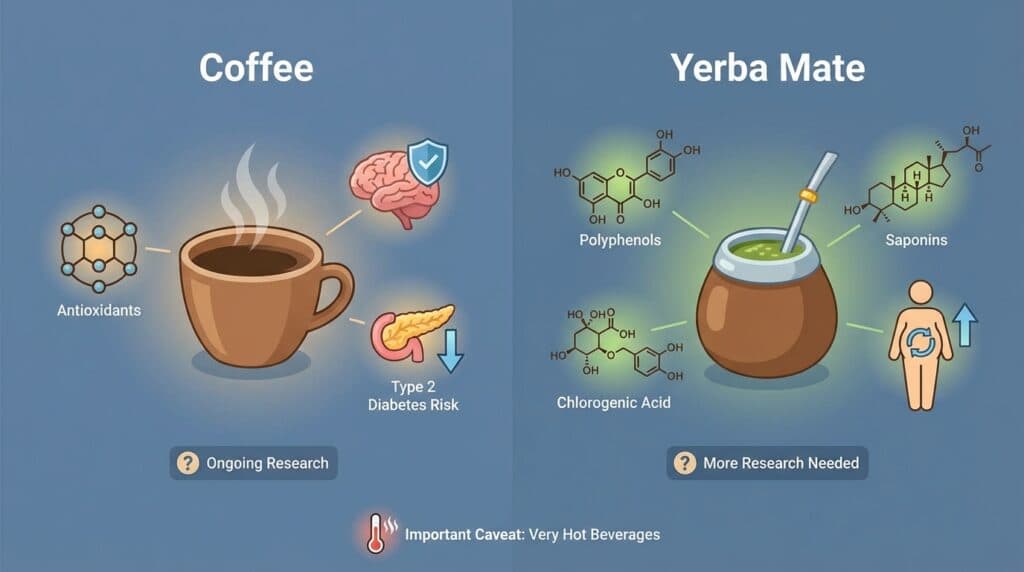
Very hot drinks. In 2016 the International Agency for Research on Cancer (IARC), the World Health Organization’s cancer agency, classified drinking very hot beverages, above 65 °C, as probably carcinogenic to humans (Group 2A), based on limited evidence for cancer of the oesophagus. It noted that mate is traditionally drunk very hot, at about 70 °C. Drinking mate at temperatures that are not very hot was not classifiable as to its carcinogenicity (Group 3). The same evaluation found no conclusive evidence for a carcinogenic effect of drinking coffee. IARC’s director summarised that it is the temperature, rather than the drinks themselves, that appears to be responsible. Letting either drink cool before you sip is the practical takeaway from that finding.
Other health claims. The 2007 review notes epidemiological studies linking mate drinking with some cancers, while IARC’s 2016 evaluation points to very hot temperature rather than mate itself. None of this makes either drink a treatment. If you are concerned about a medical condition or medication, or are pregnant, trying to become pregnant or breastfeeding, the FDA recommends talking to your health care provider about whether to limit caffeine.
Who Should Choose What
Yerba mate may suit you if:
- you like sipping one drink slowly over a long stretch;
- you want caffeine from something other than coffee;
- you can keep track of refills, since each one adds caffeine.
Coffee may suit you if:
- you prefer a single, measured serving;
- you want to estimate your caffeine from published per-cup figures;
- you enjoy the range of roasts and brewing methods.
Frequently Asked Questions
Does yerba mate have more caffeine than coffee?
Per cup, no clear winner: the 2007 review gives about 78 mg for a 150 mL cup of mate against about 85 mg for a cup of coffee, and the 2021 review gives about 80 mg for a similar cup of mate. Per traditional session, mate can be higher, at 260 mg or more for around 500 mL.
How much caffeine is in yerba mate per 8 oz?
No source here measures an 8 oz serving. Scaling the review’s 78 mg per 150 mL gives roughly 125 mg for 240 mL, but the real figure depends on how much leaf you use and how hot the water is.
How much caffeine is in Club-Mate compared with coffee?
Club-Mate Original is labelled at 20mg per 100ml, so 100 mg in 500 ml by arithmetic, which is close to a cup of coffee at EFSA’s 90mg per 200 ml.
Is mate safer than coffee during pregnancy?
Mate contains caffeine, and EFSA’s 200mg daily figure for pregnancy covers caffeine from all sources. Club-Mate’s own label says it is not recommended for pregnant or breastfeeding women. Ask your doctor or midwife before switching.


Comments