


Table of Contents
- Why Grind Size Actually Matters
- Fixing Bitter Coffee with Grind Adjustments
- Other Culprits Behind Bitterness
- Fixing Sour Coffee by Going Finer
- The Under-Extraction Checklist
- What About Weak, Watery Coffee?
- Myth vs. Reality: Grind Size Edition
- A Simple Troubleshooting Framework
- Quick Reference: Grind Adjustments by Symptom
- Key Takeaways
There’s this particular smell—sharp, almost burnt—that hits you when you’ve ground your beans way too fine for a French Press. I know it well. If your morning cup tastes like you’re chewing on grapefruit peel or drinking liquid charcoal, the fix is probably sitting right inside your grinder settings. Learning how to use grind size to fix bitter, sour or weak coffee at home changed everything for me, and honestly, it’s simpler than most guides make it sound.
The short version: Bitter coffee usually means your grind is too fine. Sour coffee? Too coarse. Weak and watery? That’s often a ratio problem disguised as a grind problem. Let me break this down.
Why Grind Size Actually Matters
Coffee extraction is just water pulling flavor compounds out of ground beans. That’s it. But here’s where people get tripped up: the size of those grounds determines how fast or slow that extraction happens.
Fine grounds = more surface area = faster extraction.
Coarse grounds = less surface area = slower extraction.
When water extracts too much from the coffee (over-extraction), you get bitterness, harshness, and that dry feeling on your tongue. When it extracts too little (under-extraction), you get sour, acidic, thin-tasting coffee that makes you wince.
I ruined probably thirty cups before this clicked for me. Thirty. My partner started hiding the “good” beans because I kept wasting them on experiments gone wrong.
Fixing Bitter Coffee with Grind Adjustments

Bitter coffee is the most common complaint I hear. It tastes harsh, ashy, maybe even a little hollow. Your tongue feels like it’s been scraped.
The cause: Over-extraction. Your water pulled out too many compounds, including the unpleasant ones that come out last.
The fix: Go coarser. One notch at a time.
Here’s what I do: if my pour-over tastes bitter, I’ll adjust my grinder exactly two clicks coarser and brew again with the same recipe. Same 15g of coffee, same 250ml of water, same 93°C temperature. The only variable I change is grind size. This way, I know exactly what caused the improvement.
Barista Tip: If you’re using a blade grinder, you’re fighting an uphill battle. Those things produce a mix of powder and boulders, which means some particles over-extract while others under-extract simultaneously. A decent burr grinder—even a $40 hand grinder—makes troubleshooting actually possible.
Frankly, I hate to admit it, but I used a blade grinder for two years before upgrading. The difference was embarrassing.
Other Culprits Behind Bitterness
Before you blame grind size entirely, check these:
- Water too hot: Anything above 96°C can scorch your coffee. Aim for 92°C-96°C.
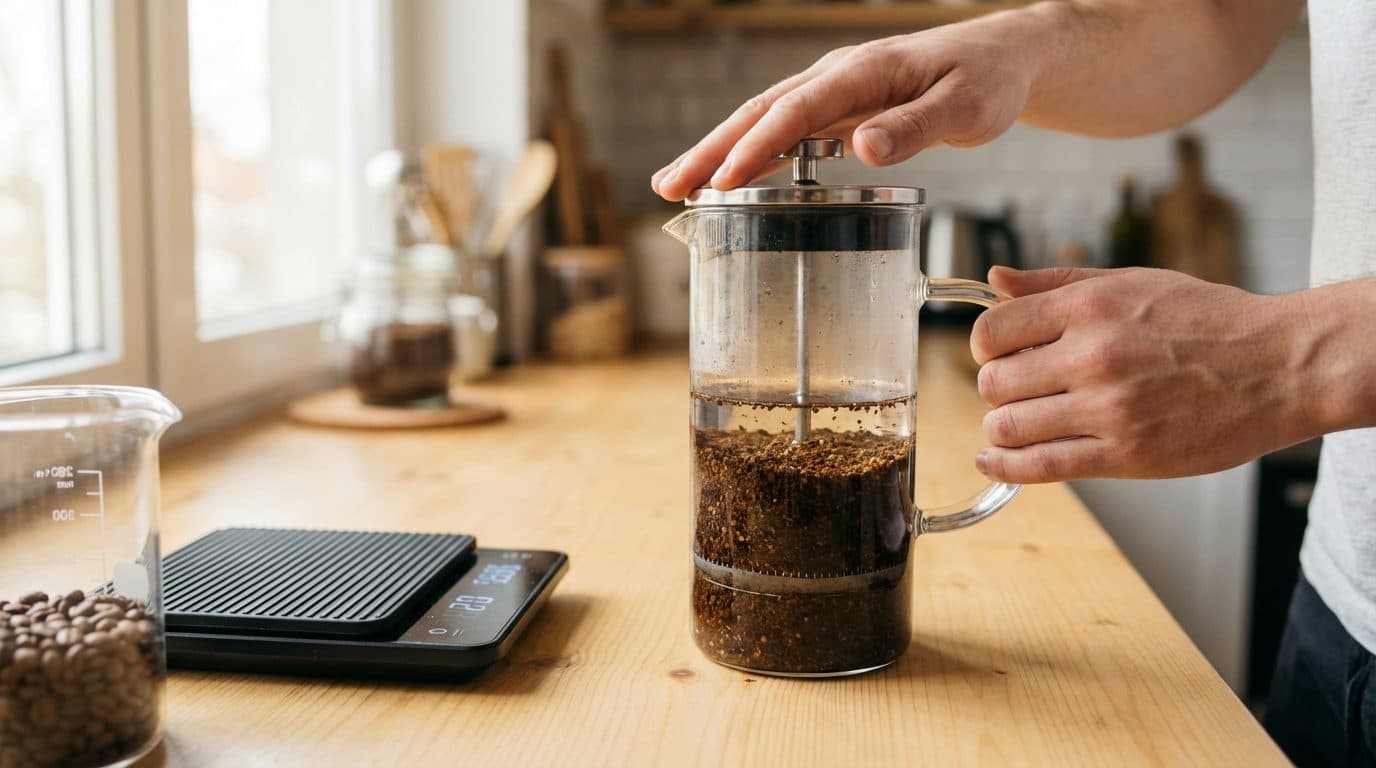
- Brew time too long: If your French Press steeps for 6 minutes instead of 4, you’re over-extracting regardless of grind.
- Stale beans: Old coffee often tastes bitter and flat. If your bag has been open for three weeks, that might be your real problem.
Fixing Sour Coffee by Going Finer

Sour coffee is sneaky. People sometimes confuse it with “bright” or “acidic” specialty coffee, but there’s a difference. Good acidity tastes like citrus or berries. Bad sourness tastes like biting into an unripe lemon. Sharp. Unpleasant. Makes your face scrunch up.
The cause: Under-extraction. Water didn’t pull enough sweetness and body from the grounds to balance the acids that extract first.
The fix: Go finer. Again, one adjustment at a time.
I learned this the hard way with a light-roasted Ethiopian I bought last spring. Beautiful floral notes on the bag description. In my cup? Pure vinegar vibes. I was ready to blame the roaster until my friend Sarah (who’s way more patient than me) suggested I grind finer. Three adjustments later, I finally tasted those blueberry notes everyone raves about.
The Under-Extraction Checklist
- Grind too coarse: Most common issue. Go finer.
- Water too cool: Below 90°C won’t extract properly. Use hotter water.
- Brew time too short: Rushing your pour-over or pulling your French Press plunger early? Give it more time.
- Not enough coffee: A weak ratio (like 10g coffee to 250ml water) can taste sour because there’s not enough material to extract from.
What About Weak, Watery Coffee?
This one’s tricky. Weak coffee isn’t always a grind problem.
Sometimes it’s under-extracted (grind too coarse), but more often it’s a ratio issue. You’re simply not using enough coffee for the amount of water.
Start here: A 1:15 to 1:17 ratio works for most methods. That’s 15-17 grams of water for every 1 gram of coffee. So for a 300ml cup, you’d use about 18-20g of coffee.
If your ratio is solid and coffee still tastes weak and watery, then yes—try grinding finer to increase extraction. But don’t skip the ratio check. I see people grinding finer and finer, chasing body, when they really just need to add another 3 grams of beans.
Myth vs. Reality: Grind Size Edition

Myth: “There’s one perfect grind size for each brew method.”
Reality: Grind size depends on your specific grinder, your beans, your water, and your taste preferences. “Medium-coarse for pour-over” is a starting point, not a rule. I adjust my grind for every new bag of coffee I buy.
Myth: “Finer grind always means stronger coffee.”
Reality: Finer grind means more extraction, which can increase intensity—but go too fine and you’ll get bitter, astringent coffee that tastes worse, not stronger. Strength comes from your coffee-to-water ratio.
Myth: “Pre-ground coffee is fine for troubleshooting.”
Reality: You can’t troubleshoot what you can’t adjust. Pre-ground locks you into one particle size. If that size doesn’t work for your setup, you’re stuck. Grinding fresh gives you control.
A Simple Troubleshooting Framework
Here’s the ugly truth: most people overcomplicate this. When your coffee tastes off, ask yourself two questions:
- Is it bitter or sour? Bitter = go coarser. Sour = go finer.
- Is it weak? Check your ratio first. Then adjust grind if needed.
That’s genuinely 80% of home coffee troubleshooting. The other 20% involves water quality, freshness, and brew temperature—but grind size is your biggest lever.
Quick Reference: Grind Adjustments by Symptom
| Symptom | Likely Cause | Grind Adjustment |
|---|---|---|
| Bitter, harsh, ashy | Over-extraction | Go coarser |
| Sour, sharp, acidic | Under-extraction | Go finer |
| Weak, watery, thin | Under-extraction or low ratio | Check ratio first, then go finer |
| Both bitter AND sour | Uneven extraction (inconsistent grind) | Improve grinder or technique |
Key Takeaways
- Bitter coffee → grind coarser to reduce extraction
- Sour coffee → grind finer to increase extraction
- Weak coffee → check your coffee-to-water ratio before adjusting grind
- Change one variable at a time so you know what actually fixed the problem
- A burr grinder makes troubleshooting possible; blade grinders make it frustrating
- There’s no universal “correct” grind—adjust based on taste, not charts
Honestly, once you understand the bitter-sour spectrum, coffee stops being mysterious. It becomes a puzzle you can actually solve. My mornings got so much better once I stopped guessing and started adjusting with intention. Yours will too.
Start with your next brew. If something tastes off, make one small grind adjustment and try again. You’ll dial it in faster than you think.

Comments