


Table of Contents
- Making a Coffee Ground Scrub That Won't Wreck Your Skin
- How to use it, following the AAD's tips
- Coffee Grounds for Plants: What Actually Helps (and What Doesn't)
- Myths and what the extension sources say
- Composting: the lowest-risk route
- Using grounds directly in beds
- Using Coffee Grounds as a Natural Deodorizer
- What NOT to Do with Coffee Grounds
- Storing Your Grounds for Later Use
- Frequently Asked Questions
- Are used coffee grounds good for plants?
- Do coffee grounds make soil more acidic?
- Do coffee grounds keep slugs away?
- Is a coffee scrub safe for the face?
- Can I rinse leftover grounds down the sink?
Used coffee grounds have three realistic second lives at home: a gentle body scrub, a garden amendment, and a dry odor absorber. Each works only within limits. Oregon State University (OSU) Extension soil scientist Linda Brewer calls grounds a fine garden amendment that is often overdone, dermatologists say any scrub should be used gently and not on broken or sunburned skin, and wastewater utilities ask that grounds never go down the drain. This guide sets out what each use can and cannot do, based on those sources.
One thing to settle first: grounds are wet and perishable straight out of the brewer. OSU notes that mold may grow on stored grounds, and the National Coffee Association (NCA) points out that coffee absorbs moisture as well as odors from the air around it. The scrub and the deodorizer start with grounds that are either fresh from today’s brew or properly dried; compost is more forgiving.
Making a Coffee Ground Scrub That Won’t Wreck Your Skin
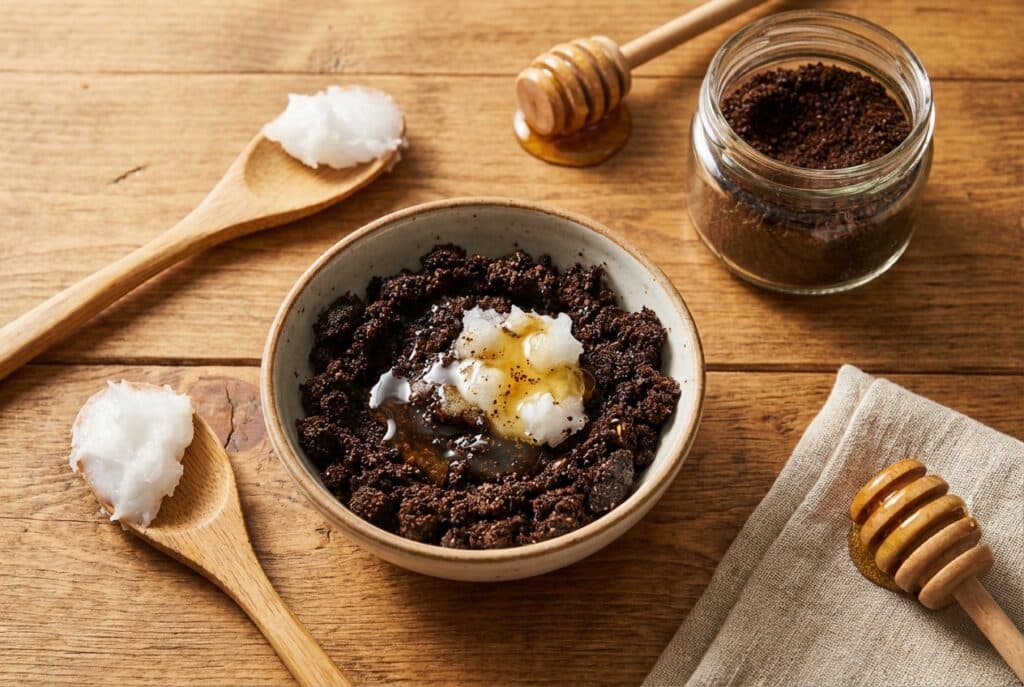
A coffee scrub is a form of what the American Academy of Dermatology (AAD) calls mechanical exfoliation: using a tool, such as a brush or sponge, or a scrub to physically remove dead skin cells. The AAD does not address coffee scrubs specifically, but its general tips for using a scrub safely are a sensible guide for a homemade one too.
A simple version is cooled, used grounds stirred into enough plant oil to form a paste you can spread. Make only what you will use in one go, because a wet mix of grounds sits in exactly the conditions that let mold grow.
How to use it, following the AAD’s tips
- Check what else you use on your skin. The AAD warns that prescription retinoid creams and products containing retinol or benzoyl peroxide can make skin more sensitive, and exfoliating on top of them may worsen dry skin or cause breakouts.
- Match the method to your skin. The AAD says people with dry, sensitive or acne-prone skin may prefer just a washcloth and a mild chemical exfoliator, because mechanical exfoliation may be too irritating for them. It also advises avoiding strong mechanical exfoliation if you have a darker skin tone or notice dark spots after burns, bug bites or acne, since aggressive exfoliation can lead to increased pigmentation.
- Be gentle. Apply the scrub in small, circular motions for about 30 seconds, then rinse with lukewarm, not hot, water.
- Skip damaged skin. The AAD says never to exfoliate over open cuts or wounds or sunburned skin.
- Moisturize afterward. Exfoliation can be drying, so the AAD recommends moisturizer immediately after.
- Do not overdo it. The more aggressive the exfoliation, the less often it needs doing; over-exfoliating can leave skin red and irritated.
The AAD notes that exfoliation is not for everyone and, done badly, can do more harm than good. And none of the sources here support claims that a coffee scrub reduces cellulite.
There is also a plumbing problem with scrubbing in the shower. Madison Utilities lists coffee grounds, and grease, fats or cooking oil, among the things never to flush or pour down the drain, and says even small amounts can accumulate over time and block pipes. Rinsing off a coffee-and-oil scrub sends both into the drain. Wipe off as much as you can with a cloth you shake out over the trash, and use a drain strainer, which Madison recommends for sink and floor drains; if you want to follow the utility guidance fully, choose a different exfoliant. Oil left on the tub or shower floor can also make it slippery, so rinse the floor afterward.
Coffee Grounds for Plants: What Actually Helps (and What Doesn’t)
The garden is where the most myths collect. Two extension publications cover it in detail: an OSU news story quoting OSU Extension soil scientist Linda Brewer, and Washington State University (WSU) Extension fact sheet FS207E, “Using Coffee Grounds in Gardens and Landscapes,” by Dr. Linda Chalker-Scott. Brewer’s summary is blunt: “The big message is that generally people are too enthusiastic.”
Myths and what the extension sources say
| Common claim | What the sources say |
|---|---|
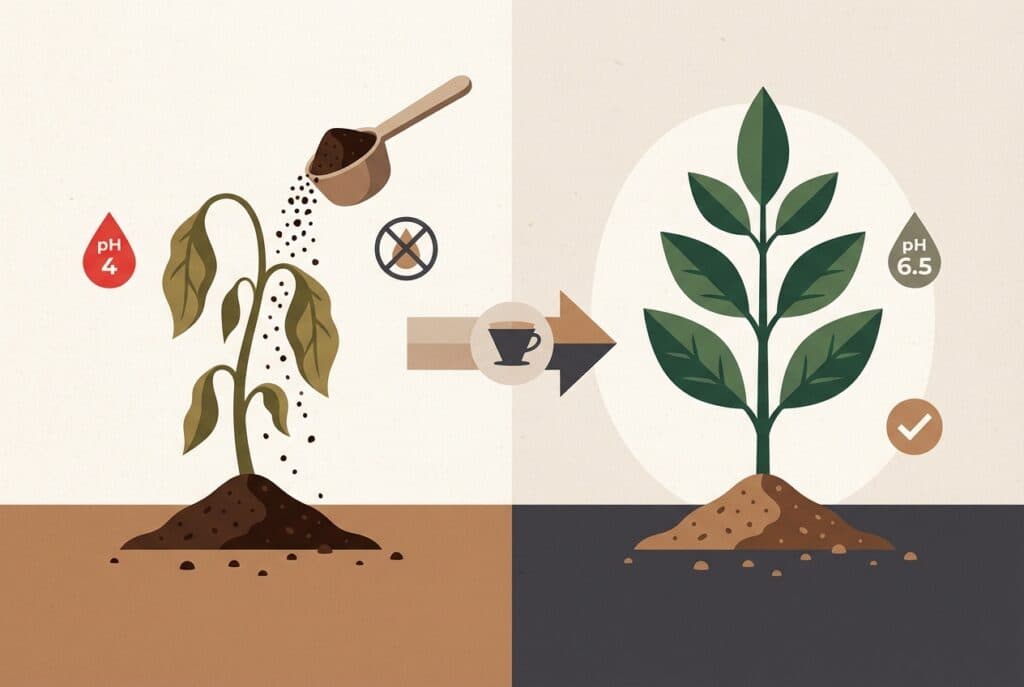
| Used grounds are acidic and will lower soil pH for acid-loving plants | OSU calls this a myth: after brewing, grounds are close to pH neutral, between 6.5 and 6.8, and will not keep soil pH low for plants such as rhododendrons, azaleas and blueberries. WSU adds that composting studies have reported pH from mildly acidic to somewhat alkaline, so you should not assume grounds will always, or ever, be acidic. |
| Grounds are a fertilizer | OSU: grounds provide some nitrogen (1% to 2%) and minor amounts of other nutrients, but not in quantities that satisfy plant needs. Their main value is improving soil structure and drainage. |
| Grounds repel slugs and other pests | WSU: there is no published evidence that coffee grounds will repel or kill any garden pests. |
| Grounds attract earthworms | WSU: there is no science-based information on their ability to attract pests or beneficial animals like earthworms, although earthworms do use grounds as food. |
| More is better | OSU: Brewer has seen a raised bed ruined by too many grounds. Excess grounds tie up nitrogen while they break down, and caffeine residues can suppress germination and slow the growth of some plants. |
Composting: the lowest-risk route
Both sources put the ceiling at the same figure. WSU says to use no more than 20 percent coffee grounds by volume in a compost pile, and OSU says the pile should not exceed 20% coffee grounds by volume or it can be toxic to plants. OSU’s suggested layering is 3 parts leaves to 1 part fresh grass clippings to 1 part coffee grounds by volume; coffee filters can go in too. Turn the pile once a week and watch the moisture, and OSU says the compost will be ready in three to six months.
WSU adds two cautions: let grounds cool before adding them, because heat can kill beneficial microbes, and avoid adding coffee grounds to vermicomposting (worm) bins, where they can injure or kill earthworms in the confined space.
Using grounds directly in beds
The two extension sources differ on uncomposted grounds, so follow the more cautious one if you are unsure.
- As a soil amendment. OSU’s Brewer recommends working in a half inch of grounds to a depth of 4 inches, and adding a nitrogen source such as composted manure, alfalfa meal or grass clippings to offset the nitrogen tied up as the grounds break down. WSU is stricter: in general, only composted grounds should be worked into soil, because fresh grounds are more likely to be harmful to plants.
- As a mulch. WSU says to apply no more than half an inch of grounds and cover it with about four inches of coarse organic mulch such as wood chips. Thick layers of grounds on their own compact and can interfere with moisture and air movement in the soil. OSU likewise suggests a layer of leaves or bark mulch over grounds to stop them drying out and repelling water.
- Not near seeds. WSU advises against using grounds where you are growing plants from seed, because reduced germination and growth have been observed in experiments, and recommends keeping fresh grounds away from direct contact with plant roots.
If you have an espresso machine, the same rules apply to the pucks you collect; the knock box guide covers collecting them and applies the same OSU compost limits.
Using Coffee Grounds as a Natural Deodorizer
The deodorizer idea rests on a property the NCA describes when it explains why coffee should be stored airtight: coffee absorbs and retains moisture, odors and tastes from the air around it. The NCA adds that many people recommend using coffee as a natural air freshener. None of the sources here measure how well spent grounds remove odors, so treat this as a low-cost household practice rather than a tested product.
The same moisture-absorbing property is why the grounds must be dry. Damp grounds left in a container can grow mold, which OSU notes can happen to stored grounds. A practical routine:
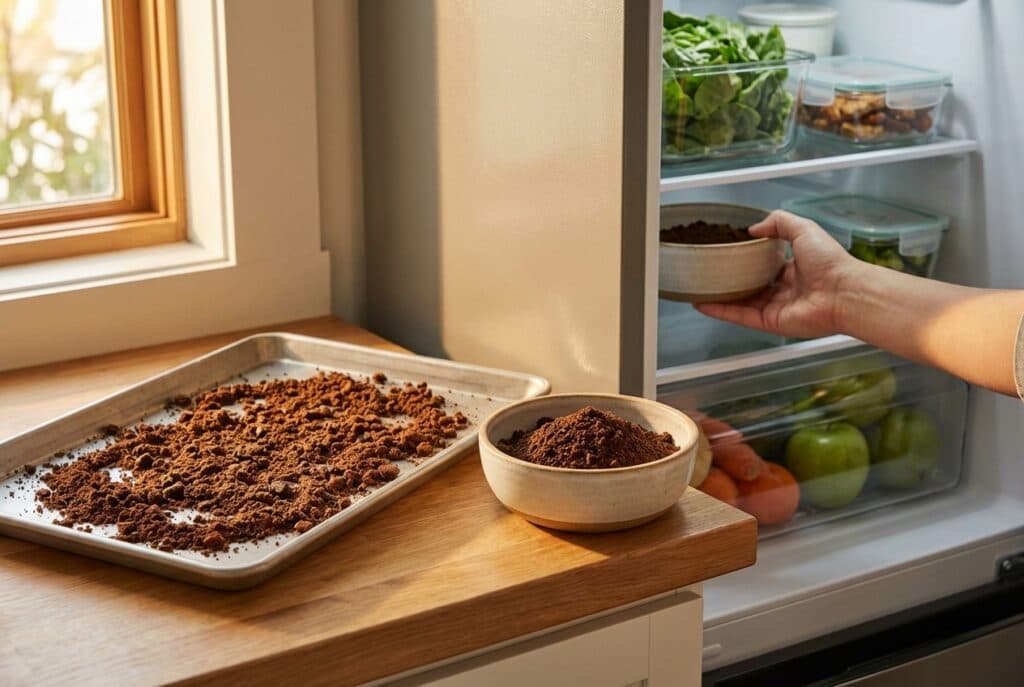
- Spread the grounds in a thin layer on a tray and let them dry fully, until they are loose and crumbly rather than clumped.
- Put them in an open dish, or a jar with a perforated lid, where the smell is: the refrigerator, a cupboard, the bottom of a trash can under the bag.
- Replace them when they start to clump or look damp, or as soon as you see any mold.
- Remove the source of the smell as well; an absorber in a refrigerator does nothing about spoiled food left inside it.
Dried grounds tied into a thin cloth pouch can go in shoes overnight on the same principle. Keep the pouch dry and empty it into the trash or compost when it is spent.
What NOT to Do with Coffee Grounds
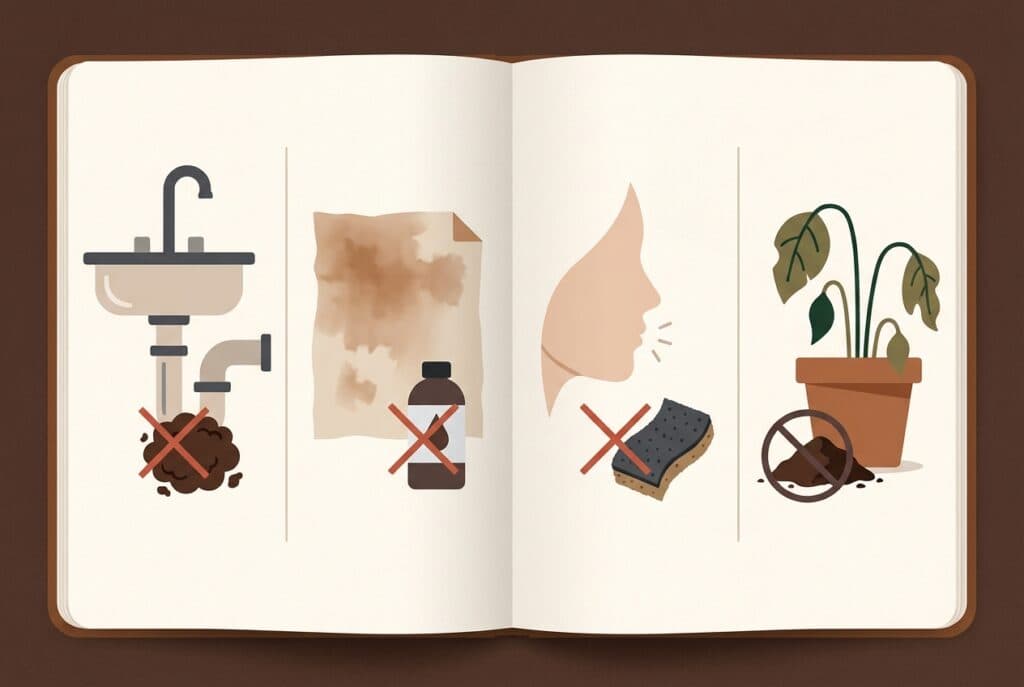
- Do not pour them down the drain. Madison Utilities lists coffee grounds, food waste and eggshells among items never to flush or pour, and says even small amounts can accumulate over time and block pipes.
- Do not use them as a stand-alone mulch. WSU says thick layers of grounds compact and can interfere with moisture and air movement in soils.
- Do not rely on them to acidify soil. OSU says used grounds are close to pH neutral and any change they bring is short-lived.
- Do not put them in a worm bin. WSU warns they can injure or kill earthworms in the confined space of a vermicomposting bin.
- Do not use them where you are starting seeds. WSU reports reduced germination and growth in experiments with grounds as an amendment or mulch.
- Do not scrub sunburned or broken skin. The AAD says never to exfoliate over open cuts, wounds or sunburn.
Storing Your Grounds for Later Use
If you are collecting grounds over several days, OSU’s advice for grounds from coffee shops applies at home: store them tightly covered until you are ready to use them. Mold may still grow, but OSU notes that moldy grounds can be composted, where the mold contributes to decomposition. Moldy grounds are not suitable for a skin scrub or a deodorizer dish, so for those uses start with today’s grounds or a batch you dried straight away.
Which storage route to take depends on the use:
- For compost: a covered container is enough; the pile does the rest.
- For a deodorizer: dry the grounds fully first, then keep them in a closed container until needed.
- For a scrub: use cooled grounds from the same day and mix only one application at a time.
Frequently Asked Questions
Are used coffee grounds good for plants?
In moderation. OSU says grounds are best at improving soil structure and drainage, not at feeding plants, and WSU says that when used properly they can supply nutrients and other benefits. Both cap compost at 20 percent grounds by volume.
Do coffee grounds make soil more acidic?
Not reliably. OSU puts brewed grounds at pH 6.5 to 6.8, close to neutral, and WSU says decomposing grounds have measured anywhere from mildly acidic to somewhat alkaline.
Do coffee grounds keep slugs away?
WSU’s fact sheet says there is no published evidence that coffee grounds repel or kill any garden pests.
Is a coffee scrub safe for the face?
The AAD says people with dry, sensitive or acne-prone skin may find mechanical exfoliation too irritating, and that strong mechanical exfoliation should be avoided by people with darker skin tones or a tendency to dark spots. If you are unsure of your skin type, the AAD suggests asking a board-certified dermatologist.
Can I rinse leftover grounds down the sink?
No. Wastewater utilities such as Madison Utilities list coffee grounds among items never to pour down the drain. Put them in the trash, the compost or a covered collection container.




Comments