


Table of Contents
- Why Instant Coffee Suits Iced Drinks
- Gear and Ingredients You'll Need
- How to Make Instant Iced Coffee: Step by Step
- Quick method (a few minutes)
- Make-ahead method (Nescafé's recipe)
- Expected Taste Profile
- Variations
- Troubleshooting Common Problems
- How Much Caffeine Is in Instant Iced Coffee?
- Frequently Asked Questions
- How do you make iced coffee at home without a machine?
- Can you make iced coffee with instant coffee and cold water only?
- Can you make cold brew with instant coffee?
- Can I make a batch ahead of time?
To make iced coffee at home with instant coffee, dissolve the granules in a small amount of hot water first, then add cold water or milk and ice. That order is the National Coffee Association’s own advice for instant iced coffee, and it is the main thing that separates a smooth glass from one with undissolved grit at the bottom. No machine, filter or grinder is needed. Daily Home Coffee does not test products; the amounts below come from the NCA, Nescafé’s published recipe and USDA nutrient data, or from the arithmetic of the recipe.
Why Instant Coffee Suits Iced Drinks
Instant coffee is already brewed. The NCA describes it as real coffee that is roasted, brewed much stronger than home coffee, and then dehydrated, either by freezing at -40 °C (freeze-dried granules) or by spraying into very hot air (spray-dried powder). Because the brewing has already happened, all you are doing at home is dissolving it, which is why the method takes minutes rather than the hours a cold brew steep needs.
The catch is that it dissolves best in hot water. The NCA’s guidance is to “first dissolve the instant coffee in a small amount of hot water to allow for better dissolution, then add ice and cold water.” It also notes that some instant coffees are sold to dissolve in colder water; if your jar says so, follow its label.
Gear and Ingredients You’ll Need
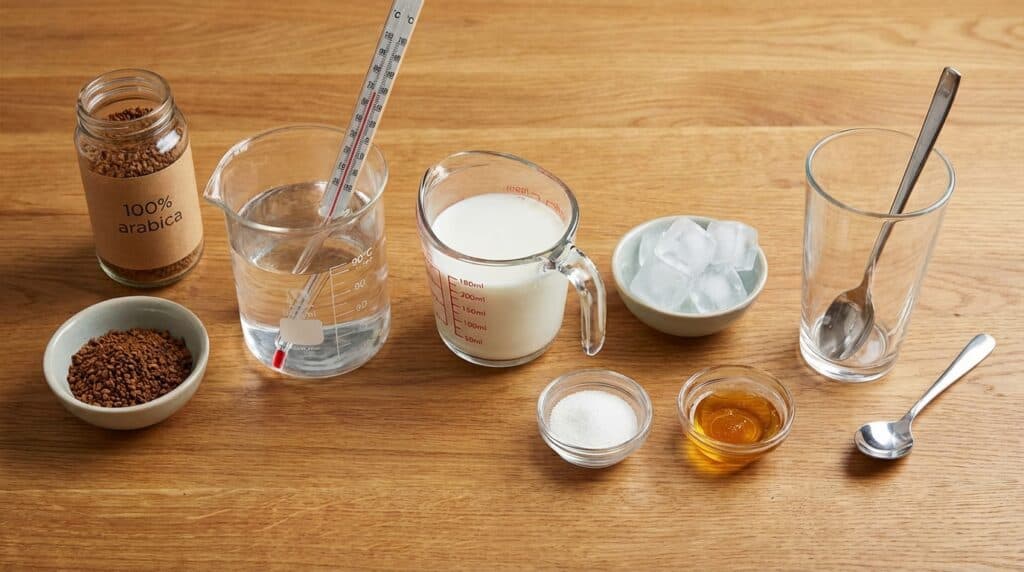
Nescafé’s UK iced coffee recipe uses kitchen basics only:
- 2 teaspoons of instant coffee
- 200 ml hot water, freshly boiled but no longer boiling
- About 50 ml milk or a milk alternative, or none for black iced coffee
- Ice
- Syrup or sugar, to taste
- A tall glass and a long spoon
For strength, the NCA’s general ratio for instant coffee is 1 teaspoon of granules per 6 ounces of hot water, at around 80 °C, slightly below boiling. Nescafé’s recipe uses 2 teaspoons for 200 ml of water, which is 1 teaspoon per 100 ml, a stronger mix than the NCA’s 1 teaspoon per 6 ounces (about 177 ml) for a hot cup.
How to Make Instant Iced Coffee: Step by Step
There are two ways to do it. The quick version follows the NCA’s order; the make-ahead version follows Nescafé’s recipe and avoids pouring hot liquid over ice.
Quick method (a few minutes)
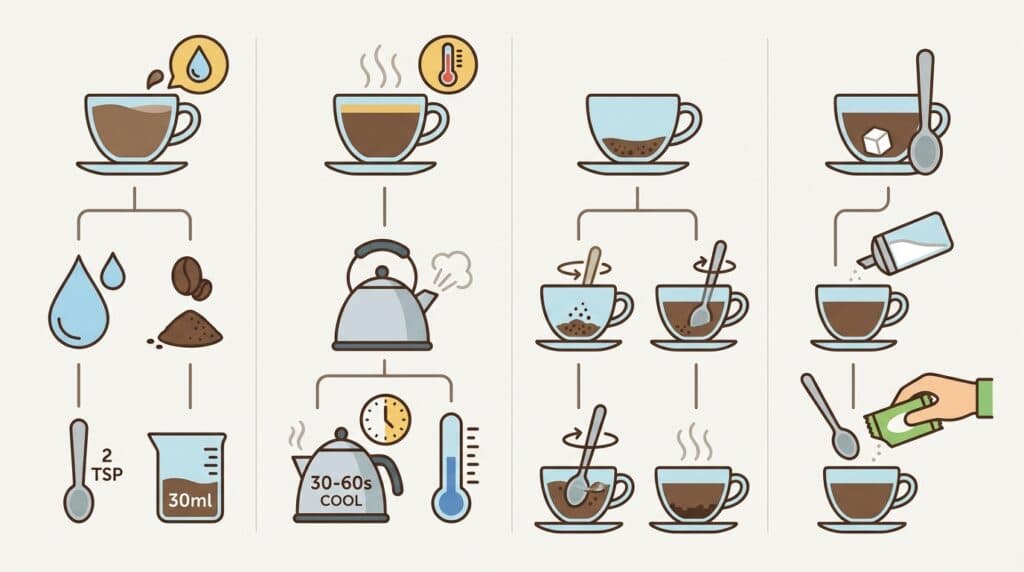
- Put the instant coffee in the glass. Start with 1 to 2 teaspoons, depending on how strong you like it.
- Add a small splash of hot water and stir until fully dissolved. Water slightly below boiling, around 80 °C, is the NCA’s figure for instant. Check the bottom of the glass for undissolved granules before going on.
- Stir in any sugar now. It dissolves in the hot coffee; granulated sugar does not dissolve easily in a cold drink.
- Add ice, then cold water or milk. Top up to taste and stir.
- Taste and adjust. Too strong, add a splash of cold water or milk. Too weak, use more coffee next time rather than less water up front.
Make-ahead method (Nescafé’s recipe)
- Pour 200 ml of freshly boiled, no longer boiling, water into the glass.
- Stir in 2 teaspoons of instant coffee, plus sugar or syrup if you want it.
- Let it cool to room temperature on the counter, or chill it in the fridge for a few hours.
- Add around 50 ml of milk or a milk alternative, or skip it for black coffee.
- Fill the rest of the glass with ice.
Nescafé also suggests making the coffee the night before and chilling it overnight, so it is cold in the morning. Because the coffee goes in cold, the ice melts more slowly than it would under a hot mix.
Expected Taste Profile

The taste depends mostly on which instant coffee you buy. The NCA notes that instant can be made from light, medium or dark roasts, so the label on the jar is the best guide to what the glass will taste like. Milk softens the result, and the more ice melts into the glass, the weaker and thinner it gets.
Variations
- Black iced coffee: skip the milk step, as Nescafé’s recipe allows for black coffee.
- Dairy-free: swap the milk for a plant milk; Nescafé’s recipe treats a milk alternative as a straight substitute.
- Sweetened: use syrup rather than granulated sugar if the coffee is already cold. Granulated sugar does not dissolve easily in cold drinks, while a syrup is already liquid.
- Coffee ice cubes: freeze some made-up instant coffee in an ice tray. Nescafé suggests ice cubes made from coffee so the drink does not dilute as they melt.
Troubleshooting Common Problems
| Problem | Likely cause | What to change |
|---|---|---|
| Grit at the bottom | Granules added straight to cold liquid | Dissolve in a little hot water first |
| Watery, weak glass | Too little coffee, or ice melting into a hot mix | More coffee, or cool the coffee before adding ice |
| Sugar will not dissolve | Granulated sugar in a cold drink | Add it while the coffee is hot, or use syrup |
| Weaker by the end of the glass | Plain ice melting | Use coffee ice cubes |
How Much Caffeine Is in Instant Iced Coffee?
USDA FoodData Central gives a measured figure for one generic product, not for every brand. Its entry for regular instant coffee powder lists 3,142 mg of caffeine per 100 g and a portion of 1 teaspoon = 1.0 g, which works out to about 31 mg per teaspoon by that measure. Its entry for regular instant coffee prepared with water lists 26 mg per 100 g and a 6 fl oz serving of 179 g, or about 47 mg for a 6 fl oz cup of instant made with water. For this recipe, the powder figure is the better guide: the 1 to 2 teaspoons used here come to about 31 to 63 mg (2 × 31.42 mg = 62.8 mg).
Brands differ, and a heaped teaspoon weighs more than a level one, so treat those numbers as a reference point rather than a count for your jar. The label is the better guide when it gives a caffeine figure. Decaffeinated instant is the low-caffeine option: USDA lists 1.0 mg per 100 g for decaf instant prepared with water.
Frequently Asked Questions
How do you make iced coffee at home without a machine?
Instant coffee needs no equipment at all. Dissolve 1 to 2 teaspoons in a little hot water, stir until no granules remain, then add ice and cold water or milk. For brewed coffee without a machine, cold brew made in a jar is the other option, but it has to steep for hours.
Can you make iced coffee with instant coffee and cold water only?
Only with instant coffees made for it. The NCA says some products allow you to “simply add colder water and ice”; ordinary instant dissolves better if you start it in a small amount of hot water.
Can you make cold brew with instant coffee?
Not in the usual sense. Nescafé describes cold brew as made without any heat at all, while instant coffee has already been brewed and dried. Mixing instant into cold water gives you iced instant coffee, not cold brew. For the real thing, see the cold brew concentrate recipe.
Can I make a batch ahead of time?
Yes. Nescafé suggests making the coffee the night before and chilling it in the fridge. Add milk and ice when you pour. Once a glass is poured, with or without milk, apply the USDA’s general rule for perishable food: do not leave it out of refrigeration for more than 2 hours, or more than 1 hour above 90 °F. Applying that rule to a poured glass is this site’s reasoning rather than a coffee-specific USDA rule.


Comments