


Table of Contents
- What You'll Need
- The Perfect Cold Brew Concentrate Ratio
- Taste Profile to Expect
- How to Dilute Cold Brew Concentrate Step by Step
- Adjusting Your Ratio for Different Drinks
- Classic Iced Cold Brew
- Cold Brew with Milk
- Hot Cold Brew (Yes, It's a Thing)
- Cold Brew Cocktails and Mocktails
- Common Mistakes When Diluting Cold Brew
- Frequently Asked Questions
- Can I dilute cold brew concentrate with hot water?
- How long does diluted cold brew last in the fridge?
- Why does my diluted cold brew taste watery?
- Is there a difference between diluting with water versus milk?
- What's the caffeine content after diluting?
- Summary and Your Next Step
Start with one part cold brew concentrate to two parts water, taste, and adjust from there. For a stronger glass, move to one part concentrate to one part water; for a longer, lighter drink, try one to three. Concentrate is meant to be thinned: the National Coffee Association describes it as “designed to be diluted with water or enjoyed with ice, even as it melts” (NCA cold brew guide).
Below: the starting ratios, what they mean on paper for a 1:4 or 1:5 batch, how to adjust for water, milk, ice and hot water, and why only the glass should be diluted, never the whole jar. Daily Home Coffee does not test products; the figures here come from the named sources or from the arithmetic of a recipe.
What You’ll Need
A measuring cup or kitchen scale, a glass and a spoon. A scale makes the first few glasses repeatable, which is what lets you settle on a ratio instead of guessing each morning.
Ingredients:
- Cold brew concentrate, homemade or store-bought
- Cold filtered water, milk, or a plant milk
- Ice, if you want an iced drink
- Sweetener, if you use one
The Perfect Cold Brew Concentrate Ratio

There is no single correct dilution, because concentrates are brewed at different strengths. The NCA gives 1 gram of coffee to 4-5 grams of water (1:4 to 1:5) for cold brew, steeped for around 12 hours. For a batch made in that range, 1:2 is a sensible place to start, with 1:1 for a stronger glass and 1:3 for a lighter one, the same starting points as the cold brew concentrate recipe.
The table shows what each dilution works out to on paper, counting the coffee that went into the batch against all the water that ends up in the glass. Coffee grounds hold back some of the brewing water, so the real drink comes out somewhat stronger than these figures, but the comparison between rows still holds.
| Concentrate brewed at | Dilution (concentrate : water) | Coffee to total water, on paper |
|---|---|---|
| 1:4 | 1:1 | About 1:8 |
| 1:4 | 1:2 | About 1:12 |
| 1:5 | 1:1 | About 1:10 |
| 1:5 | 1:2 | About 1:15 |
The arithmetic is simple. A 1:4 batch made with 200 g of coffee and 800 g of water, diluted 1:1, adds another 800 g of water across the batch, so 200 g of coffee ends up spread over 1,600 g of water, or 1:8. Diluting the same batch 1:2 adds 1,600 g, giving 1:12.
If you do not know how strong a store-bought concentrate is, follow the dilution printed on the bottle first. If there is none, start at 1:2 and taste before adding more water: thinning a strong glass is easy, while rescuing a watery one means pouring in more concentrate.
Taste Profile to Expect
The NCA says brewing without heat over a longer time gives “a smoother, more mellow cup” and that cold brew “offers a less bitter, smoother taste” than iced coffee. Which flavours you notice still depends on the beans. If a glass tastes harsh at 1:1, try 1:2 or 1:3 before blaming the beans; if it still tastes harsh, the batch itself is the problem, and dilution will not fix it.
How to Dilute Cold Brew Concentrate Step by Step

- Measure the concentrate. Pour it into the glass first. 120 ml (about 4 oz) is a convenient amount to start with because it scales easily: 240 ml of water for 1:2, 120 ml for 1:1.
- Add the diluting liquid. For 1:2, add twice the volume of cold water or milk. For a stronger 1:1, add the same volume.
- Decide on ice. Ice melts into the drink and dilutes it further. If you fill the glass with ice, use less water up front.
- Stir. Mix before the first sip so you taste the whole glass, not just the top.
- Taste and write it down. Too strong, add a splash of water. Too weak, use less liquid next time. Note the ratio that worked so the next glass starts from it.
The NCA’s advice for brewing water is to use filtered water if possible and avoid distilled or softened water. It does not address dilution water, but after a 1:1 or 1:2 dilution most of what is in the glass is that water, so the same reasoning applies to what you pour in.
Adjusting Your Ratio for Different Drinks
One jar of concentrate can be served several ways. The ratios below are starting points; change one thing at a time so you know what made the difference.
Classic Iced Cold Brew
Fill the glass with ice, then pour over concentrate and water mixed at 1:2. The ice keeps melting while you drink, so if the last third of the glass tastes thin, move to 1:1 next time rather than adding more ice.
Cold Brew with Milk
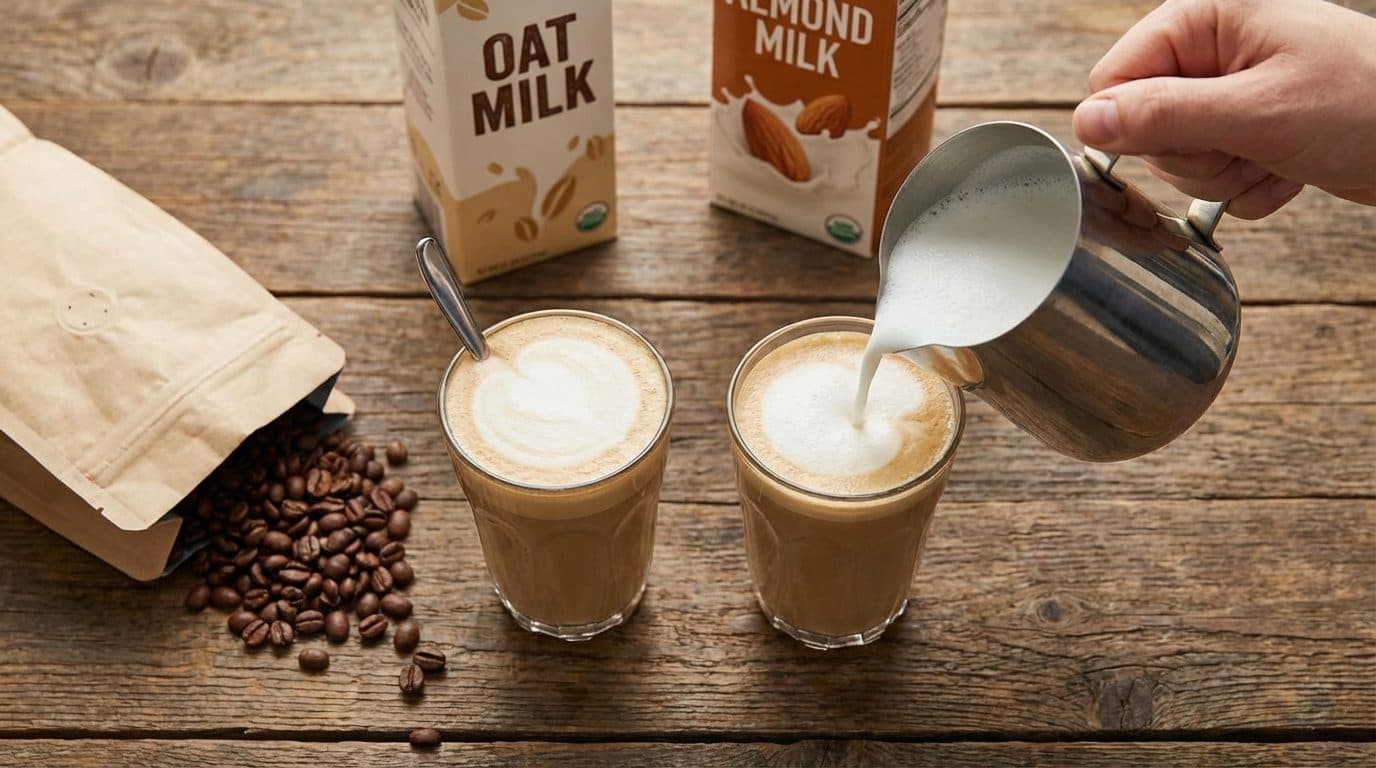
Replace some or all of the water with milk. One part concentrate to one part water and one part milk is still a 1:2 dilution overall, just creamier. Oat milk, dairy milk and other plant milks all work; the choice is a matter of taste.
Cold brew made without heat already needs refrigeration, and adding milk does not change that. The USDA’s general rule for perishable food is that it should not sit out of refrigeration for more than two hours, or one hour above 90 °F (USDA FSIS “Danger Zone”). Applying that rule to any poured glass, with or without milk, is this site’s reasoning rather than a cold-brew-specific USDA rule. Mix drinks to order rather than batching them.
Hot Cold Brew (Yes, It’s a Thing)
The NCA notes that cold brew “can be served hot or over ice”. Use 1:2 with hot water in a heat-safe mug as a starting point: the extra water both warms the concentrate and brings it closer to the strength of an ordinary cup. Cold-brewed and hot-brewed coffee from the same light-roast beans have been measured with comparable pH, ranging from 4.85 to 5.13, while the hot brews had higher total titratable acidity (Rao & Fuller, 2018). That study measured chemistry, not how the coffee feels to drink, and it is not medical advice.
Cold Brew Cocktails and Mocktails
When other ingredients add volume, use less water or none. Tonic water, a flavoured syrup or a splash of orange juice all count toward the dilution, so measure them as part of the liquid you add, not on top of it.
Common Mistakes When Diluting Cold Brew

- Forgetting about ice melt. A glass packed with ice gains water as it melts. Use less water up front, or freeze concentrate into coffee ice cubes so the melt adds coffee instead of water.
- Using one ratio for every concentrate. A 1:4 homemade batch and a store-bought concentrate can differ a lot in strength. Taste each new batch at 1:2 before settling on a ratio.
- Diluting the whole batch at once. It takes away the ability to adjust each glass and does not make the batch keep any longer, because storage time is counted from the day it was brewed.
- Ignoring the liquid in syrups. Simple syrup and flavoured syrups add volume. If you use them, cut the water slightly.
- Judging strength by colour. A dark glass is not necessarily a strong one. Measure the ratio instead of pouring until it looks right.
Frequently Asked Questions
Can I dilute cold brew concentrate with hot water?
Yes. Start at one part concentrate to two parts hot water in a heat-safe mug and adjust. The NCA notes that cold brew can be served hot or over ice.
How long does diluted cold brew last in the fridge?

Count from the day the batch was brewed, not the day you diluted it. Wisconsin’s agriculture department treats cold brew made without a heat step as a time/temperature control for safety food that needs refrigeration. Its retail guidance, written for cafés and shops, requires no HACCP plan or variance when cold brew is brewed, held and served at 41 °F or below and date-marked for no more than seven days from production (Wisconsin DATCP cold brew fact sheet). This site applies the same seven days at home as a conservative ceiling for a batch steeped and kept in the fridge; none of the sources cited here gives a keeping time for a batch steeped at room temperature. Adding water to a four-day-old concentrate gives you a four-day-old drink, so dilute only what you will drink now. The full reasoning is in the cold brew shelf life guide.
Why does my diluted cold brew taste watery?
Either the concentrate was weak to begin with or too much liquid went in, including ice melt. Move from 1:3 to 1:2, or from 1:2 to 1:1, and use coffee ice cubes in place of plain ice. If the batch itself is thin, brew the next one at the NCA’s 1:4 rather than 1:5, for example 200 g of coffee to 800 ml of water.
Is there a difference between diluting with water versus milk?
Yes. Water keeps the coffee’s own flavour in front; milk adds body and softens bitterness. The dilution ratio stays the same either way, and either way, mix to order and keep the glass cold.
What’s the caffeine content after diluting?
It depends on how much coffee went into the batch and how much concentrate you pour, so no single figure applies. Dilution does not remove caffeine; it spreads the same amount across a bigger glass. A 1:1 glass made from 120 ml of concentrate holds the same caffeine as a 1:2 glass made from the same 120 ml. In one lab comparison using a single Hawaiian Arabica coffee, at 35 g of coffee in 350 ml of water (1:10), cold brews made from coarse grinds had substantially higher caffeine concentrations than hot brews made with the same ratio in a French press (Fuller & Rao, 2017). If you are sensitive to caffeine, pour less concentrate rather than relying on extra water.
Summary and Your Next Step
Start at 1:2 concentrate to water, move to 1:1 for a stronger glass or 1:3 for a lighter one, and count ice, milk and syrups as part of the dilution. Keep the jar as concentrate in the fridge, dilute one glass at a time, and finish a fridge-steeped batch within seven days of brewing it.
For the next glass, measure 120 ml of concentrate and 240 ml of water, taste, and change only the water. Repeat with one change per glass until a ratio sticks.

Comments