


Table of Contents
- How Long Does Cold Brew Coffee Last?
- Why Does Cold Brew Last Longer Than Regular Coffee?
- The safety side: no heat step
- The acidity question
- What Counts Toward the Seven Days
- Where it steeped
- Concentrate versus diluted
- Storage Container
- Fridge temperature
- Milk, cream, sugar and syrups
- Signs Your Cold Brew Has Gone Bad
- Smell and taste
- Visual Cues
- How to Make a Batch Last the Full Week
- Start clean
- Strain thoroughly
- Label it
- Brew to your week
- Consider Freezing
- Frequently Asked Questions
- Can I drink cold brew that's been in the fridge for two weeks?
- Does store-bought cold brew last longer than homemade?
- Can cold brew go bad if left out overnight?
- Why does my cold brew taste different after a few days?
- Is it safe to drink cold brew with a slightly sour taste?
- The Seven-Day Rule in Practice
Use homemade cold brew within seven days of the day you brewed it, and keep it in the fridge at 41 °F (5 °C) or below the whole time. That limit is borrowed from retail food-safety guidance rather than from taste: Wisconsin’s agriculture department treats cold brew made without a heat step as a time/temperature control for safety (TCS) food and, for cafés and shops, sets seven days as the date-mark limit for cold brew brewed, held and served at 41 °F or below (Wisconsin DATCP cold brew fact sheet). This guide applies the same seven days at home as a conservative ceiling.
Below you will find what the seven-day limit is based on, what counts toward it, how to store a batch so it stays good for the whole week, and when to pour it out. Daily Home Coffee does not test products; the figures here come from the named sources or from the arithmetic of a recipe.
How Long Does Cold Brew Coffee Last?
The short answer is up to seven days for a batch steeped and kept in the fridge, and less once it has been left out or mixed with milk. The table sets out what the sources actually support.
| Situation | How long | Basis |
|---|---|---|
| Concentrate or ready-to-drink cold brew, steeped and kept cold in an ordinary lidded container (not a keg or nitrogen-flushed) | Up to 7 days from the day it was brewed | DATCP: held at 41 °F (5 °C) or below, date-marked for no more than seven days from production |
| Strained cold brew left out of the fridge after brewing | No more than 2 hours (1 hour above 90 °F) | USDA FSIS general rule for perishable food |
| A glass with milk or cream added | Drink it, then refrigerate or discard within the same 2-hour window | USDA FSIS general rule; the milk’s own date still applies |
Two details in that table matter more than they look. First, the clock starts on the day the batch was brewed, not on the day you diluted a glass. DATCP counts from “the date of production”, so adding water to a four-day-old concentrate gives you a four-day-old drink. Second, the seven days assume the batch has stayed cold. The FSIS rule is that perishable food should not sit out of refrigeration for more than two hours, or one hour when it is above 90 °F (USDA FSIS “Danger Zone”).
Why Does Cold Brew Last Longer Than Regular Coffee?
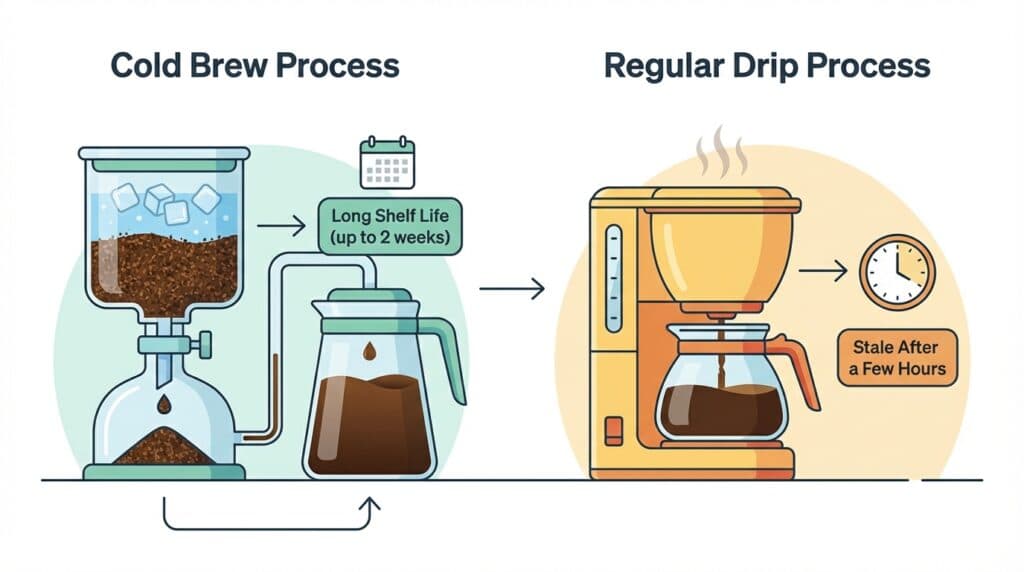
The question assumes it does, and the sources do not say so. The NCA says brewing without heat over a longer time gives “a smoother, more mellow cup”, which is a statement about taste. On keeping time, the relevant source is DATCP’s retail guidance, which requires cold brew to be refrigerated at 41 °F or below and date-marked for no more than seven days. Cold storage is what keeps the risk down; it does not replace the heat step that cold brew never gets.
The safety side: no heat step
Hot brewing water is close to boiling. Cold brew never gets that heat, which is exactly why DATCP classifies it as a TCS food: “If the production of the cold brew coffee lacks a heat step, the final product is considered a Time/Temperature Control for Safety (TCS) food and requires refrigeration.” The same fact sheet lists temperature abuse, holding for more than seven days and reduced-oxygen packaging among its safety concerns, and it notes that “if prepared, stored, and served properly, the risks of illness after consuming cold brew are low.”
The fact sheet is written for retail food businesses, so it is not a rule for home kitchens. The reason behind it still applies at home: the liquid never goes through a heat step.
The acidity question
Cold brew is often said to keep well because it is “less acidic”. The evidence is narrower than that. Rao and Fuller compared cold and hot brews made from the same light-roast coffees and found the pH of the two “comparable, ranging from 4.85 to 5.13”; the hot brews had higher total titratable acidity and higher antioxidant activity (Rao & Fuller, Scientific Reports). The study measured freshly prepared coffee, so it says nothing about how long either drink keeps. It is not a reason to extend the seven-day limit, and it is not medical advice.
What Counts Toward the Seven Days
The seven-day ceiling is the end of the window, not a promise that every batch is fine until then. Several things decide whether a batch makes it that far.
Where it steeped
The National Coffee Association says cold brew can steep “in the refrigerator or at room temperature for 12 hours, or overnight” (NCA cold brew guide). DATCP’s no-variance case, though, is cold brew that is “brewed, held, and served at 41°F or below”. If you plan to keep a batch for the full week, steep it in the fridge so it has been cold from the start. None of the sources cited here gives a keeping time for a batch steeped at room temperature, so the seven-day figure in this guide applies only to batches steeped and kept in the fridge.
Concentrate versus diluted
Store the batch as concentrate and dilute a glass at a time. The NCA describes concentrate as “designed to be diluted with water or enjoyed with ice”, so keeping it strong costs you nothing. Diluting the whole batch does not buy extra days, because the clock still runs from the brew date, and it takes away your ability to adjust each glass.
Storage Container

The NCA’s equipment list is relaxed: “a carafe, jar, or another plastic or glass container” will do. What matters more than the material is that it is clean and has a lid that closes. A lid keeps out fridge odours and keeps the coffee from being exposed to air each time the door opens.
One kind of container needs care. DATCP warns that mishandled kegged cold brew could allow botulism to grow, and it lists reduced-oxygen packaging, including exchanging oxygen with nitrogen, as a separate concern; under Wisconsin’s retail rules, kegged cold brew held more than 48 hours needs a HACCP plan and variance. An ordinary lidded jar in the fridge is not that kind of packaging. Home nitro kegs fall into that category, so they are outside what this guide covers.
Fridge temperature
FSIS puts the target for cold food at 40 °F (4 °C) or below; DATCP uses 41 °F (5 °C). Bacteria grow most rapidly between 40 °F and 140 °F, according to FSIS. Keep the container on a shelf in the main body of the fridge rather than in the door, where the temperature swings every time it opens. If you are not sure how cold your fridge runs, an appliance thermometer will tell you.
Milk, cream, sugar and syrups
Add these to the glass, not to the batch. Once milk or cream is in the coffee, the drink also carries the milk’s own limits, and the FSIS two-hour rule applies to the glass sitting on your desk. Keeping the batch black and unsweetened also keeps it useful for drinks you have not decided on yet.
Signs Your Cold Brew Has Gone Bad
A batch can spoil before the seven days are up if it was kept warm, stored in an unclean container or contaminated. Your senses cannot confirm that a batch is safe, but they can give you reasons to pour it out early.
Smell and taste
Fresh cold brew smells like coffee. A sour, musty or fermented smell, or a sharp sourness in the taste that was not there on day one, means the batch should go.
Visual Cues

Discard the batch if you see any of these:
- Fuzzy spots or a film on the surface
- A slimy feel on the inside of the container or on a spoon
- Bubbles or fizz in a batch that was flat when you put it away
How to Make a Batch Last the Full Week
Most of the work happens on brew day. If you want the full recipe, our cold brew concentrate recipe covers ratios, steeping and straining step by step.
Start clean
Wash the jar, the filter and anything that touches the coffee before you brew. The NCA notes that coffee grounds and coffee oil left behind “can make your next cup taste bitter”, and reusable cloth filters need thorough rinsing and drying between batches.
Strain thoroughly
Strain through a paper filter, or a fine sieve lined with cheesecloth, and strain a second time if the liquid still looks cloudy.
Label it
Write the brew date on the jar. A piece of tape is enough. It turns “is this still OK?” into a date check, and it is the same habit the DATCP rule is built on.
Brew to your week
Size the batch to what you will drink in seven days. At the NCA’s 1:4 ratio, 200 g of coffee and 800 g of water makes a batch of concentrate that you dilute to taste, one glass at a time. If you keep throwing out the last third, cut the recipe by a third next time.
Consider Freezing
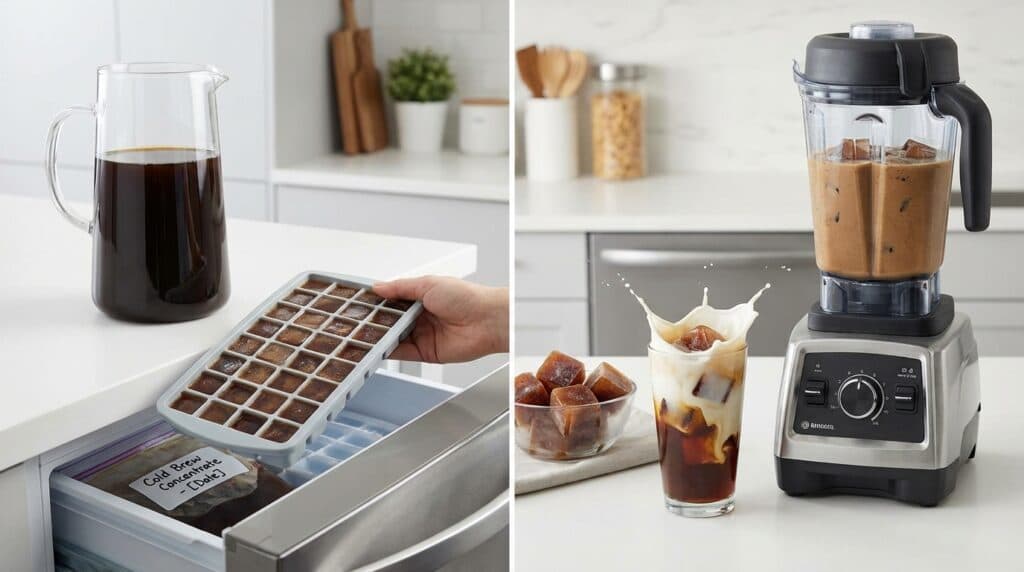
If you will not finish a batch inside the seven days, freeze some of it before the week is out rather than at the end. Concentrate frozen in an ice-cube tray gives you coffee ice cubes that chill an iced coffee without watering it down. None of the sources cited here gives a quality window for frozen cold brew, so use frozen cubes for iced drinks where small flavour changes matter less.
Beans and grounds have their own freshness rules, separate from brewed coffee. For those, see our guide to coffee bean freshness.
Frequently Asked Questions
Can I drink cold brew that’s been in the fridge for two weeks?
No. Two weeks is double the seven-day limit Wisconsin’s retail guidance sets for cold brew made without a heat step. A batch can look and smell normal and still be past it, so pour it out and brew a smaller batch next time.
Does store-bought cold brew last longer than homemade?
This guide covers homemade cold brew only. For a bottled product, follow the date and storage instructions printed on the bottle.
Can cold brew go bad if left out overnight?
Treat finished cold brew that sat out overnight as spent. As a general rule for perishable food, FSIS says food should not stay out of refrigeration for more than two hours, or one hour above 90 °F, and a night on the counter is far longer than either.
Why does my cold brew taste different after a few days?
None of the sources cited here describes how cold brew’s flavour changes during storage. A change in taste is not proof that a batch is safe or unsafe: keep to the seven days, and discard the batch early if the taste comes with an off smell, fizz or a film.
Is it safe to drink cold brew with a slightly sour taste?

Taste and smell are not a safety test. If the sourness is new, comes with an off smell, fizz or a film, or you are not sure how the batch has been kept, discard it.
The Seven-Day Rule in Practice
Brew in the fridge, strain well, keep it as concentrate in a clean lidded jar, write the date on it and finish it within seven days. Add milk and sweetener per glass, and do not leave the jar on the counter. That routine follows the seven-day limit Wisconsin sets for cold brew in retail food service, applied at home as a conservative ceiling.

Comments