


Table of Contents
- What Happens When You Steep Cold Brew Too Long
- The Bitterness Problem
- Muddy, Flat Flavors
- Why the "Longer is Better" Myth Persists
- Confusion About Strength vs. Quality
- Variable Factors Create Inconsistent Advice
- The Ideal Cold Brew Steeping Time
- The Taste Test Method
- How to Fix Over-Steeped Cold Brew
- Dilute It
- Add Salt (Yes, Really)
- Sweeten Strategically
- Use It in Recipes
- Preventing Cold Brew Mistakes: A Better System
- Use a Consistent Recipe
- Brew on a Schedule
- Strain and Store Separately
- Frequently Asked Questions
- Can cold brew steep for 48 hours?
- Does cold brew get stronger the longer it steeps?
- What's the minimum time for cold brew?
- How can I tell if my cold brew is over-extracted?
- Is it better to cold brew in the fridge or at room temperature?
- Final Thoughts and Your Next Batch
You’ve done everything right—measured your coffee, used filtered water, and tucked your cold brew into the fridge with high hopes. Then you forgot about it. Maybe life got busy, or you thought “longer is better.” Now you’re sipping something that tastes less like smooth, refreshing coffee and more like you’re chewing on a handful of bitter grounds. Sound familiar? You’ve just discovered one of the most common cold brew mistakes: steeping too long.
Over-extraction is the silent killer of great cold brew. In this guide, I’ll explain exactly what happens when you let your coffee steep beyond the sweet spot, how to fix a batch that’s gone too far, and how to nail the perfect timing every single time. Life is too short for bad coffee—let’s make sure your next batch is worth the wait.
What Happens When You Steep Cold Brew Too Long
Cold brew is forgiving, but it’s not infinitely patient. When coffee grounds sit in water, they slowly release their soluble compounds—the oils, sugars, acids, and bitter elements that create flavor. The magic of cold brew is that cold water extracts these compounds more gently and selectively than hot water, which is why it tends to be smoother and less acidic.
But here’s the catch: extraction doesn’t stop just because you’ve hit the “ideal” window. Leave your grounds in water too long, and you start pulling out compounds you don’t want.
The Bitterness Problem
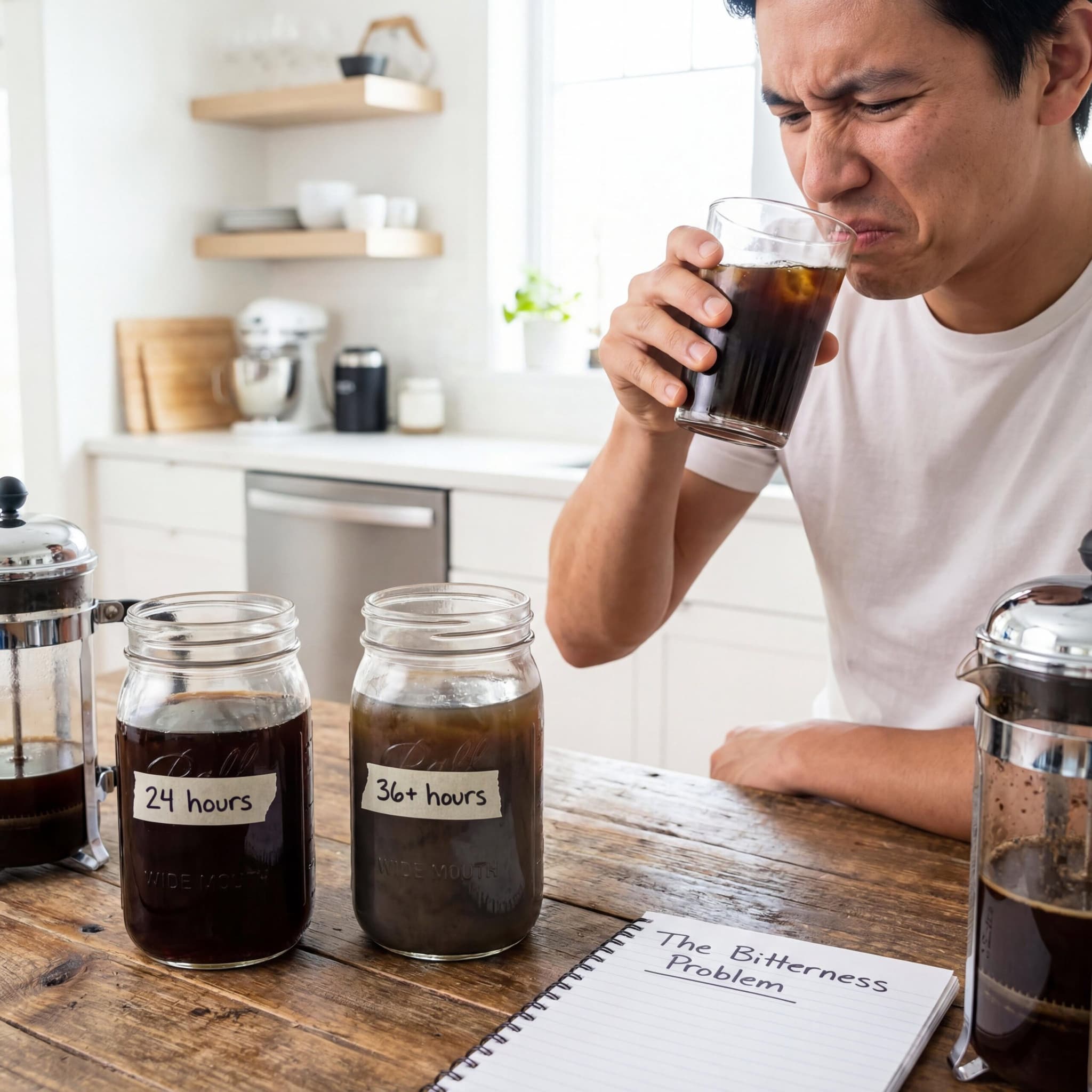
The most obvious symptom of over-steeped cold brew is intense bitterness. Those harsh, astringent flavors come from over-extracted tannins and other compounds that typically stay locked in the grounds during proper extraction. In my experience, anything beyond 24 hours in the fridge starts pushing into risky territory, and past 36 hours? You’re almost guaranteed a bitter mess.
Muddy, Flat Flavors
Over-extraction doesn’t just add bitterness—it also drowns out the good stuff. The bright, nuanced flavors that make cold brew enjoyable get buried under a wall of harsh, one-dimensional taste. That chocolatey smoothness or subtle fruity note you were hoping for? Gone. What you get instead is something muddy and unpleasant.
Key Takeaway: Cold brew extraction is a curve, not a straight line. You want to stop at the peak of flavor extraction before the decline into bitterness begins.
Why the “Longer is Better” Myth Persists
I’ve talked to plenty of home baristas who swear by 48-hour or even 72-hour steeping times. Where does this idea come from? There are a few reasons this cold brew mistake keeps getting repeated.
Confusion About Strength vs. Quality
Longer steeping does create stronger coffee—there’s no denying that. But strength and quality aren’t the same thing. A concentrate steeped for 18 hours can be just as strong as one steeped for 48 hours; you simply use more grounds or less water. The difference is that the 18-hour version will taste balanced, while the 48-hour version will taste like regret.
Variable Factors Create Inconsistent Advice
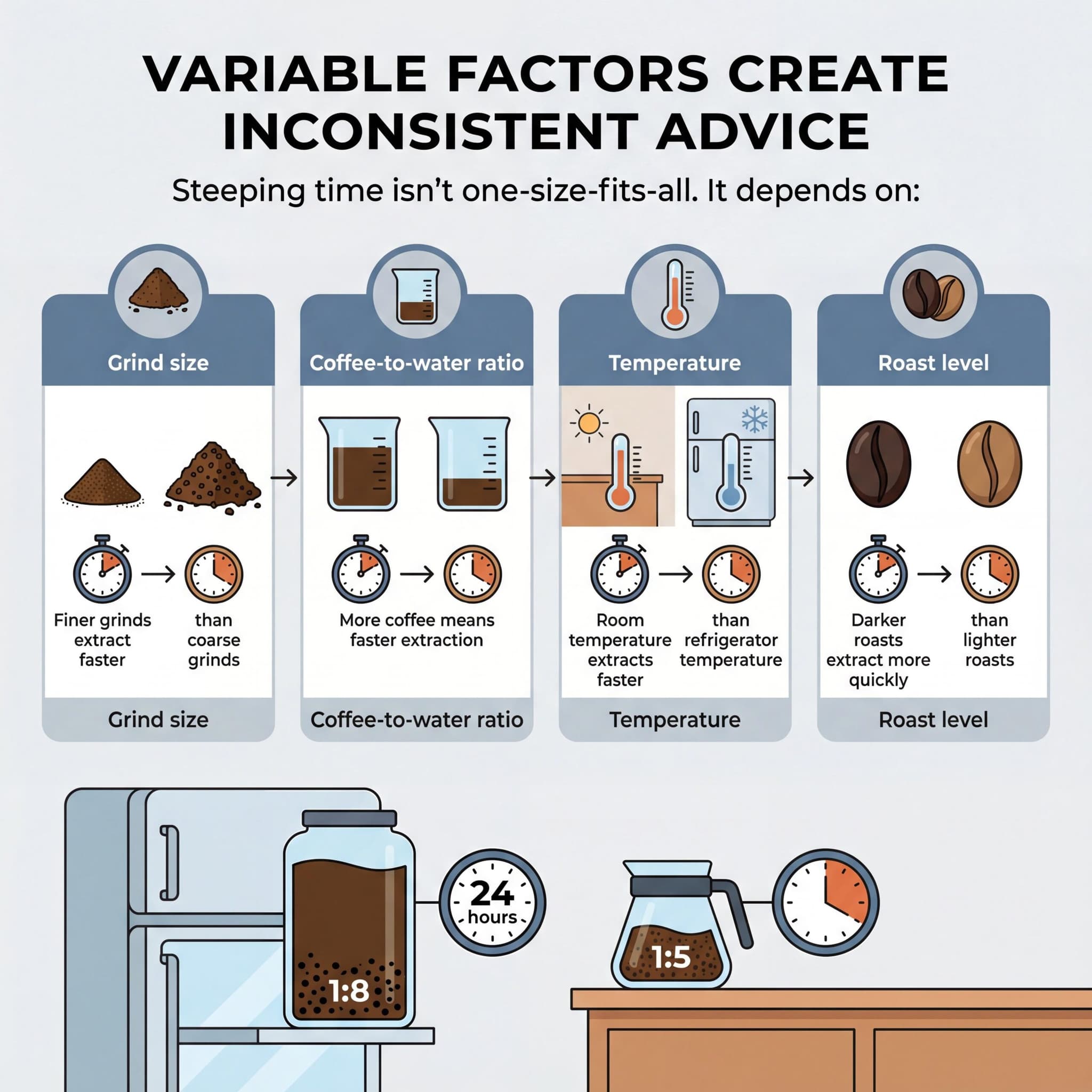
Steeping time isn’t one-size-fits-all. It depends on:
- Grind size: Finer grinds extract faster than coarse grinds
- Coffee-to-water ratio: More coffee means faster extraction
- Temperature: Room temperature extracts faster than refrigerator temperature
- Roast level: Darker roasts extract more quickly than lighter roasts
Someone using a very coarse grind at a 1:8 ratio in the fridge might genuinely need 24 hours. But if you’re using a medium-coarse grind at room temperature with a 1:5 ratio, you could hit over-extraction in 12 hours. The problem is that generic advice doesn’t account for these variables.
Did You Know? Room temperature extraction happens roughly 20-30% faster than refrigerator extraction. If a recipe was developed for counter-top steeping, you’ll need to add several hours when brewing in the fridge.
The Ideal Cold Brew Steeping Time
So what’s the actual sweet spot? In my experience, most home cold brew setups hit their stride between 12 and 18 hours. Here’s a more specific breakdown based on common variables:
| Brewing Method | Temperature | Recommended Steep Time |
|---|---|---|
| Coarse grind, fridge | 35-40°F (2-4°C) | 18-24 hours |
| Coarse grind, room temp | 65-75°F (18-24°C) | 12-16 hours |
| Medium-coarse grind, fridge | 35-40°F (2-4°C) | 14-18 hours |
| Medium-coarse grind, room temp | 65-75°F (18-24°C) | 10-14 hours |
I’ve found that starting at the lower end of these ranges and tasting as you go is the best approach. You can always steep a bit longer, but you can’t un-extract bitter compounds once they’re in your brew.
The Taste Test Method
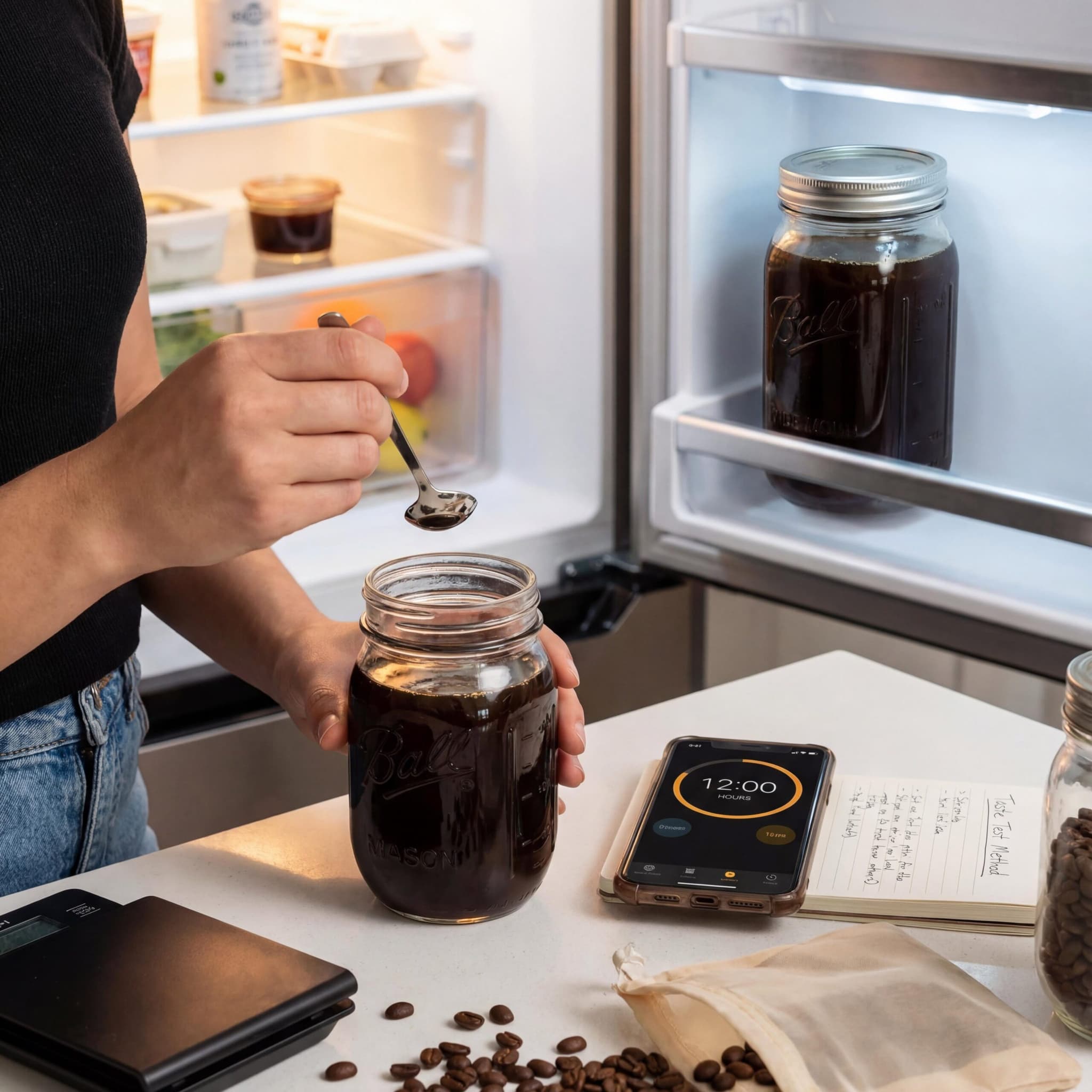
Here’s a practical approach I use: around the 12-hour mark (or 16 hours for fridge brewing), I take a small taste. I’m looking for a smooth, full-bodied flavor without any harsh or drying sensation on my tongue. If it tastes weak or thin, I give it another 2-3 hours and taste again. The moment it tastes right, I strain it immediately.
Barista Tip: Set a timer or alarm on your phone. It sounds obvious, but “I’ll check it in the morning” often turns into “I completely forgot about it for two days.” Trust me, I’ve been there.
How to Fix Over-Steeped Cold Brew
Let’s say the damage is done. You pulled out your cold brew after 30 hours and it tastes like you’re drinking a tire fire. Is it salvageable? Sometimes, yes.
Dilute It
The simplest fix is dilution. If your cold brew is bitter but not completely undrinkable, try adding more water or milk than you normally would. This won’t remove the bitter compounds, but it will reduce their concentration to a more tolerable level. For a severely over-extracted batch, you might need to dilute at a 1:1 ratio or even more.
Add Salt (Yes, Really)
A tiny pinch of salt—we’re talking a few grains, not a proper pinch—can help counteract bitterness. Salt doesn’t remove bitter compounds, but it changes how your taste buds perceive them. This trick works best for mildly over-extracted brews. Start with less than you think you need; you can always add more.
Sweeten Strategically
Sugar, simple syrup, or flavored syrups can mask bitterness to some degree. This isn’t a fix so much as a cover-up, but if you’re determined to salvage your batch, a vanilla or caramel syrup can make over-steeped cold brew drinkable in a pinch.
Use It in Recipes
Bitter cold brew might not be great for drinking straight, but it can still work in recipes where other flavors will dominate. Think cold brew ice cream, coffee cake, or blended with chocolate and banana in a smoothie. The bitterness becomes less noticeable when it’s one ingredient among many.
In short: you can often rescue a slightly over-steeped batch, but if it’s genuinely terrible, sometimes starting fresh is the better choice. Coffee is relatively inexpensive, and your taste buds deserve better.
Preventing Cold Brew Mistakes: A Better System
The best fix for over-steeping is not doing it in the first place. Here’s a simple system I’ve developed after making this mistake more times than I’d like to admit.
Use a Consistent Recipe
Pick a grind size, ratio, and temperature and stick with it. I use a coarse grind (think sea salt texture), a 1:7 coffee-to-water ratio, and brew in the refrigerator. With this setup, I know my cold brew hits peak flavor at around 18 hours. Once you find your sweet spot, write it down.
Brew on a Schedule
The easiest way to avoid forgetting is to make cold brew part of your routine. I start a batch every Sunday evening before bed. By Monday afternoon, it’s ready to strain. The consistency means I never have to guess or remember when I started it.
Strain and Store Separately
Here’s a common mistake within the mistake: leaving coffee grounds in the container “just in case” you want to steep longer. Don’t do this. Once you’ve hit your target time, strain the grounds immediately and store your concentrate separately. Extraction continues as long as grounds are in contact with water, even if you think you’re done.
- Use a fine mesh strainer lined with a paper filter or cheesecloth
- Transfer the strained concentrate to a clean jar or bottle
- Refrigerate immediately—cold brew concentrate keeps for about 1-2 weeks
Barista Tip: If you’re forgetful, try brewing at room temperature during the day when you’re awake and can monitor it. You’ll get faster extraction and you’re less likely to forget about it overnight.
Frequently Asked Questions
Can cold brew steep for 48 hours?
Technically, yes. Should it? Almost never. While some people claim to enjoy 48-hour cold brew, the vast majority of coffee will be significantly over-extracted and bitter at this point. If you’ve accidentally steeped this long, expect harsh flavors and try the dilution tricks mentioned above.
Does cold brew get stronger the longer it steeps?
It does extract more caffeine and flavor compounds over time, so yes, it gets stronger. However, “stronger” doesn’t mean “better.” After a certain point, you’re extracting undesirable bitter compounds that make the coffee taste worse, not more flavorful.
What’s the minimum time for cold brew?
For most setups, you’ll want at least 12 hours to get proper extraction. Going shorter typically results in weak, sour, or thin-tasting cold brew because the water hasn’t had enough time to pull the good stuff from the grounds.
How can I tell if my cold brew is over-extracted?
The biggest signs are intense bitterness, an astringent or drying sensation on your tongue, and a lack of the smooth, sweet notes cold brew is known for. If your cold brew tastes harsh or makes you wince, it’s likely been steeped too long.
Is it better to cold brew in the fridge or at room temperature?
Both work well, but they require different timing. Room temperature extracts faster (12-16 hours is usually sufficient), while refrigerator brewing is slower and more forgiving (18-24 hours). Fridge brewing also reduces any risk of bacterial growth, which can be a concern in warmer climates.
Final Thoughts and Your Next Batch
Steeping cold brew too long is one of those mistakes that’s easy to make and frustrating to experience. But now that you understand what’s happening during extraction and why timing matters, you’re equipped to brew better coffee every time.
Remember the key points: stick to 12-24 hours depending on your setup, taste as you go, and strain your cold brew the moment it hits peak flavor. Once you dial in your personal sweet spot, you’ll never go back to guessing—or grimacing at bitter, over-steeped mistakes.
Ready to put this into practice? Start your next batch tonight with a timer set, and taste it tomorrow at the 14-hour mark. You might be surprised how much better your cold brew can be when you stop it at just the right moment. Here’s to smooth, balanced coffee that’s actually worth waiting for.

Comments