


Table of Contents
- Why Hand Grinder Burrs Rust
- Routine Cleaning: Dry Brush and Air
- How often
- Deep Cleaning: Taking the Grinder Apart
- Removing Oils and Odors
- Can You Use Water at All?
- What If You Already Have Rust?
- Frequently Asked Questions
- Can I wash my hand grinder burrs with water?
- How often should I clean a hand grinder?
- Is rice safe for cleaning a grinder?
- How do I store a hand grinder to prevent rust?
To keep a hand grinder from rusting, keep water away from the burrs: clean them with a dry brush and an air blower, take the grinder apart for a thorough clean about once a month, and store it somewhere dry. That is the routine 1Zpresso gives for its grinders, and Comandante’s care advice for its C40 points the same way. If oils or odors build up, 1Zpresso suggests grinding a small amount of rolled or instant oats, then wiping with a damp (not wet) towel and drying immediately.
This guide is based on the care instructions published by 1Zpresso and Comandante, plus cleaning guidance from Baratza and Urnex. Daily Home Coffee has not tested these methods on its own grinders. Models differ, so where your manual says something different, follow your manual.
Why Hand Grinder Burrs Rust
Rust needs moisture on unprotected steel. The makers’ instructions reflect that in three ways.
- Water on the burrs. 1Zpresso’s FAQ says plainly: “Do not clean the grinder with water.” It adds that excessive moisture will damage the grinder.
- Burr material. Comandante warns owners of its older C40 Ironheart burrs not to use water on them, because “the carbon steel isn’t stainless and should be looked after carefully.” It says its current Nitro Blade burrs, made from a high-nitrogen alloy, come in “a very low-maintenance format”.
- Storage. 1Zpresso’s J-Series manual tells owners to keep the grinder in a dry environment to extend its lifetime.
So check what your burrs are made of. A carbon steel burr set needs more care with moisture than a stainless or specially alloyed one, and the manual or the maker’s FAQ is the place to check.
Routine Cleaning: Dry Brush and Air
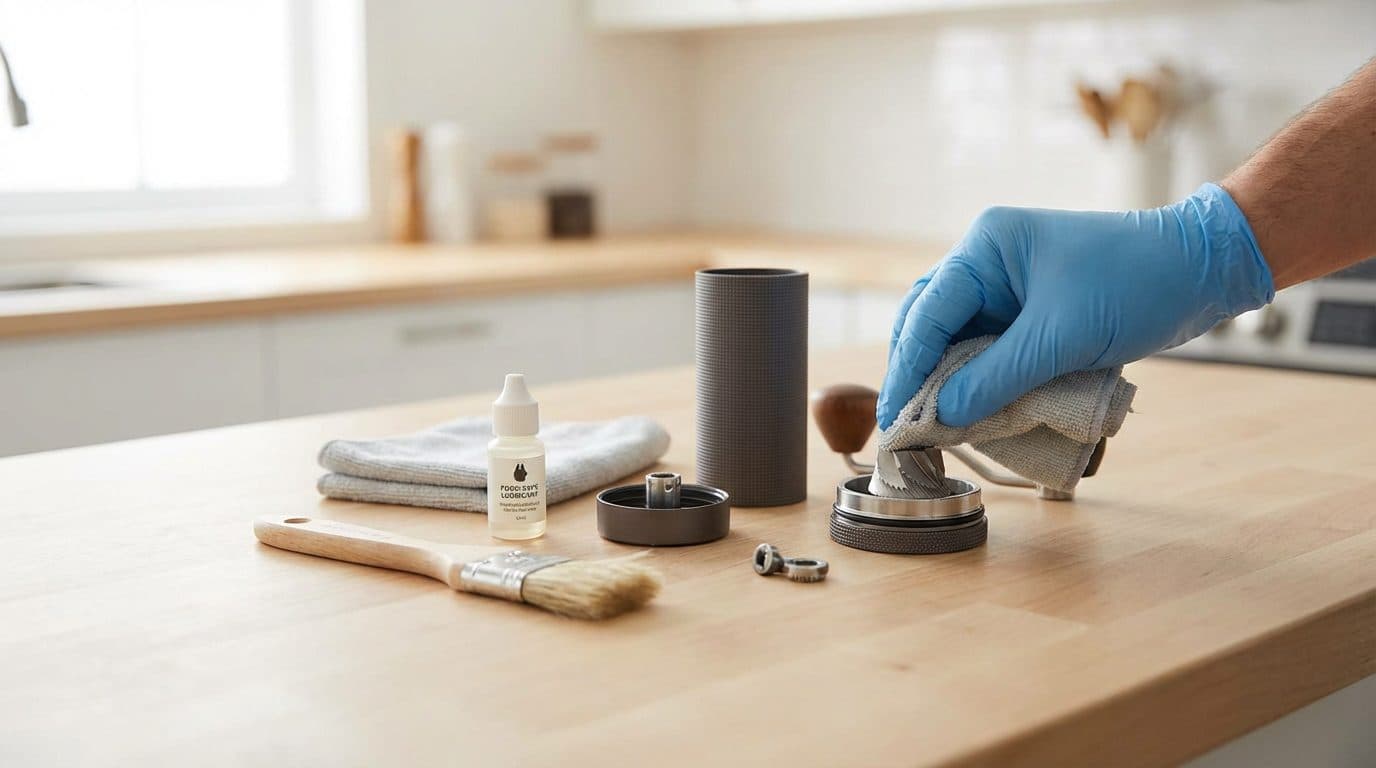
Both makers describe the same basic method. 1Zpresso says its grinders can be cleaned with a dry brush and an air blower. Comandante recommends brushing the burr and grinder interior, and suggests compressed air, a camera lens blower or “good old lung-power” for hard-to-reach areas.
What you need:
- The brush that came with the grinder (1Zpresso’s is nylon) or another dry brush
- An air blower, such as a camera lens blower
- A dry cloth
Steps:
- Empty the grinder and brush loose grounds out of the burrs and the catch cup.
- Use the blower on the burr teeth and any corners the brush cannot reach.
- Reassemble and store the grinder in a dry place.
How often
The makers give different intervals:
- 1Zpresso: disassemble and clean the grinder thoroughly once a month.
- Comandante (Nitro Blade burrs): no need to clean between uses; once a week with heavy use or once a month with light use “is more than enough”.
- Comandante (C40 Ironheart burrs): keep the burrs dry and clean them weekly if the grinder is used daily.
Deep Cleaning: Taking the Grinder Apart
Both makers say their grinders come apart for cleaning. 1Zpresso states that all its grinders can be disassembled without tools, and without needing to re-calibrate the burr. Its J-Series manual gives the order:
- Fit the crank handle and hold it still, then loosen the adjustment dial counter-clockwise and remove it.
- Clean the adjustment dial, inner burr, spring and lower bearing cap.
- Remove the burr ring unit clockwise from the body. (The manual notes not to remove the burr ring holder before step 2.)
- Clean each part with a brush and an air blower.
- Tighten the burr ring unit counter-clockwise to the tightest position.
- Put the lower bearing cap (convex side facing the bearing), spring and burr back in that order.
- Tighten the adjustment dial clockwise to the tightest position with the crank handle held still.
Those steps are for the J-Series; for another model, follow that model’s manual. On the Comandante C40, the FAQ warns not to unscrew the three mounting screws around the burr, which are tightened by hand at the factory for calibration; Comandante says undoing them can damage the grinder and void the warranty.
Removing Oils and Odors
Coffee oils build up on burrs over time. For its hand grinders, 1Zpresso’s answer is to grind rolled oats or instant oats, wipe with a damp (not wet) towel, and dry immediately.
Rice is a different matter. Baratza calls “grinding rice cleans your grinder” a myth and says rice can turn into a hard, gummy mess, strain or jam the motor, wear the burrs and leave residue. Urnex says rice carries the risk of locking up a grinder motor and leaves a starchy residue. Both warnings name the grinder motor, so they describe electric grinders, and both recommend purpose-made grinder cleaning tablets instead. No hand grinder maker cited here recommends rice either, so it is simplest to leave it out.
Cleaning tablets are not universal. The Niche Zero manual, for example, advises against running rice or any specialist cleaning products through that grinder, as covered in the Niche Zero deep cleaning guide. For a hand grinder, use the method your maker names.
Can You Use Water at All?
It depends on the model, which is why the manual matters.
- 1Zpresso: the FAQ says not to clean the grinder with water, and the J-Series manual adds not to wipe it with solvents other than water and alcohol. The only water use the FAQ describes is a damp (not wet) towel, followed by immediate drying.
- Comandante C40: do not soak it in water or put it in the dishwasher, which Comandante says could damage the wooden veneer and the ball-bearing cartridges over time. For a dirty wooden body, a damp cotton cloth is enough, dried immediately.
- Comandante C60 and X25 Trailmaster: not dishwasher safe, but Comandante says you can rinse them with water and gentle, natural detergents, provided you disassemble the grinder so all the parts dry fully.
What If You Already Have Rust?
None of the maker sources used here gives a home procedure for removing rust from burrs, so this guide does not invent one. Sensible next steps:
- Check your manual and the maker’s FAQ for burr care products or instructions.
- Contact the maker or dealer. Comandante says spare and replacement parts are available through your local dealer or directly. 1Zpresso’s FAQ says it is developing a burr replacement service.
- Stop using water on the burrs and keep the grinder dry while you decide.
For context on how long burrs are meant to last, 1Zpresso says its burrs are expected to grind 100 to 200 kg of beans.
Frequently Asked Questions
Can I wash my hand grinder burrs with water?
Not on a 1Zpresso, whose FAQ says not to clean the grinder with water, and not on Comandante’s carbon steel Ironheart burrs. Comandante allows rinsing for its C60 and X25 models, with full drying afterwards. Check your model’s manual.
How often should I clean a hand grinder?
1Zpresso recommends a thorough clean once a month. Comandante says weekly with heavy use or monthly with light use for Nitro Blade burrs, and weekly for Ironheart burrs used daily.
Is rice safe for cleaning a grinder?
Baratza and Urnex both advise against rice, mainly because of motor strain and starchy residue. For hand grinders, 1Zpresso suggests rolled or instant oats instead.
How do I store a hand grinder to prevent rust?
Somewhere dry. 1Zpresso’s J-Series manual tells owners to keep the grinder in a dry environment, and Comandante tells C40 Ironheart owners to keep the burrs dry.


Comments