


Table of Contents
- Understanding the True Cost of Café Coffee
- Breaking Down Home Brewing Costs
- The Cost of Coffee Beans
- Other Consumables
- Equipment Investment
- The Real Comparison: Annual Coffee Spending
- Café Scenario
- Home Brewing Scenario
- Factors That Change the Equation
- When Café Coffee Makes More Sense
- When Home Brewing Wins Big
- Finding Your Personal Balance
- Frequently Asked Questions
- Is home-brewed coffee actually as good as café coffee?
- How long does it take to break even on coffee equipment?
- What's the cheapest way to make good coffee at home?
- Does buying expensive beans really matter?
- Should I factor in my time when calculating home brewing costs?
- Conclusion and Next Steps
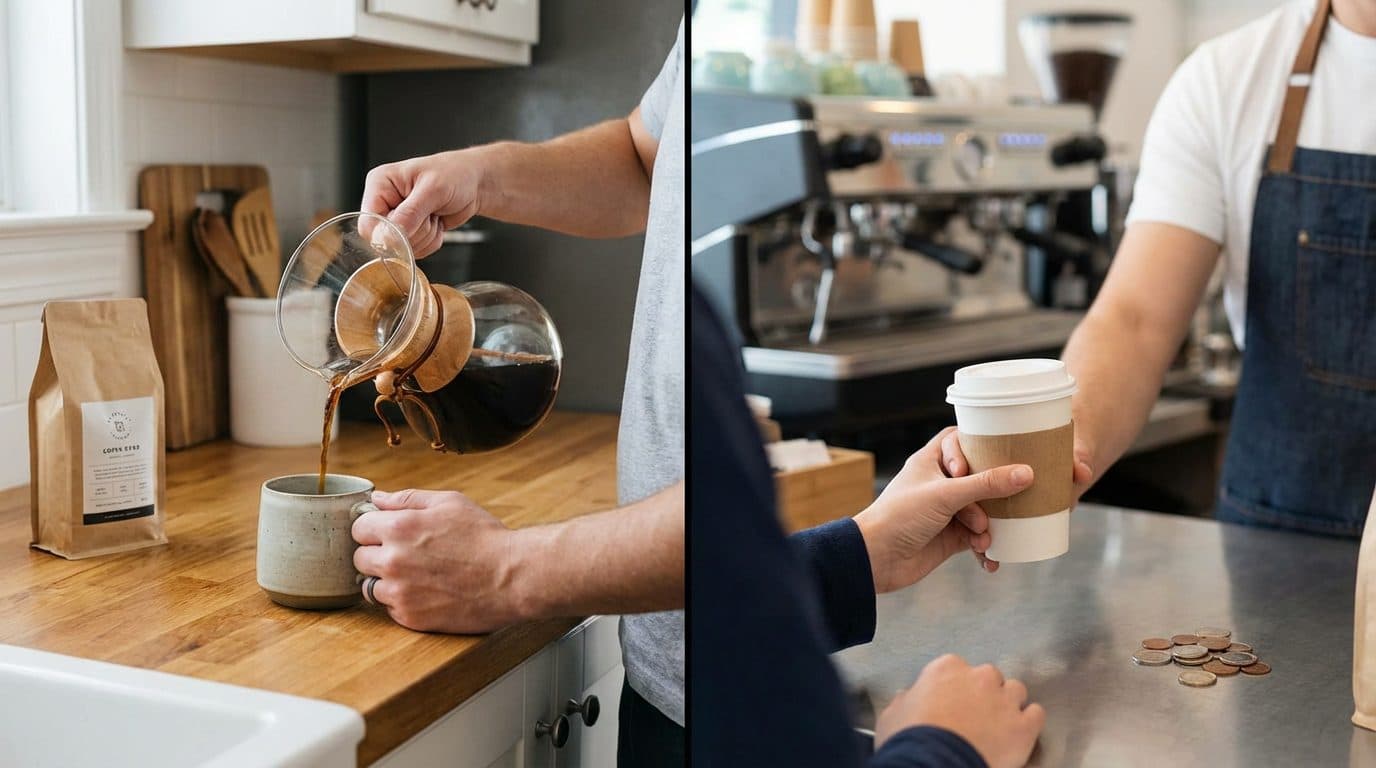
Have you ever stopped mid-sip at your favorite café and wondered exactly how much that daily latte habit is costing you? You’re not alone. With coffee shop prices climbing steadily—a standard latte now averages around $6.50 at major chains—more people are doing the math on home brewing versus café visits. The difference might surprise you, and I’ve found it’s one of the most eye-opening calculations any coffee lover can make.
In this breakdown, we’ll crunch the real numbers on cost per cup for both home brewing and café purchases. You’ll learn how to calculate your own coffee expenses, discover where the hidden costs lurk, and figure out which approach makes the most sense for your lifestyle and budget.
Understanding the True Cost of Café Coffee
Let’s start with what you’re actually paying when you walk into a coffee shop. According to recent pricing data, the average latte at US coffee shops runs between $5.50 and $7.00, depending on your location and the establishment. A basic drip coffee typically costs $3 to $4. These prices have increased noticeably over the past few years due to rising labor costs, rent, and wholesale coffee prices.
But here’s what many people overlook: the café price isn’t just for the coffee itself. You’re paying for:
- The barista’s expertise and labor
- Rent for that cozy space you’re sitting in
- Equipment maintenance on commercial espresso machines
- Milk, syrups, cups, and other consumables
- The convenience of having someone else make it for you
In my experience, people rarely factor in the extras. That $6.50 latte becomes $8 with a pastry. Add a tip, and you’re looking at $9 or more for a single coffee break. Do that five days a week, and you’re spending roughly $180 to $200 per month—over $2,000 annually—just on workday coffee runs.
Breaking Down Home Brewing Costs
Now let’s flip the equation and look at what it actually costs to brew coffee at home. The math here gets interesting, and I think you’ll find it more affordable than you might expect.
The Cost of Coffee Beans
Quality whole bean coffee typically ranges from $10 to $18 per pound at grocery stores and online retailers. Budget-conscious shoppers can find decent options around $8 per pound, while specialty single-origin beans might run $15 to $25. For this calculation, let’s use $12 per pound as a reasonable middle ground for good-quality beans.
One pound of coffee beans yields approximately 45 to 50 cups, assuming you’re using about 15 grams (roughly two tablespoons) per 8-ounce cup. That puts your bean cost at roughly $0.24 to $0.27 per cup.
Other Consumables
Don’t forget these additional costs:
- Filters (if using drip): about $0.02 to $0.05 per cup
- Water: negligible, but filtered water adds a few cents
- Milk or cream: roughly $0.15 to $0.30 per cup if you add dairy
- Electricity: minimal, typically less than $0.01 per cup
Adding these up, a basic cup of black drip coffee at home costs approximately $0.25 to $0.35. A home latte with milk runs about $0.40 to $0.60 per cup, depending on your milk choice.
Equipment Investment
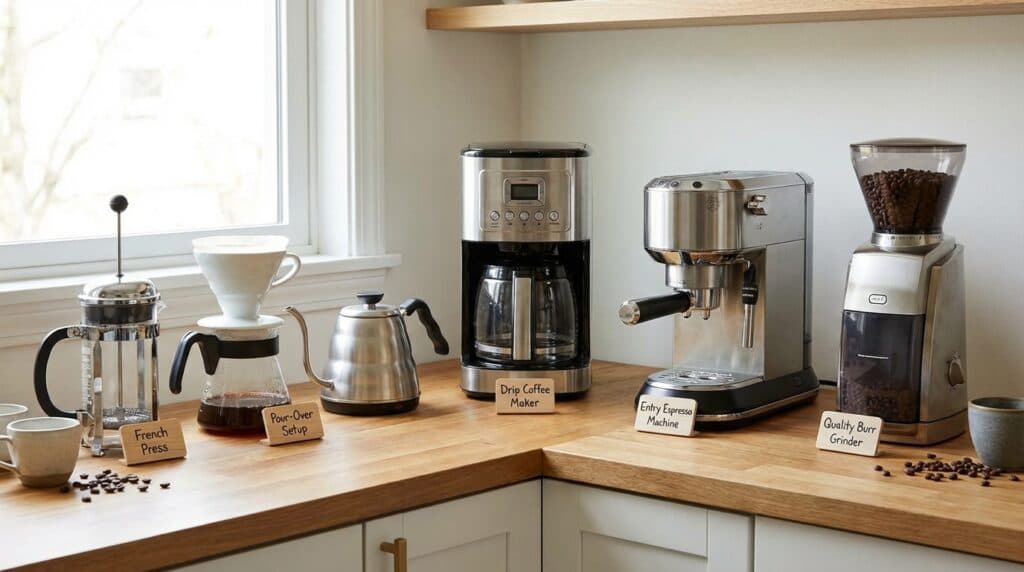
Here’s where the upfront cost comes in. Your equipment investment varies dramatically based on your brewing method:
| Brewing Method | Typical Cost | Lifespan |
|---|---|---|
| French Press | $20–$40 | 5+ years |
| Pour-Over Setup | $25–$50 | 5+ years |
| Drip Coffee Maker | $30–$150 | 3–7 years |
| Entry Espresso Machine | $100–$300 | 5–10 years |
| Quality Burr Grinder | $50–$150 | 5–10 years |
If you invest $200 in a solid grinder and brewing setup that lasts five years, and you make one cup daily, that’s about $0.11 per cup for equipment. The more you brew, the faster you amortize that cost.
The Real Comparison: Annual Coffee Spending
Let’s put this all together with a realistic scenario. Imagine you drink one coffee every weekday—that’s roughly 250 cups per year.
Café Scenario
- 250 lattes at $6.50 each = $1,625 per year
- Add occasional tips and extras: closer to $1,800–$2,000
Home Brewing Scenario
- 250 cups at $0.50 each (including milk) = $125 per year
- Add equipment cost (amortized): roughly $30 per year
- Total: approximately $155 per year
The difference? You could save $1,400 to $1,800 annually by brewing at home. That’s a vacation, a nice piece of furniture, or a significant chunk of an emergency fund—all from changing where you make your morning cup.
Factors That Change the Equation
Of course, real life isn’t always this straightforward. Several factors can shift the math in either direction.
When Café Coffee Makes More Sense
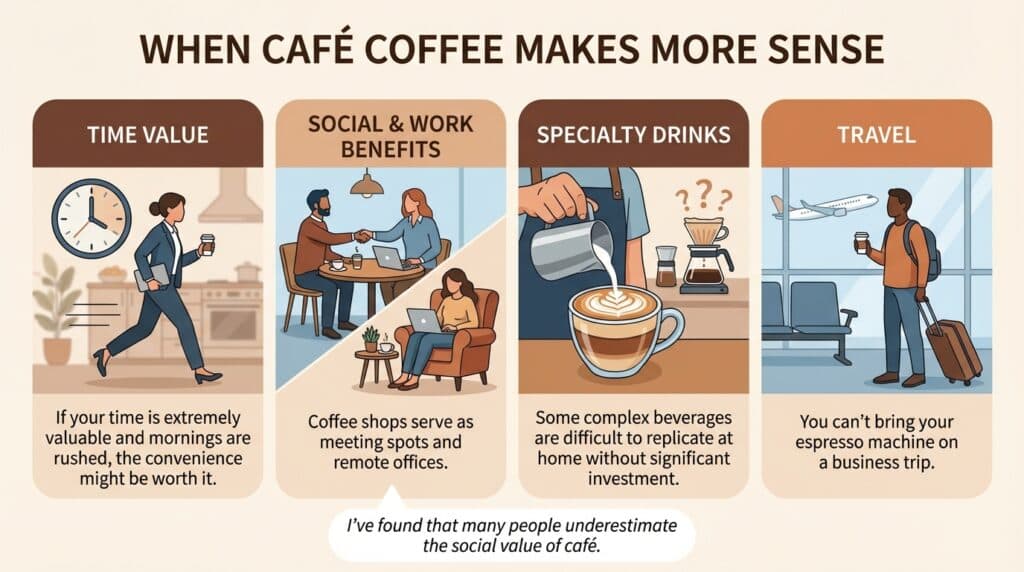
There are legitimate reasons to buy café coffee beyond pure economics:
- Time value: If your time is extremely valuable and mornings are rushed, the convenience might be worth it
- Social and work benefits: Coffee shops serve as meeting spots and remote offices
- Specialty drinks: Some complex beverages are difficult to replicate at home without significant investment
- Travel: You can’t bring your espresso machine on a business trip
I’ve found that many people underestimate the social value of café visits. If that $6 latte comes with a productive two-hour work session in a comfortable environment, the value proposition changes considerably.
When Home Brewing Wins Big
Home brewing becomes even more economical when:
- You drink multiple cups per day
- You buy beans in bulk or subscribe to a roaster
- You already own quality equipment
- You work from home regularly
For heavy coffee drinkers—say, three to four cups daily—the annual savings can exceed $4,000. At that point, you could invest in genuinely excellent home equipment and still come out far ahead.
Finding Your Personal Balance
Here’s what I recommend after years of obsessing over this exact question: most people benefit from a hybrid approach. Brew your daily driver at home, where you have full control over quality and cost, but allow yourself occasional café visits for the experience and variety.
A practical split might look like this:
- Home brew 4 days per week: $0.50 × 4 = $2.00
- Café treat 1 day per week: $6.50
- Weekly total: $8.50 (versus $32.50 for all café)
- Annual savings: still over $1,200
This approach gives you the best of both worlds—significant savings plus the occasional treat without feeling deprived.
Frequently Asked Questions
Is home-brewed coffee actually as good as café coffee?
It can be, and often better. With fresh beans, a decent grinder, and proper technique, home coffee frequently surpasses what you’d get at an average café. The key is using freshly roasted beans (ideally within 2-4 weeks of roasting) and grinding just before brewing. Many coffee enthusiasts find their home setup produces superior results once they dial in their method.
How long does it take to break even on coffee equipment?
For most setups, surprisingly fast. If you spend $150 on a grinder and pour-over setup, and you save $5 per day compared to café purchases, you break even in just 30 days. Even a $500 espresso machine pays for itself within a few months for daily drinkers.
What’s the cheapest way to make good coffee at home?
A French press or pour-over cone offers the best quality-to-cost ratio. You can get started for under $30, and these methods produce excellent coffee with minimal ongoing costs. The main investment is in a decent burr grinder, which makes a bigger difference than the brewing device itself.
Does buying expensive beans really matter?
There’s a sweet spot. Moving from $8 to $15 per pound beans typically yields noticeable quality improvements. Beyond $20 per pound, you’re often paying for rarity or specific origins rather than dramatically better taste. For daily drinking, mid-range specialty beans offer the best value.
Should I factor in my time when calculating home brewing costs?
It depends on your situation. Making pour-over coffee takes about 5 minutes, roughly the same as waiting in a café line. If you’re genuinely trading productive work time for coffee preparation, factor that in. But for most people, brewing happens during natural morning downtime and doesn’t represent a real opportunity cost.
Conclusion and Next Steps
The numbers don’t lie: brewing coffee at home costs a fraction of café purchases, typically saving $1,200 to $2,000 or more annually for regular coffee drinkers. Even with quality equipment and premium beans, your cost per cup stays well under $1, compared to $5 to $7 at coffee shops.
That said, the “right” choice depends on what you value. If café culture, convenience, and social connection matter to you, those have real worth beyond the dollar amount. The smartest approach for most people is finding a sustainable balance—enjoying the ritual and savings of home brewing while treating yourself to café visits when the experience genuinely adds value to your day.
Start by tracking your current coffee spending for a week or two. Once you see the real numbers, you’ll have a clearer picture of where small changes could make a meaningful difference. Life is too short for bad coffee—but it’s also too short to overpay for every cup.



Comments