


Table of Contents
- Quick Verdict: What to Buy First
- What Makes a Good Coffee Candle?
- Scent Authenticity
- Wax Type
- Scent Throw
- Types of Coffee Candle Scents
- Pure Coffee / Dark Roast
- Vanilla Latte / Cafe au Lait
- Espresso and Chocolate
- Coffee and Spice
- How to Choose for Your Home Office
- Match the Candle to Room Size
- Check Burn Time Honestly
- Read the Ingredient and Safety Details
- Choose by Work Style
- How to Burn Coffee Candles Properly
- What to Avoid
- Small Details That Separate Good Candles From Annoying Ones
- Bottom Line
The best coffee-scented candle for a home office is usually a medium-throw candle that smells like roasted coffee rather than dessert syrup. Too weak and you barely notice it; too strong and it competes with work, food, and actual coffee. For most desks, a well-made soy or coconut wax candle with a simple coffee, espresso, or coffee-and-vanilla profile is the most practical first pick.
Do not buy only by the word “coffee” on the label. Some coffee candles smell like caramel frosting, some smell like burnt plastic, and some have so many added notes that the coffee disappears. The goal for a workspace is pleasant background scent, not a bakery display case in candle form.
Quick Verdict: What to Buy First
If you want the most realistic cafe-like scent, start with a pure coffee or dark roast candle from a brand that lists wax type, wick type, and fragrance safety information. If you prefer a softer room scent, choose vanilla latte or cafe au lait. For a small office, pick a smaller jar or burn in short sessions before committing to a large candle.
Best fit:
- People who like the smell of brewed black coffee
- Remote workers who want a warmer desk atmosphere
- Anyone who wants a scent that feels grown-up rather than sugary
Probably not ideal:
- People sensitive to fragrance
- Very small rooms with poor ventilation
- Anyone expecting a candle to smell exactly like fresh espresso from a machine
What Makes a Good Coffee Candle?
A good coffee candle gets three things right: scent realism, burn quality, and strength. Miss one of those and the candle becomes distracting instead of useful.
Scent Authenticity
Realistic coffee scents usually include roasted, nutty, bitter-sweet, or cocoa-like notes. Sweet blends can be pleasant, but the coffee should still be easy to identify. Be skeptical of descriptions that throw in too many unrelated notes such as linen, ocean air, sandalwood, and espresso in the same jar.
Wax Type
Soy, coconut, and beeswax blends are popular for home offices because they tend to burn steadily when made well. Paraffin can also perform well in quality candles, but cheap paraffin candles sometimes smoke more or smell artificial. The label should tell you what wax is used.
Scent Throw
Throw means how far the fragrance travels. A home office usually needs medium throw. Strong throw may be nice for a living room, but at arm’s length from your keyboard it can become tiring. If reviews mention “fills the whole house,” that may be too much for a desk.
Simple rule: Choose a cleaner ingredient list, medium scent strength, and a coffee note you would actually want to smell for two hours.
Types of Coffee Candle Scents
Pure Coffee / Dark Roast

These aim for black coffee, roasted beans, or espresso. The best versions smell dry, warm, and slightly bitter. They suit people who dislike sweet candles and want the closest thing to a coffee shop aroma.
Pros:
- Most realistic coffee impression
- Less cloying than dessert scents
- Good for focused work sessions
Cons:
- Can feel sharp in a small room
- May smell too bitter for people who prefer flavored drinks
Vanilla Latte / Cafe au Lait
These blend coffee with vanilla, milk, cream, or light caramel. They are easier to live with than dark roast candles, but the balance matters. A good vanilla latte candle still smells like coffee. A poor one smells like vanilla frosting with a coffee label.
Pros:
- Soft and friendly for shared spaces
- Less likely to feel bitter
- Works well in colder months
Cons:
- Often less realistic
- Can become too sweet during long burns
Espresso and Chocolate
Mocha-style candles combine coffee with cocoa, dark chocolate, or brownie-like notes. They can be excellent for short afternoon burns, especially if you like rich scents. For all-day work, they may be too heavy.
Pros:
- Rich, warm, and cozy
- Good for larger rooms
- Often more complex than plain coffee
Cons:
- Can smell more like dessert than coffee
- May overpower a small desk area
Coffee and Spice
Cinnamon, nutmeg, clove, and cardamom can pair nicely with coffee, but spice notes are loud. If you want year-round use, choose a restrained blend. Heavy spice can make the candle feel seasonal fast.
How to Choose for Your Home Office
Match the Candle to Room Size
For a small office under about 150 square feet, buy a smaller candle or one described as moderate. For an open room, a stronger 8-12 oz candle may be reasonable. If your desk is close to the candle, less is usually better.
Check Burn Time Honestly
Long burn time sounds good, but only if the candle burns evenly. A 50-hour candle that tunnels after the first session wastes wax. Look for reviews mentioning even melt pools and consistent scent after several burns.
Read the Ingredient and Safety Details
For a work area, favor candles that clearly state:
- Wax blend, such as soy, coconut, beeswax, or a disclosed paraffin blend
- Cotton, paper, or wood wick
- Phthalate-free fragrance, where available
- No unnecessary dyes, especially if you are sensitive to scent
No candle is “clean air in a jar.” Burning anything creates some combustion byproducts. Use ventilation, trim the wick, and stop using a candle if it causes headache, throat irritation, or coughing.
Choose by Work Style
For focused tasks, plain coffee or espresso usually stays in the background. For creative work or relaxed planning, vanilla latte or mocha can feel warmer. For calls, choose a lighter scent so you are not distracted by it every time you move.
How to Burn Coffee Candles Properly
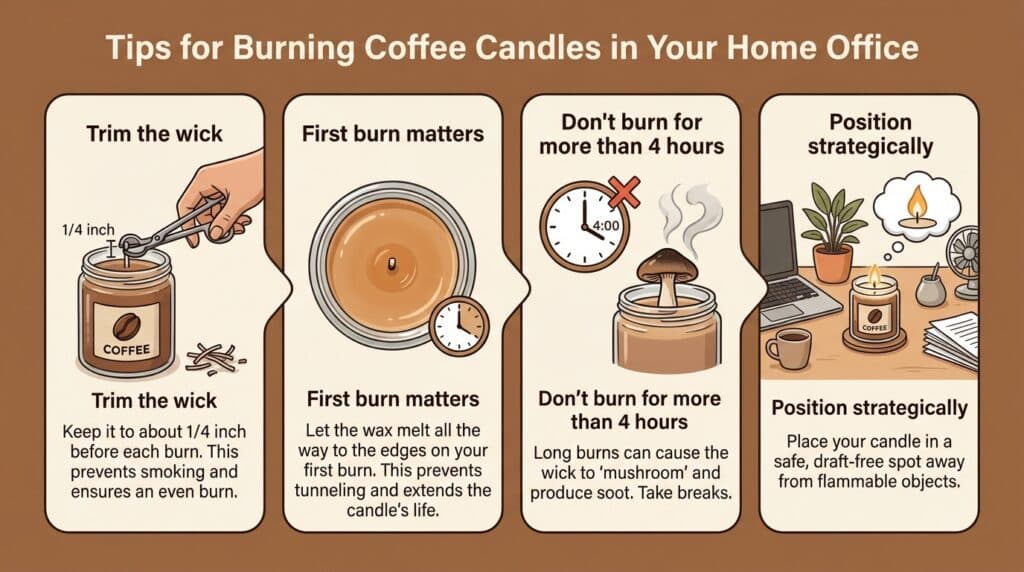
- Trim the wick: Keep it around 1/4 inch before each burn to reduce smoke and soot.
- Let the first melt pool reach the edge: This helps prevent tunneling.
- Limit long burns: Many candle makers recommend stopping around 3-4 hours.
- Keep it away from drafts: Air vents and open windows make flames flicker and burn unevenly.
- Do not place it beside papers or equipment: A desk candle should be treated like an open flame, not decor.
- Never leave it unattended: Extinguish the candle before calls in another room, errands, naps, or stepping away from a paper-heavy desk.
Practical tip: If a coffee candle feels too strong, burn it for 20-30 minutes before work, then extinguish it. The remaining scent is often enough for a small office.
What to Avoid
- Vague labels: If the brand hides wax type and wick details, be cautious.
- Very cheap novelty candles: Low-cost fragrance oils often smell thin, burnt, or synthetic.
- Overloaded scent descriptions: Coffee plus six unrelated notes usually means poor focus.
- Too-large candles for tiny rooms: Strong throw is not automatically better.
- Unsafe placement: Keep flames away from curtains, notebooks, cables, and monitor stands.
Small Details That Separate Good Candles From Annoying Ones
A coffee candle can smell convincing in the jar and still fail in a work room. The cold sniff is concentrated and close-up. What matters is the hot throw after 30-60 minutes: does it smell like brewed coffee, toasted sugar, or generic perfume? Reviews that mention the scent during an actual burn are more useful than comments about packaging.
Wick behavior is just as important as fragrance. A wick that mushrooms, smokes, or leans heavily can make even a nice scent smell dirty. If the candle starts sooting, trim the wick, move it away from drafts, and shorten the burn. If it keeps smoking after that, retire it from your desk. Work spaces should feel calmer, not hazier.
For shared homes, choose a candle that is easy to turn off emotionally as well as physically. Heavy mocha, caramel, or spiced coffee can be pleasant for an hour and exhausting for a whole afternoon. Plain coffee, light vanilla latte, or a soft roasted note is usually easier to live with if the office also connects to a bedroom, kitchen, or living room.
Bottom Line
For most home offices, the best coffee candle is realistic but moderate: soy or coconut wax, a clear coffee note, a stable wick, and enough throw to warm the room without dominating it. Start with pure coffee if you like black coffee, vanilla latte if you want softness, or mocha if you prefer rich afternoon comfort. Burn it carefully, ventilate the room, and judge it by how it smells after an hour, instead of trusting the cold jar sniff alone.




Comments