


Table of Contents
- Why Starbucks Coffee Tastes the Way It Does
- Understanding Roast Levels: Your Flavor Roadmap
- Best Roast Profiles for Starbucks Converts
- Medium-Dark Roasts: The Bridge
- Medium Roasts: The Explorer's Choice
- Origins That Work Well for Beginners
- Central and South American Beans
- Origins to Save for Later
- Practical Tips for Your First Bean Purchase
- Myth vs. Reality
- A Simple Transition Plan
- Key Takeaways
Start with a medium-dark roast from a local roaster, and you’ll bridge the gap between Starbucks’ signature boldness and the brighter flavors specialty coffee has to offer. That’s the short answer for anyone hunting for the best coffee beans for beginners switching from Starbucks to home brewing.
If you are still comparing flavor profiles, our guide to Brazil vs Colombia for beginners makes that choice much easier.
Here’s what most people get wrong: they jump straight from Starbucks’ dark, smoky blends to a fruity Ethiopian light roast and wonder why it tastes like sour tea. The flavor gap is real. Starbucks roasts darker than most specialty roasters—those caramelized, slightly bitter notes you’re used to come from beans pushed well into second crack. Understanding this is the first step to finding beans you’ll actually enjoy at home.
Quick Verdict: Best for an easy transition: medium-dark roasts from Central or South America. Best for exploring new flavors: medium roasts from Brazil or Colombia. Best for adventurous palates ready to experiment: medium-light single origins.
Why Starbucks Coffee Tastes the Way It Does
Starbucks built its empire on consistency. Whether you’re in Seattle or Singapore, that Pike Place tastes identical. To achieve this, they roast darker—dark roasts mask origin characteristics and produce uniform flavor regardless of bean source.
The typical Starbucks roast profile delivers:
- Bold, smoky, sometimes ashy notes
- Low acidity (that “smooth” feeling)
- Chocolate and caramel undertones
- Heavy body that stands up to milk and sugar
None of this is bad—it’s just one end of the coffee spectrum. Home brewing opens up the entire range.
Understanding Roast Levels: Your Flavor Roadmap
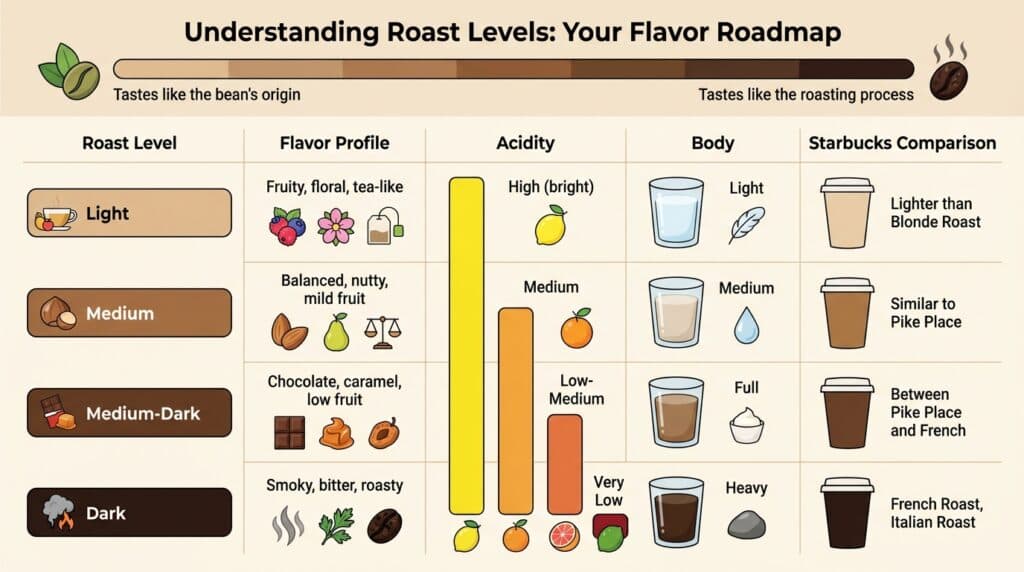
Think of roast levels as a sliding scale from “tastes like the bean’s origin” to “tastes like the roasting process.”
| Roast Level | Flavor Profile | Acidity | Body | Starbucks Comparison |
|---|---|---|---|---|
| Light | Fruity, floral, tea-like | High (bright) | Light | Lighter than Blonde Roast |
| Medium | Balanced, nutty, mild fruit | Medium | Medium | Similar to Pike Place |
| Medium-Dark | Chocolate, caramel, low fruit | Low-Medium | Full | Between Pike Place and French |
| Dark | Smoky, bitter, roasty | Very Low | Heavy | French Roast, Italian Roast |
Counter-intuitive insight: “Stronger” coffee isn’t about roast level—it’s about brew ratio. A light roast brewed at 1:15 (coffee to water) will have more caffeine and intensity than a dark roast at 1:17. Dark roasts just taste bolder due to roast flavors, not actual strength.
Best Roast Profiles for Starbucks Converts
Medium-Dark Roasts: The Bridge
This is the sweet spot for most beginners transitioning to home brewing. You’ll still get that comforting richness without the charred edge.
Pros:
- Familiar body and low acidity
- Works well with milk-based drinks
- Forgiving with different brew methods
- Chocolate and caramel notes feel “coffee-like”
Cons:
- Masks some origin characteristics
- Can taste one-dimensional after a while
- May still have slight bitterness if over-extracted
Who is this for: Anyone who drinks Starbucks black or with minimal additions and wants a smooth transition.
Who is this NOT for: Those eager to taste fruit-forward, complex coffees immediately.
Medium Roasts: The Explorer’s Choice
Once you’ve spent a few weeks with medium-dark, medium roasts introduce origin flavors without shocking your palate.
Pros:
- Balanced sweetness and acidity
- Origin characteristics start to shine
- Versatile across pour-over, drip, and French press
- Often described as “approachable specialty coffee”
Cons:
- May taste “thin” if you’re used to heavy body
- Requires slightly more attention to brew variables
- Acidity might surprise dark-roast drinkers
Who is this for: Beginners ready to explore after a few weeks of home brewing, or those who already enjoy Starbucks Blonde Roast.
Who is this NOT for: Anyone who specifically loves that smoky, intense Starbucks French Roast character.
Origins That Work Well for Beginners
Geography matters. Different growing regions produce distinct flavor profiles, and some are friendlier to transitioning palates than others.
Central and South American Beans
Brazil, Colombia, Guatemala, and Costa Rica produce beans with chocolate, nut, and mild fruit notes. These origins feel familiar to Starbucks drinkers because many commercial blends use them as a base.
- Brazilian beans: Nutty, chocolatey, low acidity. The closest to “classic coffee” flavor.
- Colombian beans: Balanced, medium body, hints of caramel. A safe starting point.
- Guatemalan beans: Slightly more complex with cocoa and subtle spice.
Origins to Save for Later
Ethiopian and Kenyan coffees—while exceptional—often feature intense fruit and floral notes that can taste jarring if you’re expecting traditional coffee flavor. A washed Ethiopian Yirgacheffe might remind you of blueberries and jasmine. Delicious once your palate adjusts, but potentially off-putting on day one.
Practical Tips for Your First Bean Purchase
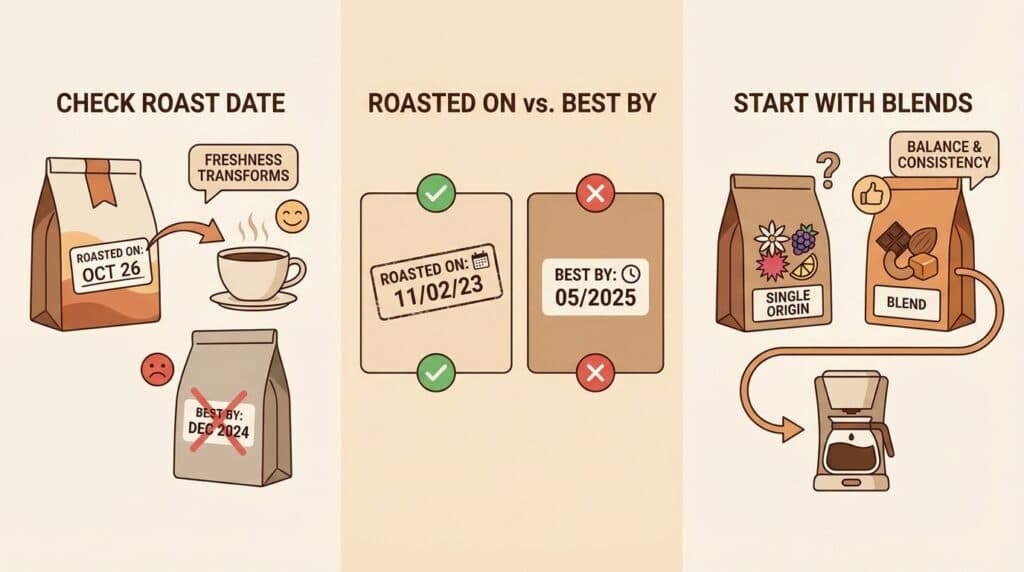
Knowing what to look for on a bag saves trial-and-error frustration.
- Check the roast date: Buy beans roasted within the last 2-4 weeks. Freshness transforms home coffee. Starbucks bags often sit for months—this alone will upgrade your cup.
- Look for “roasted on” not “best by”: Reputable roasters print roast dates. “Best by” dates are marketing, not quality indicators.
- Start with blends: Single origins highlight specific characteristics. Blends are designed for balance and consistency—easier for beginners.
- Buy small quantities: 250g-350g bags let you experiment without committing to a full kilogram of beans you might not love.
Barista Tip: Write the roast date on your bag with a marker and finish it within 4 weeks of opening. Stale beans are the number one reason home coffee disappoints—more than equipment, more than technique.
Myth vs. Reality
- Myth: Dark roast has more caffeine. Reality: Light roasts actually retain slightly more caffeine since roasting burns some off. The difference is minimal, but dark roast definitely isn’t “stronger” in caffeine terms.
- Myth: Oily beans mean fresh beans. Reality: Oil on the surface indicates a very dark roast or beans that have been sitting too long. Fresh medium roasts should look dry.
- Myth: Expensive beans are always better. Reality: A $15 bag from a local roaster, freshly roasted, will outperform a $25 bag that’s been on a shelf for three months.
- Myth: You need an espresso machine to make good coffee. Reality: A simple pour-over or French press with fresh beans produces excellent results. Equipment matters less than bean quality and freshness.
A Simple Transition Plan
Week-by-week, here’s how to ease into home-brewed specialty coffee:
- Weeks 1-2: Medium-dark roast, Brazilian or Colombian origin. Brew with your current method. Focus on freshness.
- Weeks 3-4: Medium roast from the same origin. Notice the increased brightness and sweetness.
- Weeks 5-6: Try a medium roast blend with mixed origins. Pay attention to which flavor notes you enjoy.
- Week 7+: Experiment with single origins based on what you’ve learned about your preferences.
There’s no rush. Some people happily stay in medium-dark territory forever. Others sprint toward light-roast Geishas within a month. Both paths are valid.
Key Takeaways
- Start with medium-dark roasts from Central or South American origins for the smoothest transition
- Prioritize freshness over brand—beans roasted within 2-4 weeks make the biggest difference
- Expect some acidity in lighter roasts; it’s a feature, not a flaw
- Buy small bags (250g-350g) until you know what you like
- Give your palate 2-3 weeks to adjust before judging a new roast level
Tomorrow morning, find a local roaster or order a bag of medium-dark Colombian beans online. Brew it however you normally would. That single change—fresh, quality beans—will show you exactly why home brewing is worth the switch.
If you are still comparing flavor profiles, our guide to Brazil vs Colombia for beginners makes that choice much easier.



Comments