


Table of Contents
- Quick Verdict: Whole Bean Coffee Wins
- Why This Debate Matters for Your Morning Cup
- The Science Behind Coffee Freshness
- What Happens When Coffee Is Ground
- The Freshness Timeline
- Whole Bean Coffee: Pros and Cons
- Pros of Whole Bean Coffee
- Cons of Whole Bean Coffee
- Pre-Ground Coffee: Pros and Cons
- Pros of Pre-Ground Coffee
- Cons of Pre-Ground Coffee
- Choosing the Right Grinder for Home Use
- Blade Grinders vs Burr Grinders
- Manual vs Electric Grinders
- Matching Grind Size to Brewing Method
- The Real Cost Comparison
- Initial Investment
- Long-Term Value
- Frequently Asked Questions
- How long do whole coffee beans stay fresh?
- Can I grind coffee beans the night before?
- Is a cheap blade grinder better than pre-ground coffee?
- How do I know if my coffee beans are fresh?
- What's the best grind size for a beginner?
- Conclusion: Making Your Decision
Quick Verdict: Whole Bean Coffee Wins
If you care about flavor, freshness, and getting the most out of your coffee, whole bean coffee is worth the extra effort. Grinding at home takes only 30 seconds but delivers noticeably fresher, more aromatic, and better-tasting coffee. Pre-ground has its place for convenience, but once you experience freshly ground beans, there’s no going back.
Why This Debate Matters for Your Morning Cup
Have you ever wondered why that coffee shop espresso tastes so much better than what you brew at home? The secret often isn’t the machine or even the beans themselves. It’s when those beans were ground. The whole bean vs pre-ground coffee debate has divided home baristas for years, and for good reason.
In my experience, switching from pre-ground to whole bean coffee was the single biggest upgrade I made to my home brewing routine. But is grinding at home really worth the investment in time, money, and counter space? Let’s break down the science, the practical differences, and help you decide what’s right for your coffee journey.
The Science Behind Coffee Freshness
Understanding why whole bean coffee tastes different starts with a basic chemistry lesson. Don’t worry, I’ll keep it simple and practical.
What Happens When Coffee Is Ground

Coffee beans contain hundreds of volatile aromatic compounds. These compounds are what give coffee its complex flavors and that intoxicating smell we all love. Here’s the catch: these compounds start escaping the moment you grind the beans.
- Surface area explosion: Grinding increases the bean’s surface area by roughly 10,000 times
- Oxidation begins immediately: Oxygen starts breaking down flavor compounds within minutes
- Moisture absorption: Ground coffee absorbs humidity from the air, affecting extraction
- CO2 release: The gases that carry flavor dissipate rapidly after grinding
In short, ground coffee is like a ticking clock. The flavor countdown begins the moment those beans are crushed.
The Freshness Timeline
Here’s a realistic breakdown of how coffee freshness degrades:
| Coffee State | Peak Freshness Window | Still Acceptable |
|---|---|---|
| Whole Bean (sealed) | 2-4 weeks after roast | Up to 6 weeks |
| Whole Bean (opened) | 1-2 weeks | 3-4 weeks |
| Pre-Ground (sealed) | 1-2 weeks after opening | 3-4 weeks |
| Freshly Ground | 15-30 minutes | Same day |
Key Takeaway: Pre-ground coffee from the store was often ground weeks or even months ago. By the time it reaches your cup, much of its potential flavor has already vanished into thin air.
Whole Bean Coffee: Pros and Cons
Let’s get practical about what choosing whole bean coffee actually means for your daily routine.
Pros of Whole Bean Coffee
- Superior freshness: You control when the beans are ground, maximizing flavor
- Better aroma: That fresh-ground smell alone is worth the effort
- Grind size flexibility: Adjust your grind for different brewing methods
- Longer shelf life: Beans stay fresh longer than pre-ground
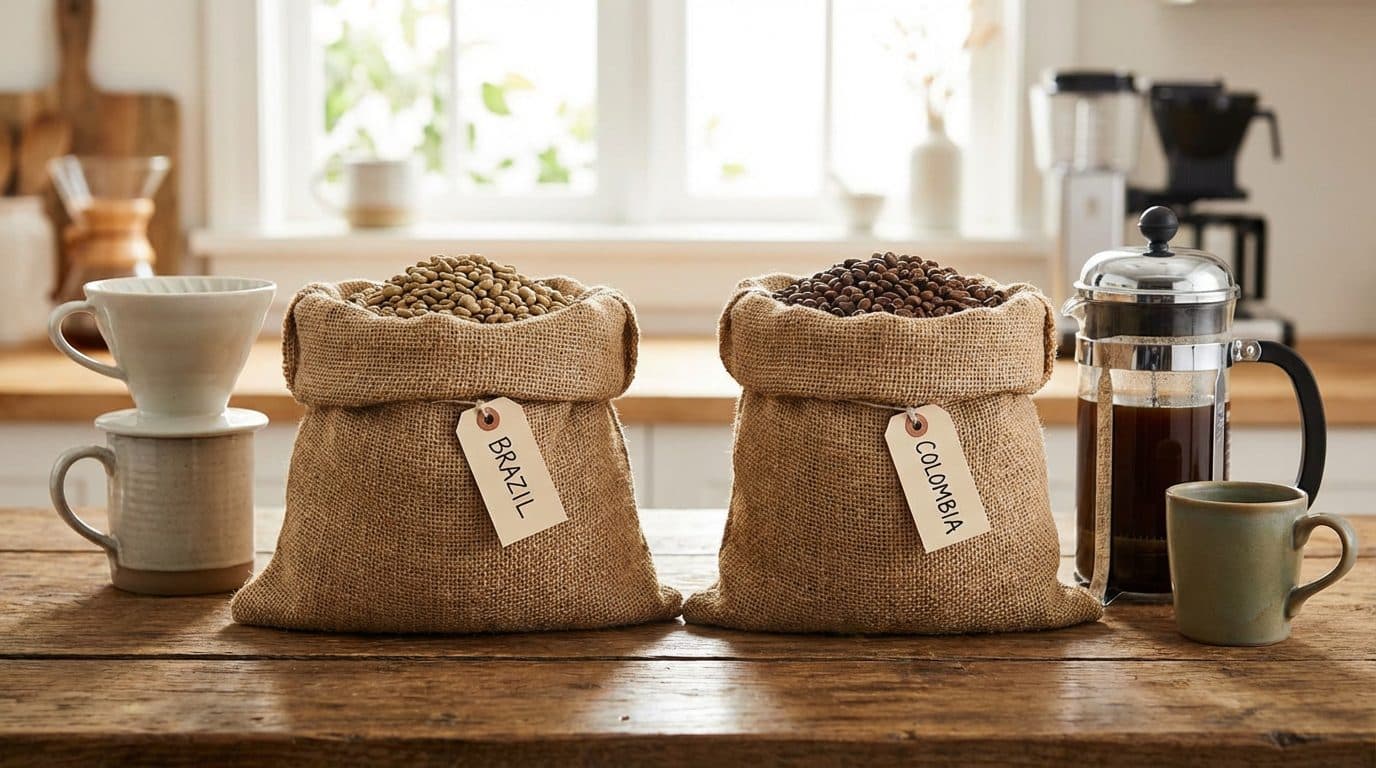
- More variety: Specialty roasters primarily sell whole bean
- Cost efficiency: Premium whole beans often cost the same as mediocre pre-ground
Cons of Whole Bean Coffee
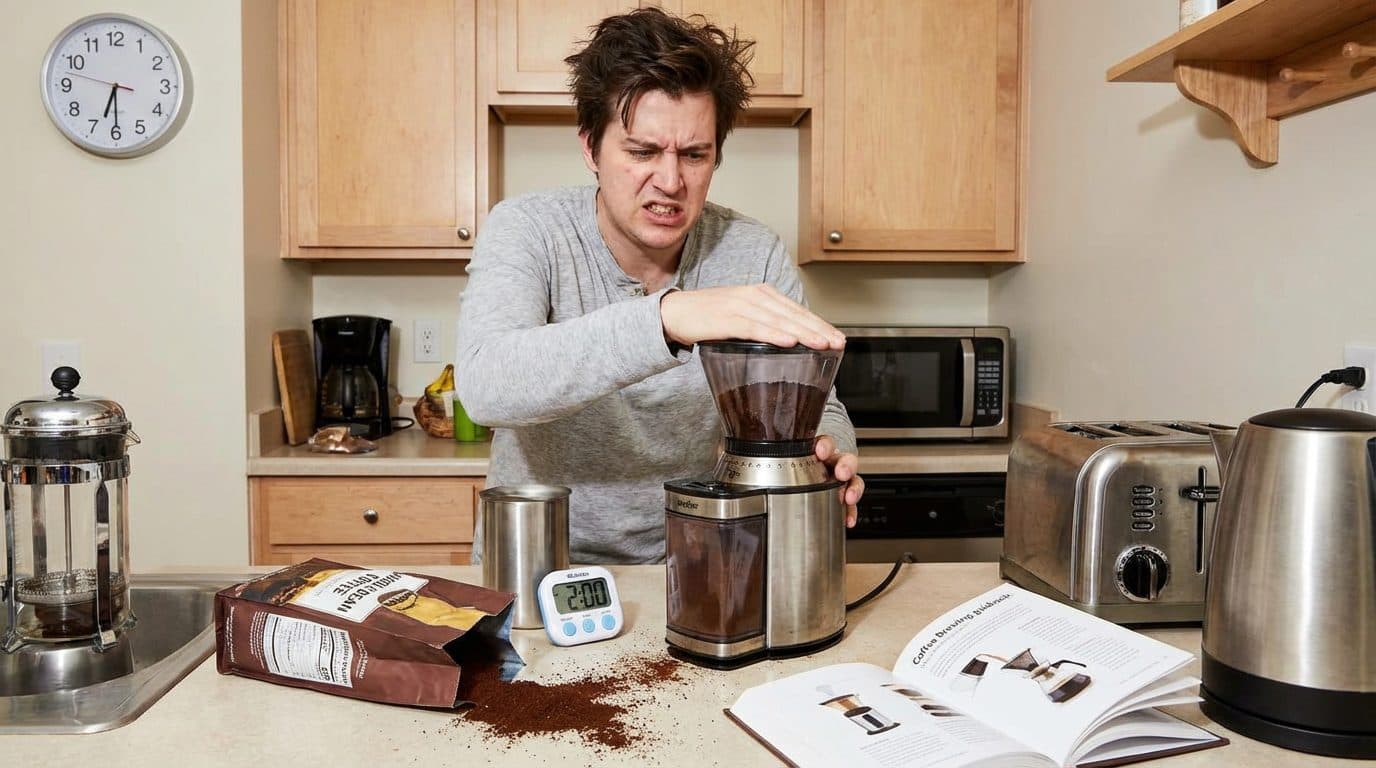
- Requires a grinder: Additional equipment cost ($30-$200+ for quality)
- Takes extra time: Adds 30 seconds to 2 minutes to your routine
- Learning curve: Finding the right grind size takes experimentation
- Noise: Grinders can be loud, especially in the early morning
- Counter space: Another appliance to store
Here’s a real scenario: My neighbor Sarah was skeptical about grinding at home. She tried it for a week using an inexpensive burr grinder. Her exact words? “I didn’t know my French press could taste this good.” The difference was that dramatic.
Pre-Ground Coffee: Pros and Cons
Pre-ground coffee isn’t evil. It serves a purpose, and there’s no shame in choosing convenience when life gets hectic.
Pros of Pre-Ground Coffee
- Ultimate convenience: Scoop, brew, done
- No equipment needed: Save money on a grinder
- Consistent grind: Commercial grinders produce uniform particles
- Quiet mornings: No grinding noise to wake the household
- Travel-friendly: Easy to pack for trips
Cons of Pre-Ground Coffee
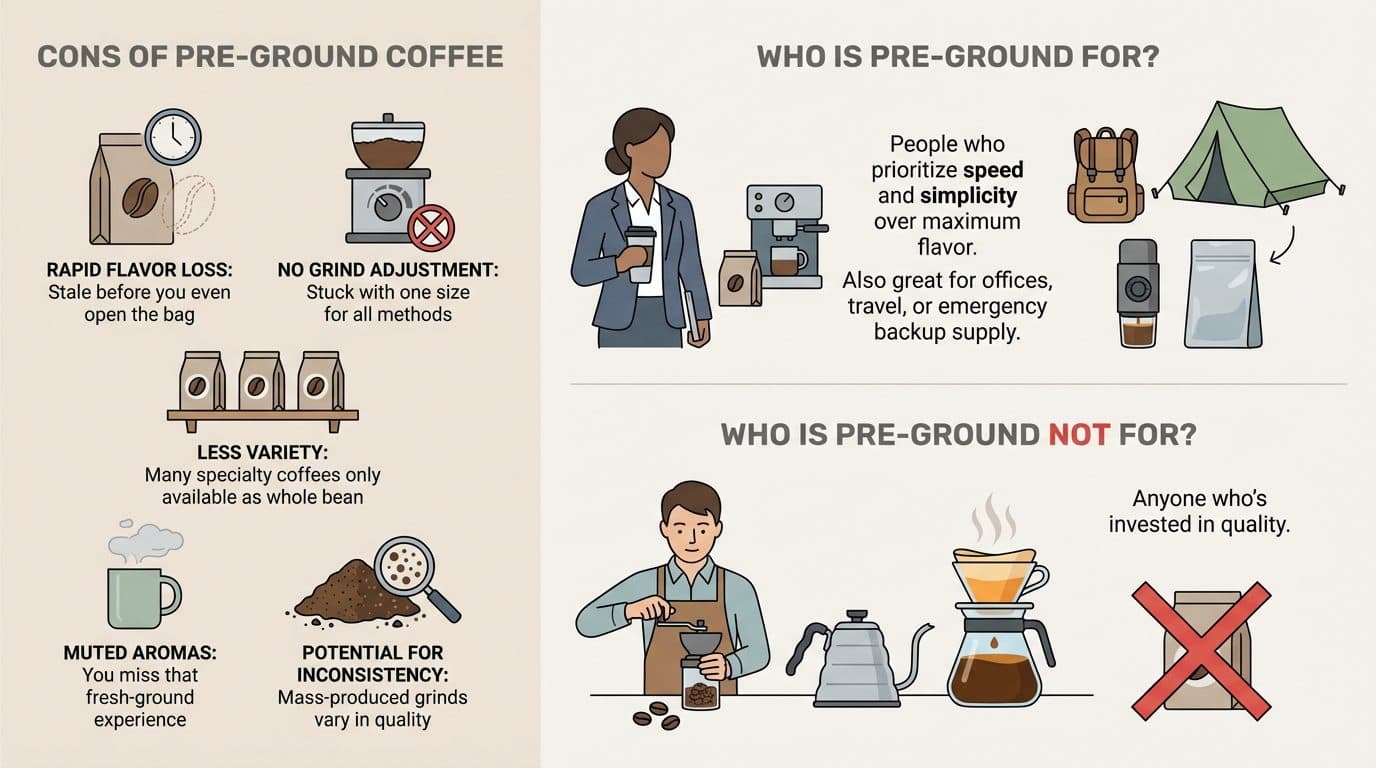
- Rapid flavor loss: Stale before you even open the bag
- No grind adjustment: Stuck with one size for all methods
- Less variety: Many specialty coffees only available as whole bean
- Muted aromas: You miss that fresh-ground experience
- Potential for inconsistency: Mass-produced grinds vary in quality
Who is pre-ground for? People who prioritize speed and simplicity over maximum flavor. Also great for offices, travel, or emergency backup supply.
Who is pre-ground NOT for? Anyone who’s invested in quality brewing equipment or who appreciates nuanced coffee flavors. If you’re spending $15+ on specialty beans, grinding them yourself protects that investment.
Choosing the Right Grinder for Home Use
If you’re leaning toward whole bean coffee, the grinder you choose matters enormously. I’ve tested dozens over the years, and here’s what I’ve learned.
Blade Grinders vs Burr Grinders
| Feature | Blade Grinder | Burr Grinder |
|---|---|---|
| Price Range | $15-$40 | $30-$300+ |
| Grind Consistency | Poor (uneven particles) | Excellent (uniform size) |
| Heat Generation | High (can burn coffee) | Low to moderate |
| Grind Settings | None (time-based) | Multiple precise settings |
| Best For | Beginners, occasional use | Daily brewing, any method |
Barista Tip: If you’re serious about coffee quality, skip the blade grinder entirely. A $50 entry-level burr grinder will outperform a $30 blade grinder every single time. The consistent particle size makes extraction predictable and flavor balanced.
Manual vs Electric Grinders
Manual hand grinders have become increasingly popular, and for good reason. A $40 manual burr grinder often matches the consistency of a $150 electric model. The trade-off is physical effort and time.
- Manual grinders: Quiet, portable, affordable quality, 1-2 minutes of grinding
- Electric grinders: Fast, effortless, louder, higher cost for equivalent quality
I keep both. My electric grinder handles weekday mornings when I’m half-asleep. The manual grinder travels with me and handles weekend pour-overs when I have more time to enjoy the ritual.
Matching Grind Size to Brewing Method

One massive advantage of grinding at home is customization. Different brewing methods require different grind sizes for optimal extraction.
- Extra coarse (sea salt): Cold brew
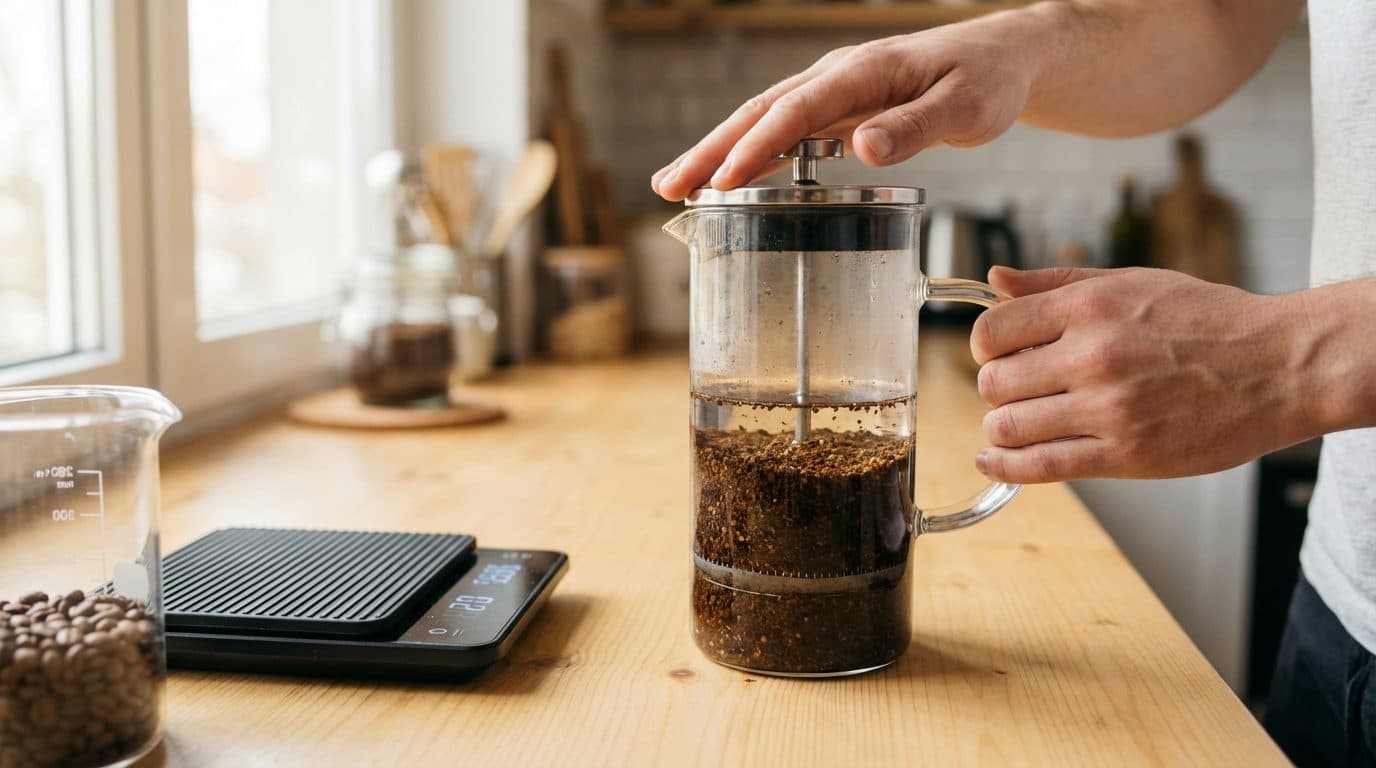
- Coarse (kosher salt): French press, percolator
- Medium-coarse: Chemex, clever dripper
- Medium: Drip coffee makers, pour-over
- Medium-fine: AeroPress, Moka pot
- Fine (table salt): Espresso
- Extra fine (powder): Turkish coffee
With pre-ground coffee, you’re typically stuck with a medium grind designed for drip machines. Try using that in your French press, and you’ll get weak, under-extracted coffee. Use it for espresso, and it’ll gush through too fast, tasting sour and thin.
Did You Know? The difference between a great cup and a mediocre one often comes down to just a few clicks on your grinder’s adjustment dial. This precision simply isn’t possible with pre-ground coffee.
The Real Cost Comparison
Let’s address the elephant in the room: is grinding at home actually cost-effective?
Initial Investment
- Quality entry-level burr grinder: $50-$100
- Mid-range burr grinder: $100-$200
- Quality manual grinder: $40-$80
Long-Term Value
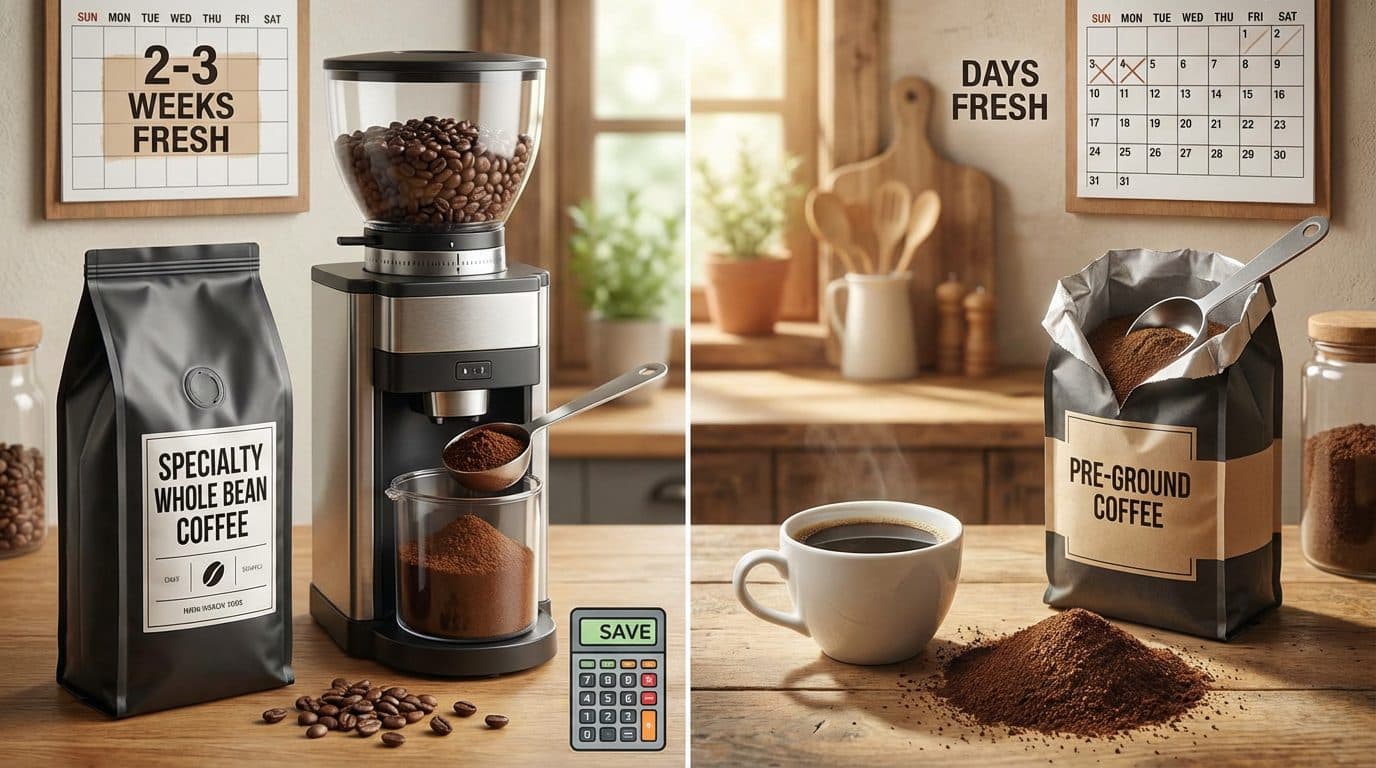
Consider this scenario. A bag of specialty whole bean coffee costs $16 for 12 ounces. The same quality pre-ground (if available) costs about the same. But here’s the difference:
- Pre-ground loses significant flavor within days of opening
- Whole bean maintains quality for 2-3 weeks after opening
- You extract more flavor from fresh-ground beans, meaning you might use slightly less per cup
A decent grinder pays for itself within 6-12 months when you factor in the improved experience and reduced waste from stale coffee you’d otherwise throw away.
Frequently Asked Questions
How long do whole coffee beans stay fresh?
Whole beans are at their peak flavor 7-21 days after roasting. Stored properly in an airtight container away from light and heat, they remain good for about 4-6 weeks. After that, they’re still safe to drink but will taste noticeably flat.
Can I grind coffee beans the night before?
You can, but I wouldn’t recommend it for best results. Ground coffee loses roughly 60% of its aroma within 15 minutes. If you must pre-grind, do it right before bed and store it in an airtight container. It won’t be perfect, but it’s better than grinding days in advance.
Is a cheap blade grinder better than pre-ground coffee?
Surprisingly, not always. Blade grinders produce wildly inconsistent particle sizes, which leads to uneven extraction. Some particles over-extract (bitter), others under-extract (sour). High-quality pre-ground from a reputable roaster might actually taste more balanced. If budget is tight, save up for a proper burr grinder instead.
How do I know if my coffee beans are fresh?
Look for a roast date on the bag, not just an expiration date. Fresh beans should have a strong aroma when you open the bag. They’ll also release CO2, so bags with one-way valves that puff up slightly indicate freshness. Stale beans look oily on the surface and smell flat or cardboard-like.
What’s the best grind size for a beginner?
Start with medium grind, roughly the texture of regular sand. This works well for most drip coffee makers and pour-over methods. From there, adjust based on taste: if coffee tastes bitter, go coarser; if it tastes sour or weak, go finer.
Conclusion: Making Your Decision
So, is grinding coffee at home really worth it? In my experience, absolutely yes, if you care about flavor and are willing to spend an extra 30 seconds each morning. The difference in taste, aroma, and overall coffee experience is substantial enough that most people never go back to pre-ground once they make the switch.
That said, life is too short for coffee snobbery. Pre-ground coffee serves its purpose when convenience matters most. There’s no shame in keeping a bag around for rushed mornings or houseguests. The best coffee is the one you actually enjoy drinking.
If you’re on the fence, try this experiment: buy a small bag of whole bean coffee from a local roaster along with your usual pre-ground. Borrow a friend’s grinder or use the grinder at the coffee shop. Brew both side by side and taste the difference yourself. That firsthand experience will tell you everything you need to know about whether grinding at home fits your coffee priorities.

Comments