


Table of Contents
- Why Your Espresso Shot Is Running Too Fast
- Common Causes of Fast Shots
- Grind Finer: The First Line of Defense
- How Grinding Finer Affects Extraction
- When to Choose Grind Adjustment
- Real-World Example
- Updosing: When More Coffee Makes Sense
- How Updosing Affects Extraction
- When to Choose Updosing
- The Risks of Updosing
- Grind Finer vs. Updose: A Quick Comparison
- Myth-Busting: Common Misconceptions
- Myth: Updosing Always Gives You a Stronger Shot
- Myth: Finer Is Always Better
- Myth: The Grind Setting Is Universal
- A Step-by-Step Troubleshooting Framework
- Frequently Asked Questions
- How do I know if my shot is running too fast?
- Should I adjust grind or dose first when dialing in new beans?
- Can I adjust both grind and dose at the same time?
- My shot is still too fast even at the finest grind setting. What now?
- Does the type of roast affect whether I should grind finer or updose?
- Conclusion and Next Steps
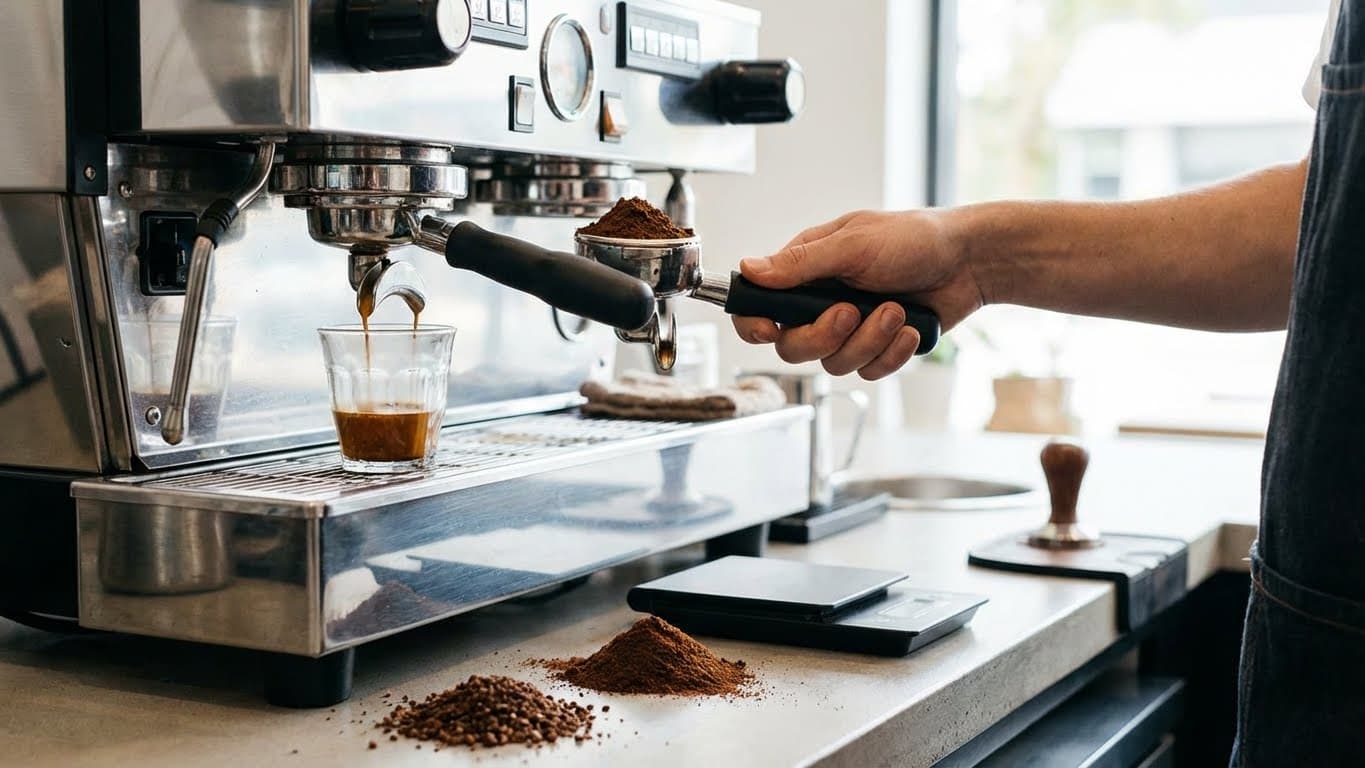
You pull what you think will be the perfect espresso shot, and it gushes out in 15 seconds flat. The resulting liquid is thin, sour, and utterly disappointing. Sound familiar? When your espresso shot runs too fast, you’re facing one of the most common home barista frustrations. The big question is: should you grind finer, or should you updose? In my experience, the answer isn’t always straightforward, and understanding *why* your shot is running fast will help you make the right adjustment every time.
In this guide, we’ll break down both solutions, when to use each one, and how to dial in your espresso like a pro. By the end, you’ll have a clear troubleshooting framework that’ll save you from wasting precious coffee beans on channeled, under-extracted shots.
Why Your Espresso Shot Is Running Too Fast
Before you start tweaking variables, let’s understand what’s actually happening. Espresso extraction is all about resistance. Water at high pressure pushes through a compressed puck of coffee, and the speed at which it flows depends on how much resistance that puck provides.
When your shot runs too fast, it means water is finding an easy path through the coffee. This typically results in under-extraction, where you’re not pulling enough of the good stuff—the sugars, oils, and complex flavors—from your beans. Instead, you get a thin, sour, and often watery shot that lacks body and sweetness.
Common Causes of Fast Shots
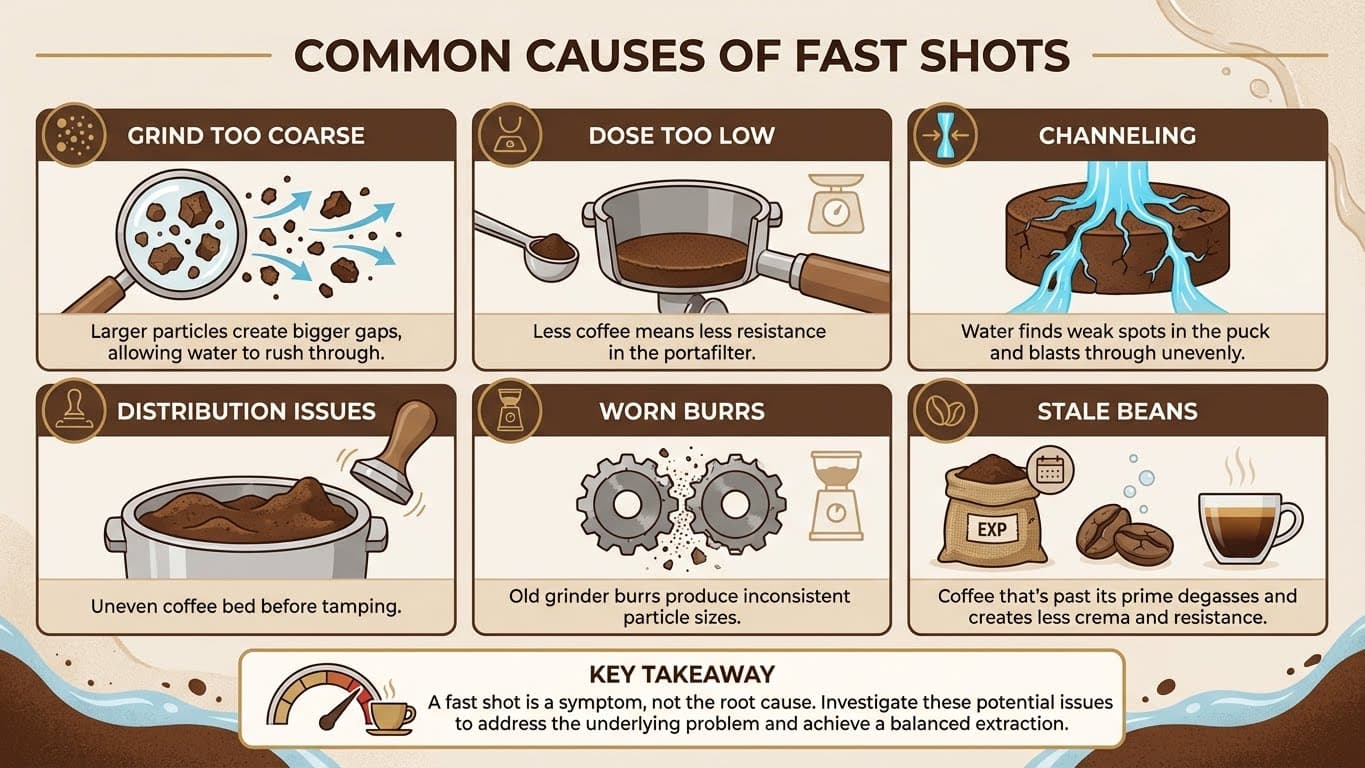
- Grind too coarse: Larger particles create bigger gaps, allowing water to rush through
- Dose too low: Less coffee means less resistance in the portafilter
- Channeling: Water finds weak spots in the puck and blasts through unevenly
- Distribution issues: Uneven coffee bed before tamping
- Worn burrs: Old grinder burrs produce inconsistent particle sizes
- Stale beans: Coffee that’s past its prime degasses and creates less crema and resistance
Key Takeaway: A fast shot is a symptom, not the root cause. Identifying whether it’s a grind, dose, or technique issue is crucial before making adjustments.
Grind Finer: The First Line of Defense
Here’s the golden rule I’ve found works about 80% of the time: when your shot runs too fast, grind finer first. This is your most powerful and precise tool for controlling extraction time.
How Grinding Finer Affects Extraction
When you grind finer, you create smaller coffee particles. These smaller particles pack together more tightly, reducing the gaps between them. Water now has to work harder to push through, which slows down the flow rate and increases contact time. More contact time means more extraction, which translates to a sweeter, more balanced, and fuller-bodied shot.
Think of it like this: imagine pouring water through a bucket of rocks versus a bucket of sand. The rocks (coarse grind) let water rush through. The sand (fine grind) makes it crawl.
When to Choose Grind Adjustment
- Your current dose already fills the basket appropriately
- You’re seeing blonde, fast-flowing espresso from the start
- The shot tastes sour and thin (classic under-extraction)
- You have room to go finer on your grinder
- Your puck prep and distribution are solid
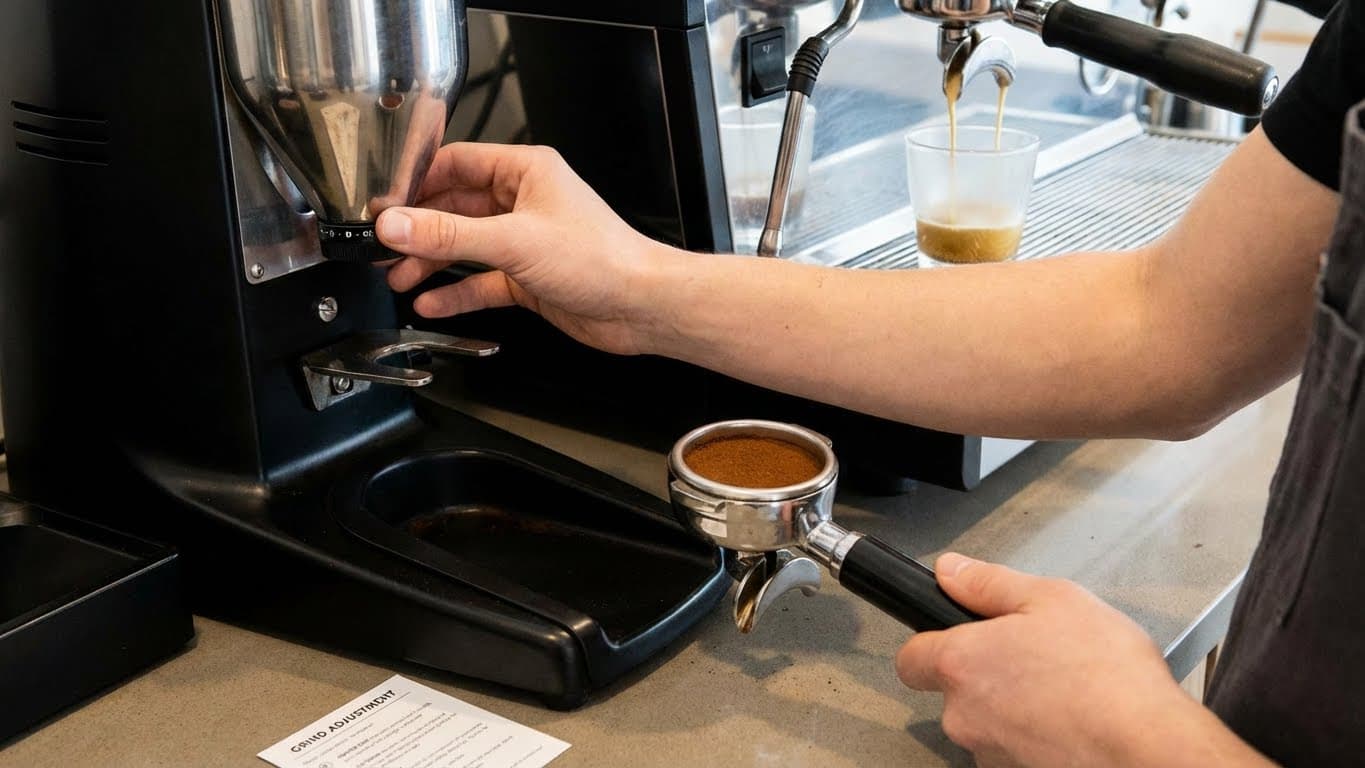
Barista Tip: Make small adjustments—I’m talking one or two notches on most grinders. Espresso is incredibly sensitive, and going too fine too fast can choke your machine entirely. In my experience, patience here saves you from swinging wildly between extremes.
Real-World Example
Let’s say you’re pulling an 18g dose targeting a 36g yield in 25-30 seconds. Your shot finishes in 18 seconds, and it tastes sharp and acidic. You grind one step finer, pull again, and now it’s at 22 seconds—still fast but improving. One more step finer, and you hit 27 seconds with a noticeably sweeter, more balanced cup. That’s the process: incremental adjustments until you land in the sweet spot.
Updosing: When More Coffee Makes Sense
Now, updosing—adding more coffee to your portafilter—is the other lever you can pull. But here’s the thing: it’s not always the right choice, and it can actually introduce new problems if you’re not careful.
How Updosing Affects Extraction
When you add more coffee, you increase the total mass of the puck. This creates more resistance simply because there’s more material for water to push through. The result is a slower flow rate and longer extraction time.
However, updosing also changes your brew ratio. If you were pulling 18g in and 36g out (a 1:2 ratio), bumping to 20g in while keeping 36g out changes that to 1:1.8. This can alter the flavor profile, sometimes making the shot more intense or concentrated.
When to Choose Updosing
- You’re already grinding at or near your grinder’s finest setting
- Your basket can accommodate more coffee (check headspace)
- You want a more intense, concentrated flavor profile
- You’re using a light roast that needs more resistance
- Your current dose leaves significant headspace in the portafilter
The Risks of Updosing
Here’s where I need to add a word of caution. Overfilling your basket creates problems:
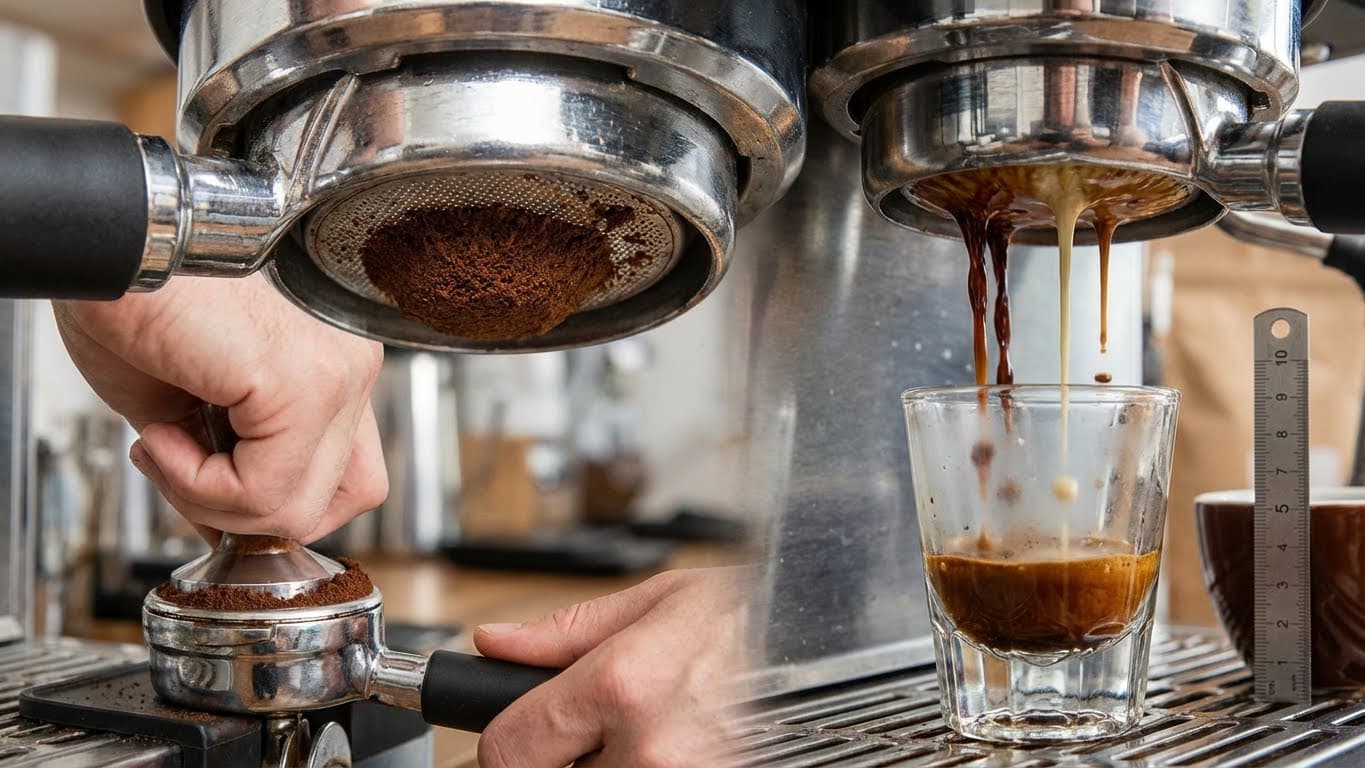
- Screen contact: If the puck touches the shower screen, it can cause channeling and uneven extraction
- Inconsistent tamping: An overfilled basket is harder to tamp evenly
- Extraction imbalance: Too much coffee can lead to under-extraction of the center while over-extracting the edges
Always check that you have about 2-3mm of headspace between your tamped puck and the shower screen. You can do this by locking in an empty portafilter, then inserting a tamped puck to see where it sits.
Grind Finer vs. Updose: A Quick Comparison
| Factor | Grind Finer | Updose |
|---|---|---|
| Precision | High—fine-tune in small steps | Lower—harder to adjust by small amounts |
| Flavor Impact | Maintains ratio; increases extraction | Changes ratio; can intensify flavor |
| Best For | Most situations | Maxed-out grind or light roasts |
| Risk | Choking the machine if too fine | Puck contact and channeling |
| Cost | No extra coffee used | Uses more coffee per shot |
Myth-Busting: Common Misconceptions
Let’s clear up some confusion I see floating around coffee forums constantly.
Myth: Updosing Always Gives You a Stronger Shot
Not necessarily. “Stronger” is subjective. Updosing can give you more body and intensity, but if your shot is running fast because of a grind issue, adding more coffee won’t fix the under-extraction. You’ll just have more under-extracted coffee. Strength and extraction are related but separate concepts.
Myth: Finer Is Always Better
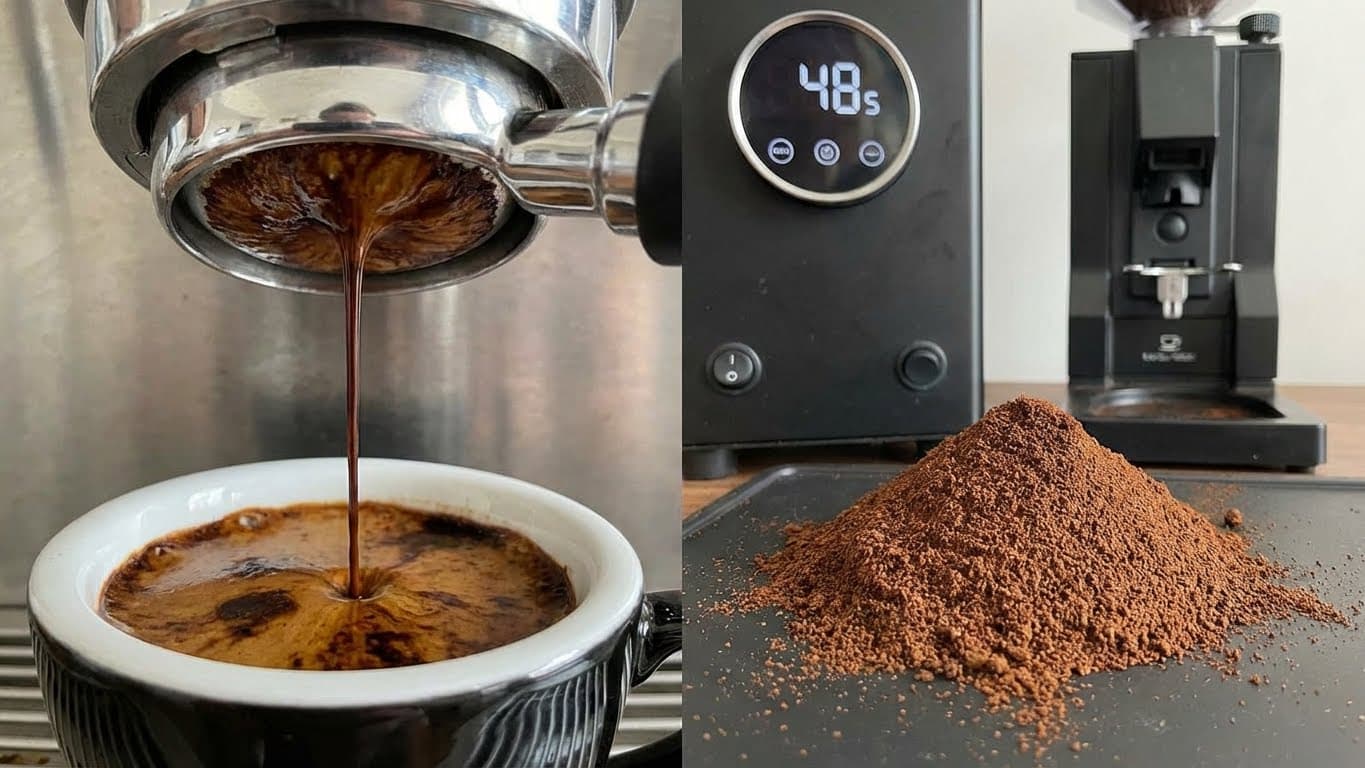
There’s a limit. Go too fine, and you’ll choke your machine—water can’t push through at all, or it comes out in drips and takes 45+ seconds. The result? Bitter, ashy, over-extracted espresso. Balance is everything.
Myth: The Grind Setting Is Universal
Your perfect grind setting changes constantly. Different beans, roast dates, humidity levels, and even temperature can all affect how your coffee extracts. I’ve found that I adjust my grinder almost daily, especially when dialing in fresh bags.
A Step-by-Step Troubleshooting Framework
Here’s the exact process I follow when my shot runs too fast. Life is too short for bad coffee, so let’s fix this systematically.
- Step 1: Check your puck prep first. Distribute evenly, tamp level, and look for obvious issues
- Step 2: Verify your dose is appropriate for your basket size
- Step 3: Grind one step finer and pull another shot
- Step 4: Taste and time. Repeat step 3 until you’re in the 25-35 second range
- Step 5: If you’ve maxed out your grinder, then consider updosing by 0.5-1g
- Step 6: If problems persist, evaluate bean freshness and grinder burr condition
Barista Tip: Keep a small notebook or use your phone to track grind settings for different beans. Future you will thank present you when you revisit a favorite roaster.
Frequently Asked Questions
How do I know if my shot is running too fast?
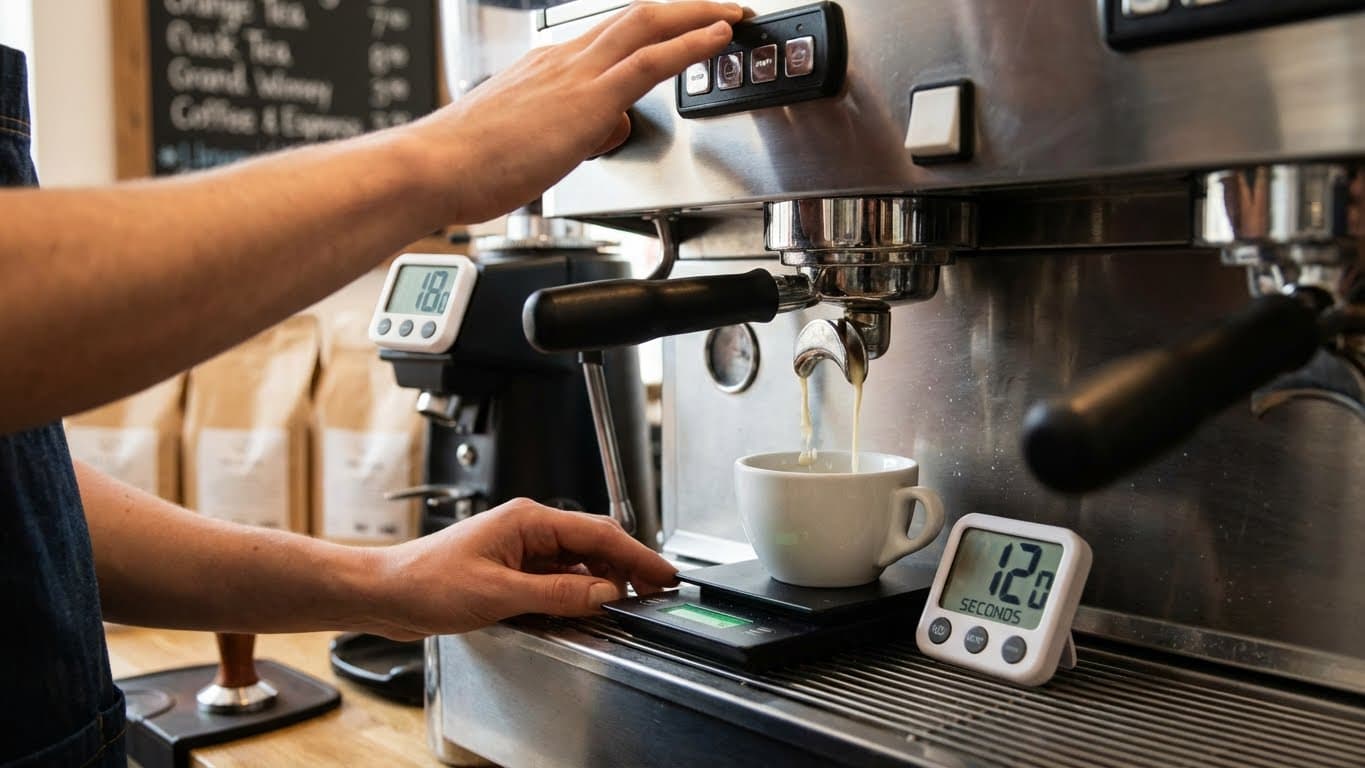
Generally, a standard espresso shot should take between 25-35 seconds from the moment you start the pump to when you stop extraction. If you’re hitting your target yield (usually double the input, so 36g out from 18g in) in under 20 seconds, your shot is running too fast. Taste is also a giveaway: sour, thin, and watery equals too fast.
Should I adjust grind or dose first when dialing in new beans?
Start with grind. Keep your dose consistent (whatever your basket recommends, usually 18-20g for a double) and adjust grind size until you’re in the ballpark. Only tweak dose once you’ve established a solid grind setting. This gives you a consistent baseline to work from.
Can I adjust both grind and dose at the same time?
I strongly advise against it. Changing two variables simultaneously makes it impossible to know which adjustment helped or hurt. Change one thing, taste, assess, then decide your next move. It feels slower, but it’s actually more efficient in the long run.
My shot is still too fast even at the finest grind setting. What now?
This suggests a few possibilities: your grinder may not be capable of true espresso-fine grinding, your burrs might be worn, or your beans are exceptionally stale. Try updosing by 1g first. If that doesn’t work, consider whether your equipment is suited for espresso. Entry-level grinders often struggle with the precision espresso demands.
Does the type of roast affect whether I should grind finer or updose?
Absolutely. Light roasts are denser and harder, requiring finer grinds and sometimes higher doses to create adequate resistance. Dark roasts are more porous and brittle, extracting faster and often needing coarser grinds. When switching between roast levels, expect to make significant adjustments.
Conclusion and Next Steps
When your espresso shot runs too fast, grinding finer should be your default first move. It’s precise, doesn’t waste extra coffee, and directly addresses the resistance problem causing under-extraction. Save updosing for situations where your grinder is maxed out, you’re working with stubborn light roasts, or you specifically want a more concentrated shot profile.
Remember that dialing in espresso is a skill that improves with practice. Every adjustment teaches you something about how your beans, grinder, and machine interact. By following the systematic approach outlined here—checking puck prep, adjusting grind incrementally, and only then considering dose changes—you’ll spend less time guessing and more time enjoying genuinely delicious espresso at home.

Comments