


Table of Contents
- Choose by Strength, Volume, and Workflow
- How These Brewers Extract Coffee Differently
- Strength and Flavor: A Direct Comparison
- Counter-Intuitive Insight
- Moka Pot: Pros and Cons
- Drip Coffee Maker: Pros and Cons
- Myth vs. Reality
- Who Should Choose the Moka Pot
- Who Should Choose the Drip Coffee Maker
- Can You Have Both?
- Key Takeaways
- Sources and Measurement Context
Choose by Strength, Volume, and Workflow
Choose a moka pot when a smaller, more concentrated serving and a hands-on stovetop workflow fit the routine. Choose an automatic drip brewer when batch volume, repeatability, and lower active attention matter more.
Quick answer: Pick a moka pot if your priority is strength and intensity, but choose a drip machine if you care more about convenience, volume, and a smoother everyday cup.
Short answer: A moka pot commonly makes a smaller, more concentrated drink than a drip brewer, but no universal multiplier applies. Separate concentration, perceived flavor intensity, and caffeine in the finished serving before deciding which meaning of “strong” matters.
Review basis: Brewing-method evidence and standards were checked on August 29, 2026. Published measurements apply to the tested coffee, dose, water, grind, equipment, and beverage yield; they are not product-wide guarantees.
Quick Verdict: Choose the moka pot if you crave intense, full-bodied coffee with a slight bitterness and don’t mind a hands-on process. Choose a drip coffee maker if you want convenience, larger batches, and a cleaner, more nuanced flavor profile. Neither is objectively superior—they serve different purposes.
The moka pot vs drip coffee maker debate comes down to a fundamental trade-off: concentration versus convenience. Understanding how each extracts coffee will help you pick the right tool for your morning routine.
How These Brewers Extract Coffee Differently
A moka pot uses steam pressure to move hot water through ground coffee. In one controlled comparison, researchers used 15 g of coffee and 150 mL of water in a moka pot operating at a reported 1.5 bar; that is one experimental protocol, not a universal pressure or ratio for every pot. Follow the exact model manual and adjust grind from the tasted result.
Automatic drip brewers distribute hot water over ground coffee and filter the beverage into a carafe. The SCA Certified Home Brewer requirements specify 92–96°C contact temperature and a four-to-eight-minute water-contact window for certification tests; those values describe the standard, not every machine or coffee recipe.
Starting grind: Use the moka-pot manufacturer’s guidance for the exact model and a medium setting for drip, then change one step at a time. Coffee, grinder calibration, dose, flow, and equipment can all change the useful setting.
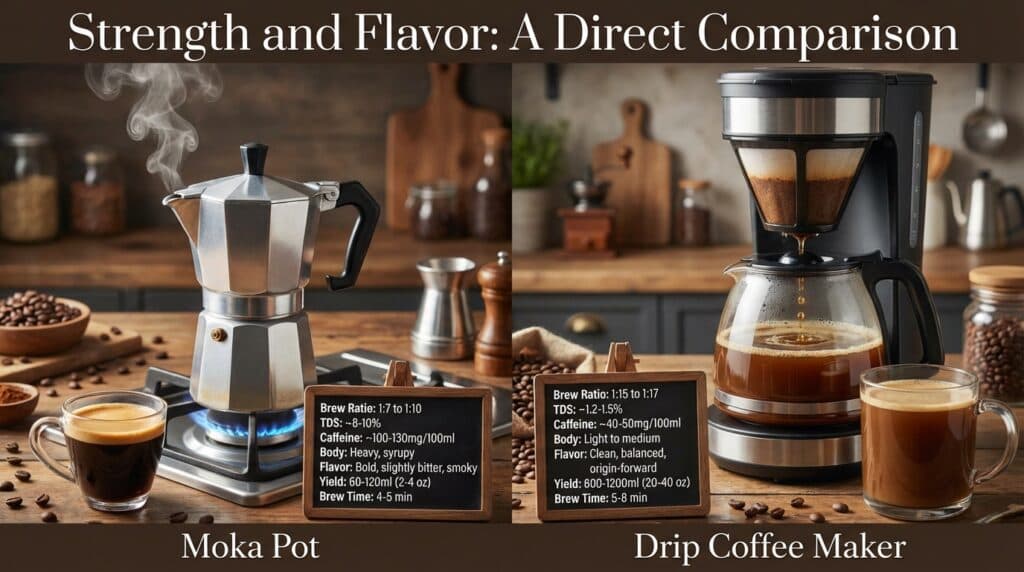
Strength and Flavor: A Direct Comparison
| Factor | Moka Pot | Drip Coffee Maker |
|---|---|---|
| Brew Ratio | Model and recipe dependent; record dry dose, starting water, and beverage yield | Use a documented brewer recipe, then adjust by taste |
| TDS (Total Dissolved Solids) | No universal value; measure the finished beverage for the exact protocol | No universal value; paper filtration, dose, grind, and yield change the result |
| Caffeine per 100ml | Not fixed; depends on coffee, dose, extraction, and finished yield | Not fixed; compare the full serving, not only 100 mL |
| Body | Often fuller-bodied; verify with the exact coffee and filter | Often cleaner with paper filtration; equipment and recipe matter |
| Flavor Profile | Can taste more intense; roast and extraction determine the profile | Can taste cleaner; balance and origin character are not guaranteed |
| Typical Yield | Use the exact pot’s labeled capacity and measure beverage yield | Use the exact brewer’s minimum and maximum batch specifications |
| Brew Time | Model, heat source, water, and dose dependent; monitor the brew | Machine and batch dependent; certified-brewer testing uses a defined window |
If “strong” means concentration or perceived intensity, a moka pot is a practical first trial. Total caffeine cannot be inferred from brewer name or drink volume alone: coffee species, roast, dry dose, extraction, and the amount consumed all matter.
Counter-Intuitive Insight
Moka coffee and pump-machine espresso use different equipment and recipes. A controlled moka study reported 1.5 bar for its test pot, while espresso standards and recipes use different pressure and beverage-yield contexts. Compare the measured drink rather than calling moka coffee espresso or a strong Americano.
Moka Pot: Pros and Cons
Pros:
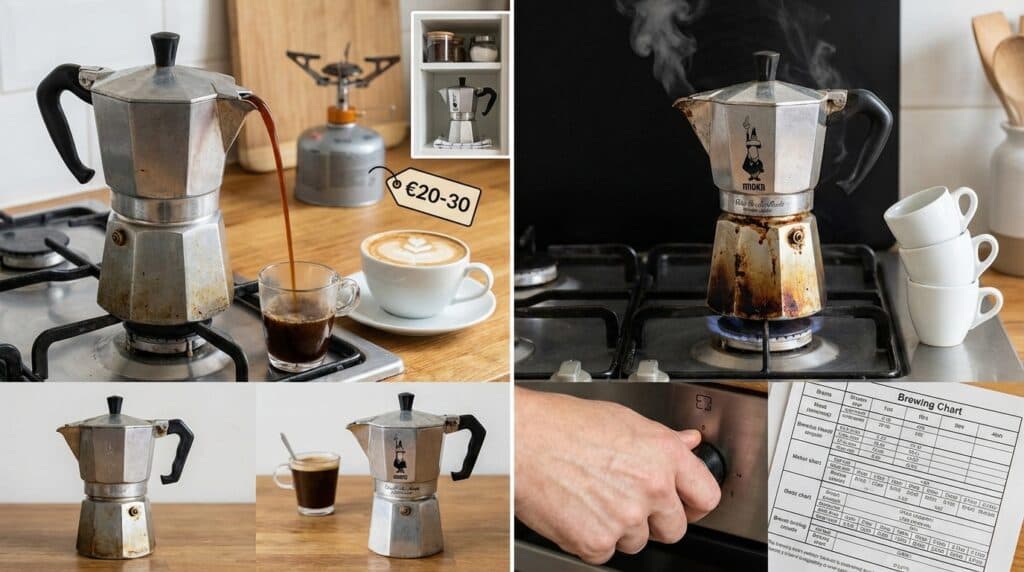
- Produces concentrated, intense coffee ideal for milk drinks or sipping straight
- Some models need no mains electricity; verify induction, gas, electric, and camping-stove compatibility in the exact model manual
- Compact manual brewer; compare current local price, size, replacement parts, and heat-source compatibility
- Compact footprint, easy to store
- Service life depends on the model, materials, gasket and valve care, water, damage, and replacement-part availability
Cons:
- Requires active heat and handling; follow the model manual and remove it from heat at the instructed stage
- Small batch sizes (most common sizes yield 3-6 cups, where “cup” means 30-50ml)
- Steeper learning curve—heat control and grind size take practice
- Can produce bitter, over-extracted coffee if technique is off
- Cleanup involves multiple parts
Drip Coffee Maker: Pros and Cons
Pros:
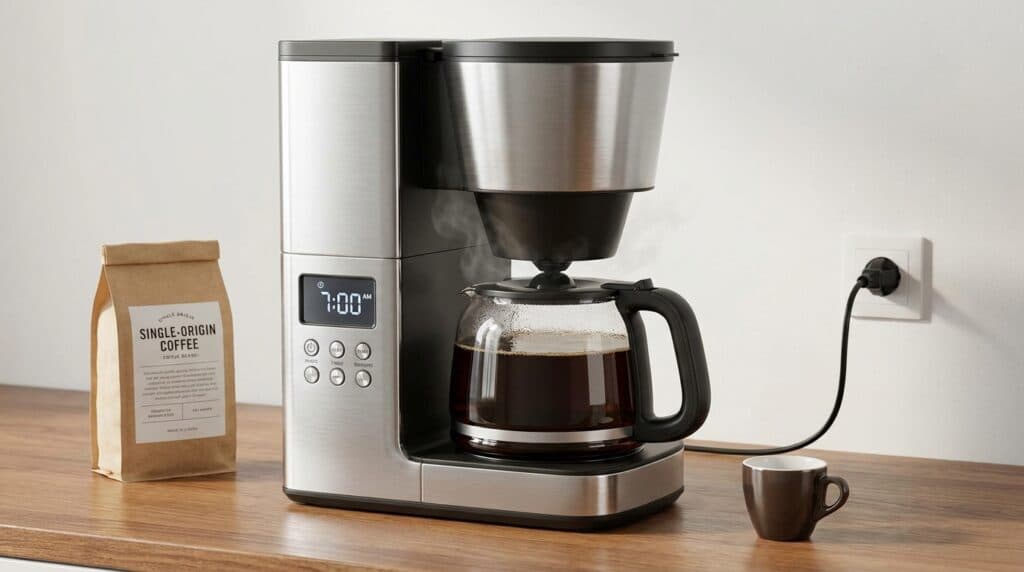
- Set-and-forget convenience—add water, grounds, press a button
- Large batch capacity for households or entertaining
- Consistent results once dialed in
- Programmable timers on many models (wake up to fresh coffee)
- Cleaner cup highlights single-origin nuances
Cons:
- Cannot produce concentrated, espresso-style coffee
- Temperature, water distribution, batch range, carafe, and certification differ by model; check current test documentation
- Takes up counter space
- Requires electricity
- A warming plate can change held-coffee flavor over time; compare hold time and carafe design without assuming a thermal carafe solves every issue
Myth vs. Reality
- Myth: Moka pot coffee is too bitter to enjoy black.
Reality: Bitterness can reflect roast, grind, dose, water, heat, or the brew endpoint. Follow the exact pot manual, handle hot water and metal carefully, and change one variable at a time. - Myth: Drip coffee is weak and watery.
Reality: A thin drip brew can reflect dose, grind, coffee, water distribution, temperature, or batch size. The SCA 92–96°C range belongs to its certified-brewer test requirements and does not guarantee a preferred cup. - Myth: You need expensive equipment for good coffee.
Reality: Price alone does not predict the preferred cup. Compare fresh coffee with the same water, record each brewer’s dose and beverage yield, and evaluate workflow separately from taste.
Who Should Choose the Moka Pot
This is for you if:
- You prefer small, intense servings over large mugs
- You enjoy making lattes, cappuccinos, or café con leche at home
- You appreciate a hands-on, ritualistic brewing process
- You want espresso-style strength without an espresso machine budget
- You travel or camp and need a portable, electricity-free option
This is NOT for you if:
- You need coffee ready the moment you wake up
- You brew for multiple people simultaneously
- You prefer light, tea-like coffee with delicate acidity
- You dislike monitoring the stove
Who Should Choose the Drip Coffee Maker
This is for you if:
- You drink multiple cups throughout the morning
- You value convenience and consistency over intensity
- You want to explore single-origin coffees and taste their distinct characteristics
- You’re brewing for a household, not just yourself
- You prefer a cleaner, less oily cup
This is NOT for you if:
- You want concentrated coffee for milk-based drinks
- You have minimal counter space
- You’re chasing that thick, punchy espresso-adjacent experience
Can You Have Both?
Absolutely. Many home coffee enthusiasts own both. The moka pot handles weekend lattes and after-dinner coffee. The drip maker covers weekday mornings when time is short. They complement rather than compete.
If budget or space forces a single choice, ask yourself one question: do you want intensity or volume? Intensity points to the moka pot. Volume points to drip.
Key Takeaways
- Moka pots commonly produce a smaller, more concentrated serving, but the multiplier depends on the measured recipe
- Drip makers excel at convenience, consistency, and larger batches
- Neither is “better”—they serve different needs and preferences
- Brewer, coffee, grind, dose, water, temperature, contact time, and filtration all affect the result
- For a smaller concentrated base without a pump espresso machine, compare a moka pot with other manual options using current local cost and workflow
- For larger paper-filtered batches, compare drip brewers by batch range, temperature documentation, water distribution, carafe, service, and current certification
Choose by the serving size, measured concentration, active attention, batch need, cleanup, heat-source compatibility, and flavor you prefer. Record dry coffee dose and finished beverage yield for both brewers before comparing caffeine or strength.
Sources and Measurement Context
- Angeloni et al.: controlled comparison of moka, V60, espresso, and other extraction methods
- PubMed record: brewing method, serving size, and caffeine context
- Specialty Coffee Association: Certified Home Brewer test requirements
- Specialty Coffee Association: current certified home brewer list
Safety: Use only a stable heat source and the exact pot’s compatible size and material. Keep the safety valve clear, do not overfill or force the pot open while hot or pressurized, and follow the manufacturer’s current instructions.



Comments