


Table of Contents
- How These Brewers Extract Coffee Differently
- Strength and Flavor: A Direct Comparison
- Is Moka Pot Coffee Espresso?
- Moka Pot: Pros and Cons
- Drip Coffee Maker: Pros and Cons
- Who Should Choose the Moka Pot
- Who Should Choose the Drip Coffee Maker
- Can You Have Both?
- Frequently Asked Questions
- Is moka pot coffee stronger than drip coffee?
- Does a moka pot have more caffeine than drip coffee?
- Can I use drip coffee grounds in a moka pot?
- How long does each one take?
- Why does my moka pot coffee taste burnt?
- The Bottom Line
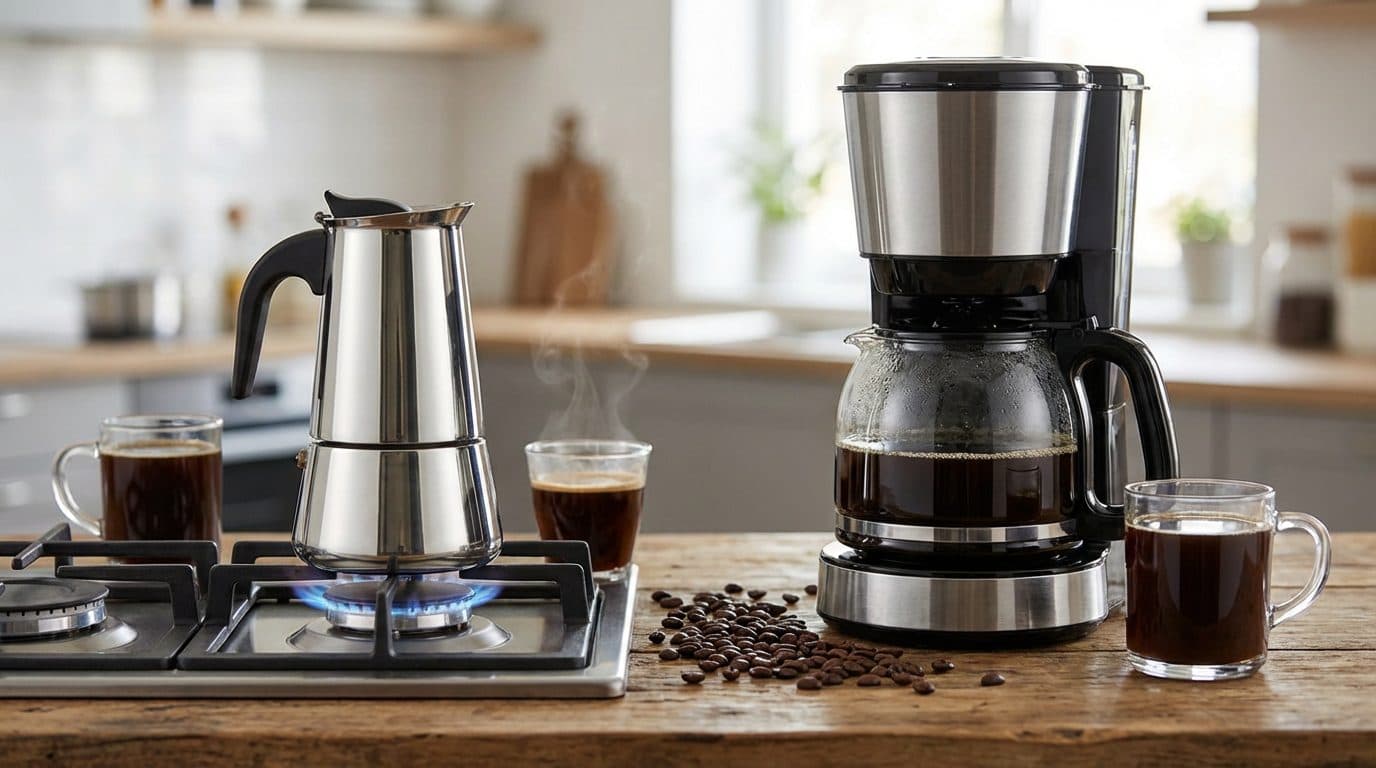
A moka pot makes the stronger coffee by concentration; a drip coffee maker makes more coffee with less effort. Wikipedia’s moka pot entry puts moka coffee at roughly 3–4% dissolved solids, against about 2% for drip-brewed coffee and 9–10% for espresso. So a moka pot gives a smaller, denser cup, while a drip machine, which the National Coffee Association (NCA) describes as convenient and consistent, suits people who want a full carafe at the press of a button. Which one is “better” depends on whether you want intensity per sip or volume.
How These Brewers Extract Coffee Differently
Moka pot. Wikipedia describes the moka pot as a stove-top or electric coffee maker that pushes hot water through ground coffee using vapor pressure and heat-driven gas expansion. As the lower chamber heats, pressure builds until it forces water up the funnel, through the coffee and into the top chamber. Unlike a percolator, it never sends brewed coffee back through the grounds. Wikipedia gives a typical extraction pressure of 1 to 2 bar and a typical coffee-to-water ratio, by mass, of about 1:10.
Drip coffee maker. The NCA describes drip coffee as brewed by an automatic machine “that slowly drips hot water over ground coffee beans in a filter,” with the coffee collecting in a glass pot or carafe. Its quick numbers for drip are 1 to 2 tablespoons of ground coffee for every 6 ounces of water, and about 5 minutes of contact between coffee and water.
The two methods also want different grinds. The NCA’s chart lists drip as medium, like kosher salt. For the moka pot, Bialetti’s New Zealand distributor recommends a medium-fine grind that feels gritty, not powdery, between your fingers, and warns that store-bought espresso grind for electric machines is typically too fine and may block the pot.
Strength and Flavor: A Direct Comparison

Each figure below is given in the unit its source uses.
| Factor | Moka pot | Drip coffee maker |
|---|---|---|
| How water moves | Pushed up by pressure, about 1 to 2 bar (Wikipedia) | Drips through the grounds in a filter (NCA) |
| Coffee to water | About 1:10 by mass (Wikipedia) | 1 to 2 tablespoons per 6 ounces of water (NCA) |
| Dissolved solids | About 3–4% (Wikipedia) | About 2% (Wikipedia) |
| Caffeine | Measured at 128–539.9 mg/100mL (Wikipedia) | 12 to 16 mg per ounce of brewed coffee (NCA, citing USDA data) |
| Brew time | 3 to 6 minutes, depending on pot size and heat (Bialetti) | About 5 minutes of contact (NCA) |
| Grind | Medium-fine, gritty not powdery (Bialetti NZ) | Medium, like kosher salt (NCA) |
| Batch size | One to eighteen 50 ml servings, depending on pot size (Wikipedia) | Many machines make a larger batch at one time than hand-poured pour-over (NCA) |
“Strong” can mean two things. By concentration and taste, moka coffee is stronger than drip, as the dissolved-solids figures show. By caffeine, the answer depends on how much of each you drink, and Wikipedia reports a wide measured range for moka coffee, so compare the amount in your cup rather than the brewer.
Is Moka Pot Coffee Espresso?
No. Moka pots are sometimes called stove-top espresso makers, but Wikipedia notes that moka coffee is extracted at about 1 to 2 bar while espresso standards specify 9 bar, so “moka coffee is not considered to be an espresso.” The espresso machine comparison covers that difference in more detail.
Moka Pot: Pros and Cons
Pros:
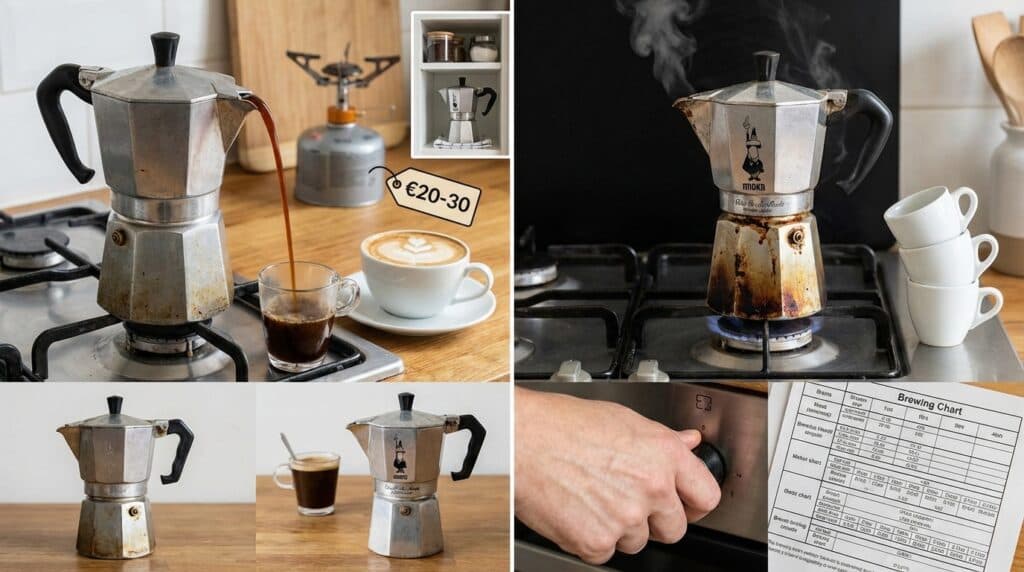
- Concentrated coffee: about 3–4% dissolved solids, against about 2% for drip (Wikipedia).
- No pump or electronics in a stovetop model. Bialetti’s New Zealand distributor says its stovetop coffee makers work on gas, electric and ceramic hobs, and its stainless steel models on induction too.
- Short brew: 3 to 6 minutes, depending on the size of the pot and the heat (Bialetti).
- Several sizes, from one to eighteen 50 ml servings (Wikipedia).
Cons:
- You have to watch it. Bialetti says to remove the pot from the heat as soon as the top is full and not to use full heat, which “may cause the coffee to have a burnt taste.”
- Brewing too long spoils the cup. Wikipedia says the gurgling sound near the end is a signal to stop, and that the steam-and-water mix that follows leads to rapid over-extraction and undesirable flavors.
- Water level matters. Bialetti warns that overfilling the base above the safety valve produces boiled coffee with a bitter or burnt taste.
- Hand washing only for the aluminium Moka Express: Bialetti says to rinse it with water, use no detergent and keep it out of the dishwasher. Wikipedia adds that the rubber seal needs periodic replacement.
- Aluminium pots and induction do not mix: Bialetti lists the aluminium Moka Express as suitable for induction only with its induction plate.
If your moka coffee keeps coming out harsh, the guide to burnt moka coffee fixes walks through heat, water level and timing.
Drip Coffee Maker: Pros and Cons
Pros:
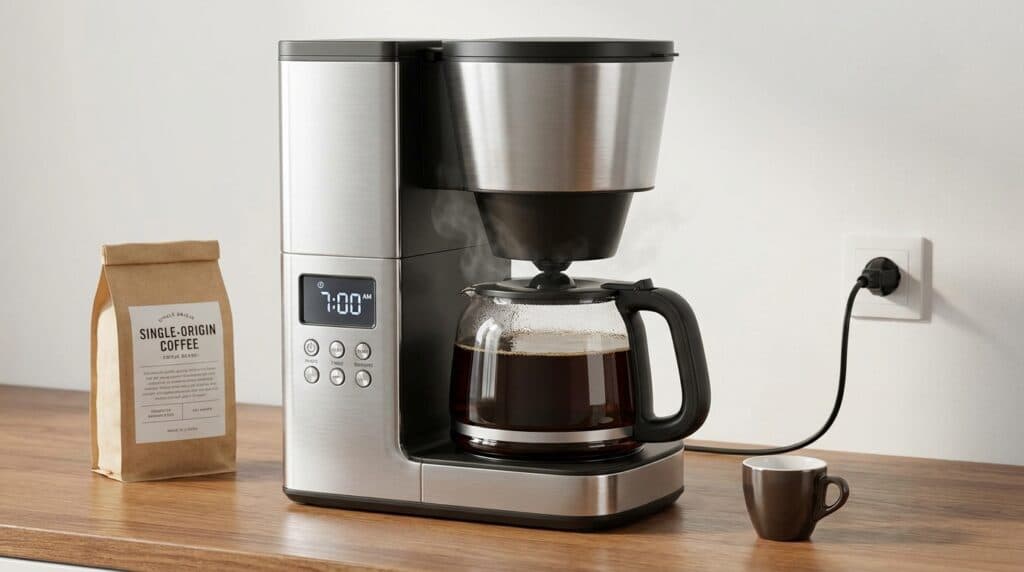
- Little effort. The NCA says the machine “does most of the work”: fill the reservoir, add a filter and ground coffee, and turn it on.
- Consistency. Because the machine controls the brewing process, the NCA says “you get a consistent cup each time.”
- Volume. The NCA notes that you can make a larger batch at one time with many drip coffee makers.
- Timers. The NCA calls the ability to program a coffee maker to brew on a timer probably the most sought-after feature.
Cons:
- Less control. The NCA says that with drip “you don’t have as much ability to customize” the brew.
- No concentrated coffee: about 2% dissolved solids by Wikipedia’s figures.
- Upkeep. The NCA says to rinse the basket and permanent filter after each use, watch for coffee-oil build-up that can make future cups bitter, wipe the hot plate once it has cooled, and notes that major manufacturers recommend descaling at least every 3–6 months.
Who Should Choose the Moka Pot
- You want a small, concentrated coffee to drink short or top up with hot water or milk.
- You are happy to stand at the stove for a few minutes and take the pot off the heat at the right moment.
- You want a brewer with no pump or electronics. Check the material against your hob, especially on induction.
Who Should Choose the Drip Coffee Maker
- You want several cups at once for a household or a long morning.
- You want the machine to handle the brewing, or to start brewing on a timer.
- You prefer a lighter, larger cup over a dense one.
Can You Have Both?
Yes, and they do not compete for the same job. A moka pot covers small, intense servings; a drip machine covers volume. Both depend on the same basics the sources stress: the right grind for the method, the right amount of water, and cleaning. The NCA also recommends cold water, filtered if possible, for drip, and Bialetti’s product page says to start the moka pot with room-temperature water.
Frequently Asked Questions
Is moka pot coffee stronger than drip coffee?
By concentration, yes. Wikipedia gives about 3–4% dissolved solids for moka coffee and about 2% for drip. Total caffeine depends on how much of each you drink.
Does a moka pot have more caffeine than drip coffee?
Per serving, it depends on the size of each cup. Wikipedia reports moka caffeine measured at 128–539.9 mg/100mL, and the NCA gives 12 to 16 mg per ounce for brewed coffee. Moka servings are usually smaller, so the total in your cup depends on how much you pour.
Can I use drip coffee grounds in a moka pot?
The NCA’s drip grind is medium, like kosher salt, while Bialetti New Zealand recommends medium-fine for its pots, so pre-ground drip coffee is coarser than the moka recommendation. Bialetti NZ also warns that espresso grind for electric machines is typically too fine and may block the pot.
How long does each one take?
Bialetti gives 3 to 6 minutes for a moka pot, depending on its size and the heat. The NCA gives about 5 minutes of contact time for drip coffee.
Why does my moka pot coffee taste burnt?
Bialetti links a burnt taste to full heat, letting the coffee boil, and overfilling the base above the safety valve. Wikipedia adds that brewing on past the gurgling phase causes rapid over-extraction.
The Bottom Line
Choose a moka pot if you want concentrated, short coffee and do not mind watching the stove for 3 to 6 minutes. Choose a drip coffee maker if you want a larger batch, a consistent cup and a machine that does most of the work. Neither is better in general; they answer different questions about how much coffee you want and how strong each cup should be.



Comments