


Table of Contents
- Quick Verdict
- French Press: Full Body, Simple Gear, Messier Cleanup
- How French Press Coffee Tastes
- French Press Pros
- French Press Cons
- Who Should Choose French Press?
- Who Should Skip It?
- AeroPress: Fast, Forgiving, and Not Very Romantic
- How AeroPress Coffee Tastes
- AeroPress Pros
- AeroPress Cons
- Who Should Choose AeroPress?
- Who Should Skip It?
- Pour-Over: Best Clarity, Highest Attention Cost
- How Pour-Over Coffee Tastes
- Pour-Over Pros and Cons
- Who Should Choose Pour-Over?
- Who Should Skip It?
- French Press vs AeroPress vs Pour-Over: Direct Comparison
- Buying Criteria That Actually Matter
- How Many Cups Do You Need?
- How Much Cleanup Will You Tolerate?
- What Coffee Do You Like?
- How Good Is Your Grinder?
- Best Choice by Morning Routine
- Final Recommendation
- Method References
French press, AeroPress, and pour-over can all make excellent coffee. The better question is which one fits your actual morning. A brewer that produces a beautiful cup on a calm Saturday may be the wrong tool when you have eight minutes, a sink full of dishes, and no patience for a perfect spiral pour.
This comparison keeps the romance in check. French press is rich and forgiving, but cleanup is not fun. AeroPress is fast and consistent, but it makes one cup at a time and looks more practical than pretty. Pour-over can give you the clearest flavors, but it asks more from your grinder, kettle, and attention. The best choice depends less on coffee identity and more on time, taste, cleanup, and how many people you brew for.
Quick Verdict
For most morning routines, the AeroPress is the safest pick. It is fast, compact, easy to clean, and forgiving when your grind or pouring is not perfect. It will not make a big pot, and it will not look elegant on an open shelf, but it reliably turns decent beans into a good cup with very little drama.
Choose French press if you like heavier, fuller coffee or brew for two or more people. Choose pour-over if you care most about clarity, aroma, and the ritual of brewing. If you are new to manual coffee and just want your mornings to improve, start with AeroPress.
French Press: Full Body, Simple Gear, Messier Cleanup
A French press is about as straightforward as manual coffee gets. Add coarse grounds, pour hot water, wait, press, and serve. There is no paper filter and no complicated equipment. That simplicity is why it has stayed popular for so long.
How French Press Coffee Tastes

French press coffee is heavy, oily, and textured. The metal mesh filter lets oils and tiny particles through, so the cup feels rounder than paper-filtered coffee. Medium and dark roasts often taste chocolatey, nutty, or earthy in a press.
The tradeoff is sediment. Even with a good grinder, some fine particles usually end up in the last sips. If you like a clean, tea-like cup, that texture may bother you. If you add milk, the body can be a benefit.
French Press Pros
- Makes several cups at once.
- No paper filters to buy.
- Affordable entry cost.
- Good for fuller, richer coffee.
- Works well for relaxed mornings and guests.
French Press Cons
- Wet grounds are messier to clean.
- Sediment is common.
- Coffee can become bitter if it sits with the grounds too long.
- Glass models can break.
- Not ideal for a single quick cup on the way out.
Who Should Choose French Press?
Choose French press if you want a bold cup, often drink coffee with another person, and do not mind a little cleanup. It is especially good for weekends, brunch, and people who like coffee with body rather than sharp brightness.
Who Should Skip It?
Skip it if you hate grit, want the cleanest flavor possible, or often leave the house in a rush. The brewer is simple, but dealing with wet grounds before work is where many people lose interest.
AeroPress: Fast, Forgiving, and Not Very Romantic
The AeroPress looks odd the first time you see it. It is a plastic tube with a plunger, a filter cap, and a reputation that sounds exaggerated until you use one for a few weeks. Its biggest strength is not that it makes the absolute best coffee. Its strength is that it makes good coffee almost every time.
How AeroPress Coffee Tastes

With paper filters, AeroPress coffee is cleaner than French press and usually smoother than a rushed pour-over. It can make a short, concentrated cup that you dilute with hot water, or a more standard mug with a slightly longer recipe. It handles medium, dark, and even many light roasts better than its simple design suggests.
The cup is not as transparent as a well-made V60, and it does not have the same heavy body as French press. It sits in the middle: clean enough for black coffee, strong enough for milk, and forgiving enough for tired mornings.
AeroPress Pros
- Very fast brew time, often around 1-2 minutes.
- Cleanup is unusually easy: pop the puck out and rinse.
- Compact, durable, and travel-friendly.
- Forgives imperfect technique.
- Works with paper filters or reusable metal filters.
AeroPress Cons
- Makes one cup at a time.
- Plastic construction may not appeal to everyone.
- Recipes can become a rabbit hole if you overthink them.
- Requires filters unless you buy a reusable one.
Who Should Choose AeroPress?
Choose AeroPress if you usually brew for yourself, want a fast routine, and care more about dependable coffee than a slow ritual. It is also a smart option for small kitchens, offices, dorms, travel, and anyone who dislikes cleaning a French press.
Who Should Skip It?
Skip it if you regularly make coffee for several people at once. You can brew multiple AeroPress cups, but it gets annoying quickly. Also skip it if the look of your coffee setup matters more than compact function.
Pour-Over: Best Clarity, Highest Attention Cost
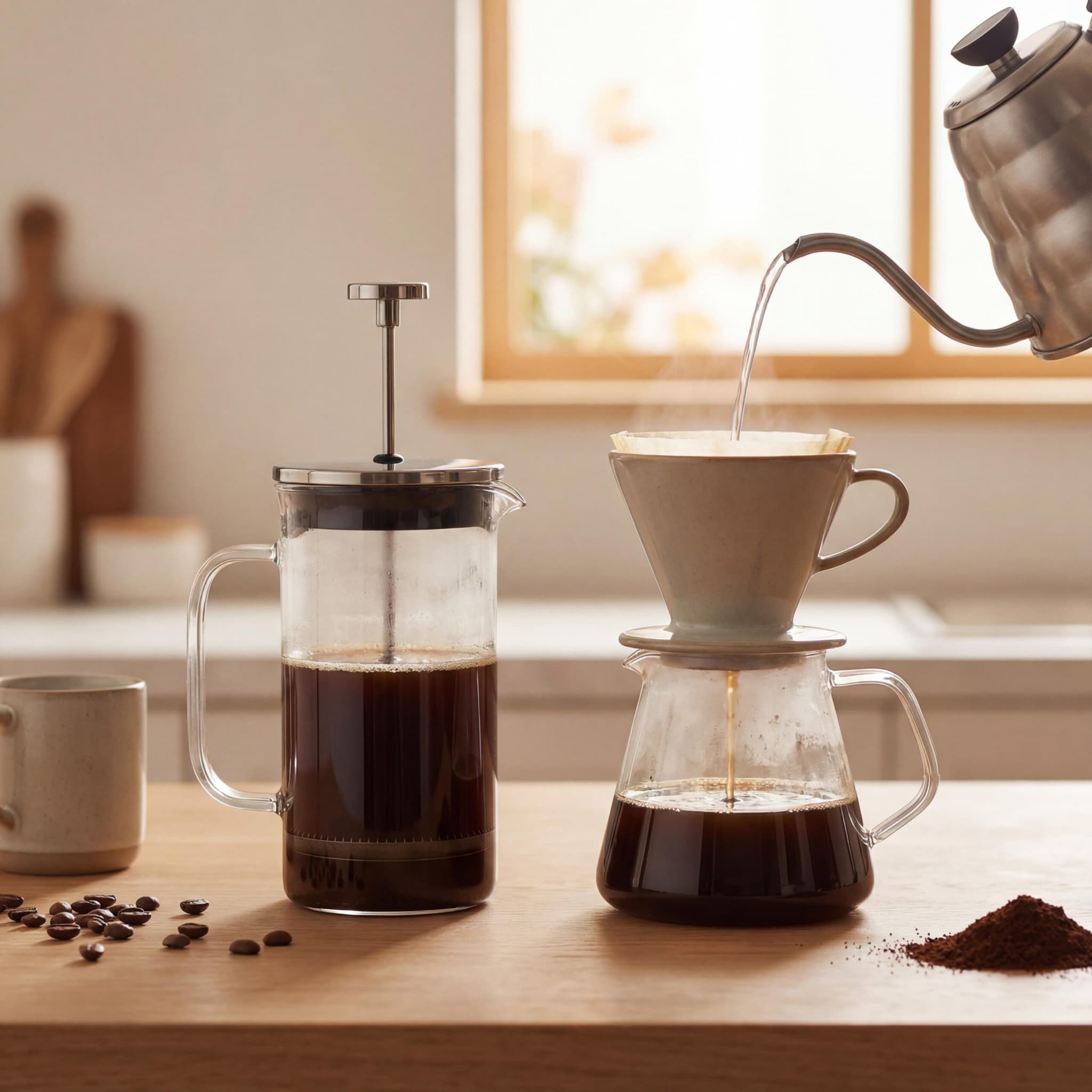
Pour-over covers brewers such as the Hario V60, Kalita Wave, Chemex, and similar drippers. The basic idea is simple: water passes through coffee grounds and a filter into a cup or carafe. The reality is more sensitive. Grind size, pouring speed, water temperature, filter type, and brewer shape all change the result.
How Pour-Over Coffee Tastes
Pour-over usually gives the cleanest and brightest cup of the three methods. Paper filters trap oils and sediment, so delicate flavors are easier to notice. If you buy light-roast or single-origin coffee for floral, citrus, berry, or tea-like notes, pour-over is often the method that lets those details show.
It is less forgiving than AeroPress. A poor grind, uneven pour, or rushed brew can taste thin, sour, harsh, or flat. When it is good, it can be excellent. When it is bad, it tends to advertise your mistakes.
Pour-Over Pros and Cons

- Pros: excellent clarity, strong aroma, great for light roasts, easy paper-filter cleanup, beautiful brewing ritual.
- Cons: more technique-sensitive, slower active brewing, usually benefits from a gooseneck kettle and scale, less forgiving with cheap grinders.
Who Should Choose Pour-Over?
Choose pour-over if you enjoy the process, buy interesting beans, and have a few quiet minutes to brew. It is ideal for people who like tasting differences between origins and roast levels.
Who Should Skip It?
Skip it if your mornings are chaotic or if you want coffee to be mostly automatic. Pour-over is not hard, but it does ask you to be present. That can be pleasant or irritating depending on the day.
French Press vs AeroPress vs Pour-Over: Direct Comparison

| Factor | French Press | AeroPress | Pour-Over |
|---|---|---|---|
| Best for | Full body and batch brewing | Fast single cups | Clean, detailed flavor |
| Brew time | About 4-5 minutes | About 1-2 minutes | About 3-4 minutes |
| Cleanup | Messiest | Easiest | Easy if using paper filters |
| Cups per brew | Usually 2-8 | Usually 1 | 1-6 depending on brewer |
| Flavor body | Heavy and oily | Medium and smooth | Light and clean |
| Technique needed | Low | Low to medium | Medium to high |
| Extra gear that helps | Burr grinder | Kettle and filters | Gooseneck kettle, scale, good grinder |
| Typical starting cost | Low | Low to moderate | Low for dripper, higher with accessories |
Buying Criteria That Actually Matter
How Many Cups Do You Need?
If you brew for a household, French press or a larger pour-over carafe makes more sense than AeroPress. If you brew one cup and leave, AeroPress is hard to beat.
How Much Cleanup Will You Tolerate?
This is the category people underestimate. French press grounds are wet and awkward. Pour-over filters lift out cleanly. AeroPress cleanup is the quickest of the three. If a brewer annoys you to clean, you will stop using it.
What Coffee Do You Like?
For darker, chocolatey, heavier coffee, French press is a natural fit. For balanced daily coffee, AeroPress is flexible. For bright, floral, fruity, or single-origin coffees, pour-over usually shows the most detail.
How Good Is Your Grinder?
A poor grinder hurts every method, but pour-over suffers the most because uneven particles extract unevenly. French press can tolerate more variation, although too many fines cause sludge. AeroPress is relatively forgiving.
Best Choice by Morning Routine
- Rushed weekday: AeroPress.
- Two people drinking coffee together: French press or a larger pour-over.
- Slow weekend with good beans: Pour-over.
- Small kitchen or office: AeroPress.
- Milk drinks without an espresso machine: AeroPress concentrate.
- Rich coffee with breakfast: French press.
Final Recommendation
The French press vs AeroPress vs pour-over debate does not have one permanent winner. French press gives you body and volume. AeroPress gives you speed and consistency. Pour-over gives you clarity and control.
If you are buying your first manual brewer, choose the AeroPress unless you have a clear reason not to. It solves the most common morning problem: making one good cup quickly without a big cleanup penalty. Add a French press later if you want bigger batches, or add pour-over when you are ready to slow down and chase more flavor detail.
The right brewer is the one you will use when the morning is imperfect. That is where coffee gear proves itself.


Comments