


Table of Contents
- Quick Verdict: Our Top Budget Coffee Scale Pick
- Why You Need a Digital Scale for Coffee Brewing
- The Real Cost of Not Using a Scale
- Key Features to Look for in a Budget Coffee Scale
- Precision: The Non-Negotiable Feature
- Built-in Timer: Nice to Have
- Watch Out for Auto-Off Timers
- Budget Scale Pros and Cons
- How to Choose the Right Budget Scale for Your Brew Method
- For Pour Over Brewing
- For French Press and Immersion Methods
- For Espresso
- Common Mistakes When Buying a Cheap Coffee Scale
- Getting the Most Out of Your Budget Scale
- Frequently Asked Questions
- Do I really need a coffee-specific scale, or will any kitchen scale work?
- How much should I spend on a budget coffee scale?
- Can I use a cheap scale for espresso?
- What's the most important feature on a budget coffee scale?
- How long do budget coffee scales typically last?
- Conclusion and Next Steps
Ever tried eyeballing your coffee grounds and ended up with a brew that tasted like muddy water—or worse, bitter disappointment? You’re not alone. A digital scale is one of the most underrated tools in any home barista’s arsenal, and the good news is you don’t need to spend a fortune to get one that works. In my experience, a cheap digital scale for coffee brewing can transform your morning cup without emptying your wallet. Let’s explore what makes a budget scale worth buying and how to pick the right one for your setup.
In this guide, you’ll learn which features actually matter on a budget coffee scale, common mistakes to avoid, and how to get the most out of your purchase. Whether you’re brewing pour over, French press, or even pulling espresso shots, the right scale makes all the difference.
Quick Verdict: Our Top Budget Coffee Scale Pick
A compact scale with 0.1g precision and a built-in timer is your best bet for home coffee brewing on a budget. Look for one in the $15–$25 range that offers fast response time and an auto-off feature you can disable. These scales handle everything from pour over to espresso dosing without breaking the bank.
Who is this for?
- Home brewers who want consistent, repeatable results
- Anyone tired of guessing coffee-to-water ratios
- Budget-conscious coffee lovers who don’t want to spend $100+ on a premium scale
Who is this NOT for?
- Professional baristas who need lightning-fast response times for high-volume espresso
- Those who want app connectivity and advanced brewing modes
Why You Need a Digital Scale for Coffee Brewing
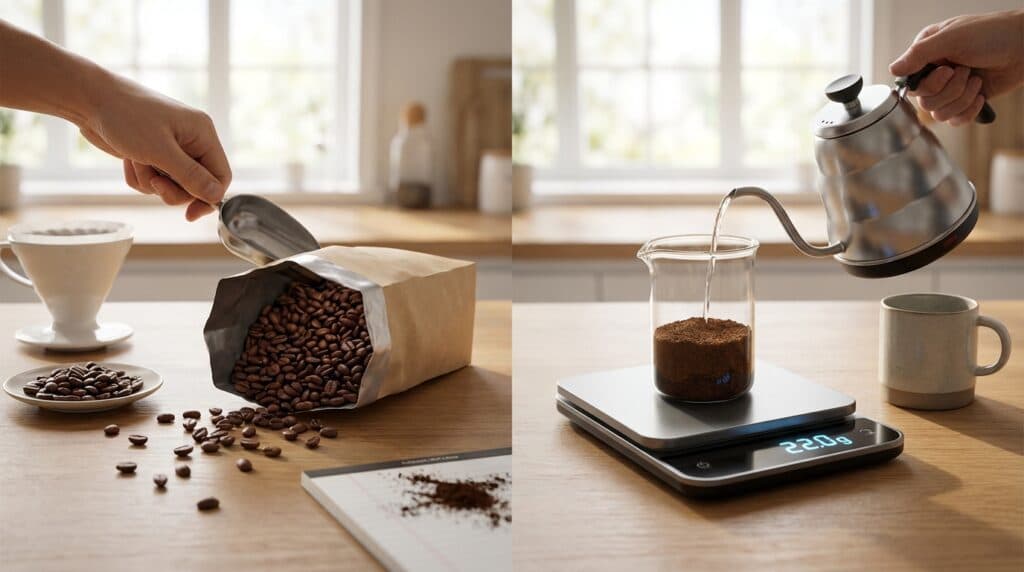
Here’s the thing: coffee brewing is essentially chemistry. The ratio of coffee grounds to water determines extraction, flavor, and strength. Most specialty coffee experts recommend a ratio between 1:15 and 1:17 (coffee to water). Without a scale, you’re just guessing—and guessing leads to inconsistent results.
I’ve found that even a basic digital scale improves my brewing dramatically. When I switched from scooping to weighing, my morning pour overs went from “sometimes great, sometimes meh” to reliably delicious. That’s the power of precision.
The Real Cost of Not Using a Scale
Think about it this way: if you’re using too much coffee, you’re wasting beans (and money). If you’re using too little, you’re under-extracting and missing out on flavor. A $20 scale pays for itself within weeks by helping you dial in the perfect dose every time.
Key Features to Look for in a Budget Coffee Scale
Not all cheap scales are created equal. Here’s what actually matters when you’re shopping on a budget:
| Feature | Why It Matters | Budget Expectation |
|---|---|---|
| Precision (0.1g) | Essential for accurate dosing | Available under $20 |
| Built-in Timer | Tracks brew time without extra devices | Common in $15–$30 range |
| Response Time | Faster = better for pour over control | Slower on budget models |
| Auto-Off Timer | Should be long enough or disableable | Check reviews carefully |
| Tare Function | Zeroes out container weight | Standard on all scales |
Precision: The Non-Negotiable Feature
Look for scales that measure to 0.1 grams. This level of precision lets you accurately dose espresso (where even 0.5g makes a difference) and fine-tune your pour over recipes. Kitchen scales that only measure to 1g increments won’t cut it for serious coffee brewing.
Built-in Timer: Nice to Have
A built-in timer is incredibly convenient for tracking brew time during pour overs. That said, you can always use your phone as a timer if your budget scale doesn’t include one. It’s a nice feature, not a dealbreaker.
Barista Tip: If your scale has a timer, start it when water first hits the grounds—not when you start pouring. This gives you a more accurate extraction time.
Watch Out for Auto-Off Timers
This is where cheap scales often frustrate home brewers. Some budget models automatically shut off after 2–5 minutes to save battery. If you’re in the middle of a slow pour over or a long French press steep, that’s a problem. According to user feedback, this is one of the most common complaints about inexpensive scales. Look for models where you can disable auto-off or extend the timer to at least 10 minutes.
Budget Scale Pros and Cons
Let’s be honest about what you’re getting (and giving up) when you go the budget route:
Pros:
- Affordable entry point ($10–$30)
- 0.1g precision available even at low prices
- Many include timers and tare functions
- Perfectly adequate for most home brewing methods
- Easy to replace if damaged
Cons:
- Slower response time compared to premium scales
- Build quality may be less durable
- Auto-off features can interrupt brewing
- No app connectivity or advanced modes
- May struggle with very fast espresso shots
How to Choose the Right Budget Scale for Your Brew Method
Your ideal scale depends on how you make coffee. Here’s a quick breakdown:
For Pour Over Brewing
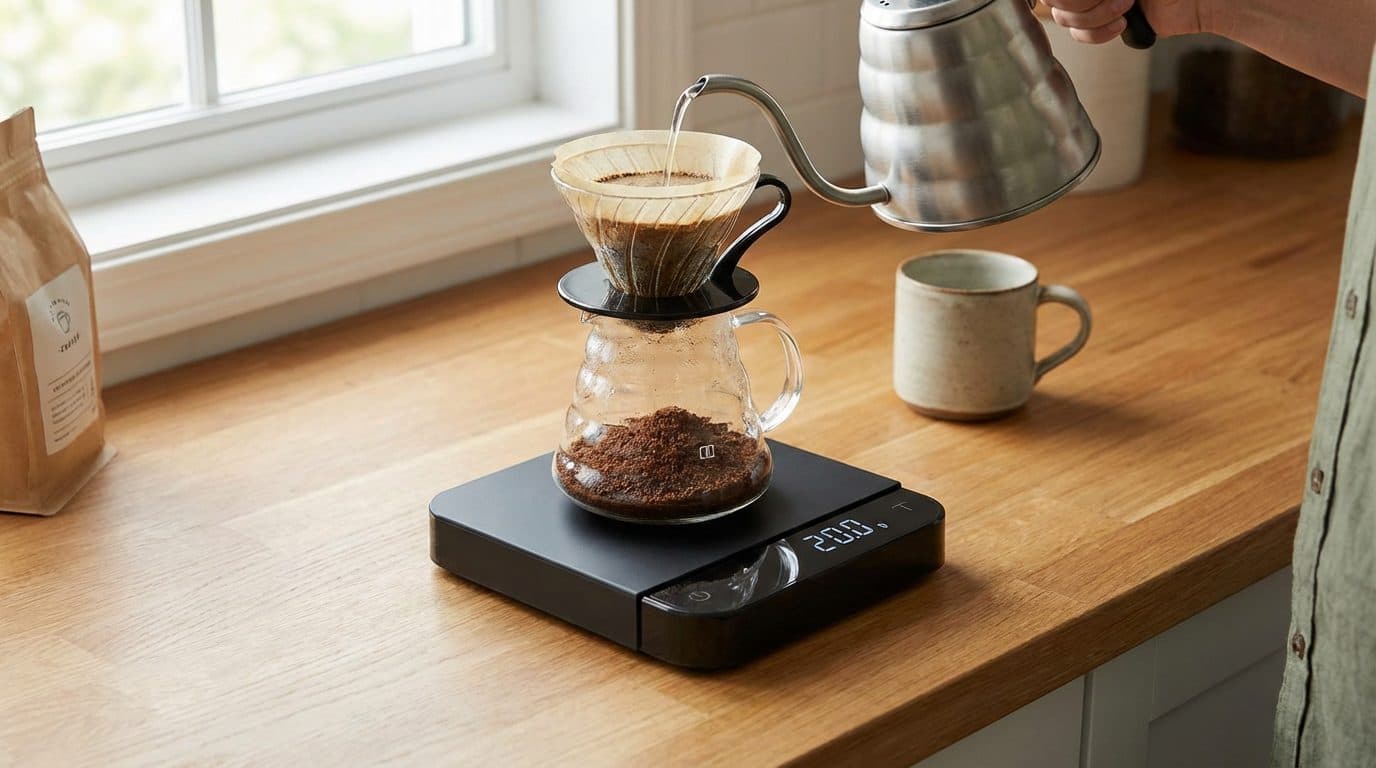
Pour over is where a scale really shines. You need to control your pour rate and total water volume precisely. Look for a scale with a timer and decent response time. Even budget scales work well here since pour over is a slower, more forgiving process.
Mini scenario: You’re brewing a V60 with 20g of coffee and 320g of water. Your scale lets you hit that 1:16 ratio exactly, and the timer helps you pace your pours over 3 minutes. Consistent, delicious results every time.
For French Press and Immersion Methods
French press is the most forgiving method for budget scales. You’re measuring coffee and water upfront, then letting it steep. Response time doesn’t matter much here. Any scale with 0.1g precision will do the job perfectly.
For Espresso
This is where budget scales show their limitations. Espresso shots pull in 25–35 seconds, and you need to stop at the right weight. Slower response times on cheap scales can make this tricky. If espresso is your main focus, consider saving up for a mid-range option with faster response. That said, budget scales still work fine for dosing your grounds before brewing.
Common Mistakes When Buying a Cheap Coffee Scale
I’ve seen home brewers make these mistakes repeatedly. Learn from their experiences:
- Ignoring the auto-off timer: Always check how long the scale stays on and whether you can disable auto-off.
- Buying a kitchen scale instead of a coffee scale: Kitchen scales often lack 0.1g precision and timers.
- Forgetting about size: Make sure the scale fits under your dripper or on your espresso machine’s drip tray.
- Skipping reviews: User reviews reveal real-world issues like slow response or inaccurate readings.
Key Takeaway: A $15 coffee-specific scale will outperform a $30 general kitchen scale for brewing purposes. Features matter more than price alone.
Getting the Most Out of Your Budget Scale
Once you’ve got your scale, here are some tips to maximize its usefulness:
- Calibrate regularly: Some scales allow calibration with a known weight. Do this monthly for best accuracy.
- Use fresh batteries: Low batteries can cause inaccurate readings and slow response.
- Protect from water: Coffee brewing involves liquids. Keep your scale dry to extend its life.
- Record your recipes: Write down your coffee weight, water weight, and brew time. This lets you replicate great cups and troubleshoot bad ones.
In short, a budget scale is a tool—treat it well, and it’ll serve you for years.
Frequently Asked Questions
Do I really need a coffee-specific scale, or will any kitchen scale work?
A coffee-specific scale offers 0.1g precision and often includes a timer, which most kitchen scales lack. For serious brewing, the extra precision makes a noticeable difference in consistency. General kitchen scales measuring only to 1g increments won’t give you the control you need for dialing in recipes.
How much should I spend on a budget coffee scale?
You can find capable coffee scales in the $15–$30 range. Scales under $15 often have slower response times or reliability issues. Above $30, you’re entering mid-range territory with faster response and better build quality. For most home brewers, $20–$25 hits the sweet spot.
Can I use a cheap scale for espresso?
Yes, but with limitations. Budget scales work great for dosing your grounds before brewing. However, their slower response time makes it harder to stop your shot at the exact target weight. If espresso is your primary method, you may eventually want to upgrade to a faster scale.
What’s the most important feature on a budget coffee scale?
Precision (0.1g accuracy) is the most critical feature. Without it, you can’t accurately dose coffee or measure water. A built-in timer is a close second for pour over brewers, though you can use your phone as an alternative.
How long do budget coffee scales typically last?
With proper care—keeping them dry, using fresh batteries, and storing them safely—budget scales can last 2–5 years. They’re inexpensive enough that replacement isn’t a major concern if something goes wrong.
Conclusion and Next Steps
A cheap digital scale for coffee brewing is one of the best investments you can make as a home barista. You don’t need to spend $100+ on a premium scale to brew excellent coffee. A budget-friendly option with 0.1g precision, a built-in timer, and a reasonable auto-off setting will serve you well for pour over, French press, and even basic espresso dosing.
Start by identifying your primary brew method, then look for a scale that fits those needs. Read user reviews to catch potential issues like short auto-off timers or slow response. Once you’ve got your scale, experiment with different ratios and record what works. Life is too short for bad coffee—and with the right scale, every cup can be a great one.

Comments