


Table of Contents
- Quick Answer: What Should a Beginner Buy First?
- The Exact Budget Bundle I Would Build
- Buy First, Buy Later, or Skip
- Who This Bundle Is For
- Grinder: Spend Carefully, Not Blindly
- What to Look For in a Budget Hand Grinder
- Brewer Choice: V60, Clever, French Press, or AeroPress?
- Plastic V60-Style Dripper
- Clever Dripper
- French Press
- AeroPress-Style Brewer
- Scale: Cheap Is Fine, But Know the Limits
- Kettle: Useful, But Not Always Urgent
- Recurring Costs Beginners Forget
- Three Practical Budget Builds
- Lowest-Cost Sensible Build
- Best Value Beginner Build
- Pour-Over Learning Build
- Common Mistakes That Waste Money
- Buying a Blade Grinder Because It Is Cheap
- Buying Too Many Brewers at Once
- Ignoring the Coffee Itself
- Chasing Precision Before Consistency
- A Simple Starter Recipe
- Frequently Asked Questions
- Can I start with pre-ground coffee?
- Is a cheap hand grinder always better than a cheap electric grinder?
- Should I choose V60 or French press first?
- Do I need 0.1 gram scale precision?
- Is a gooseneck kettle worth buying?
- How much should I budget for beans each month?
- Bottom Line
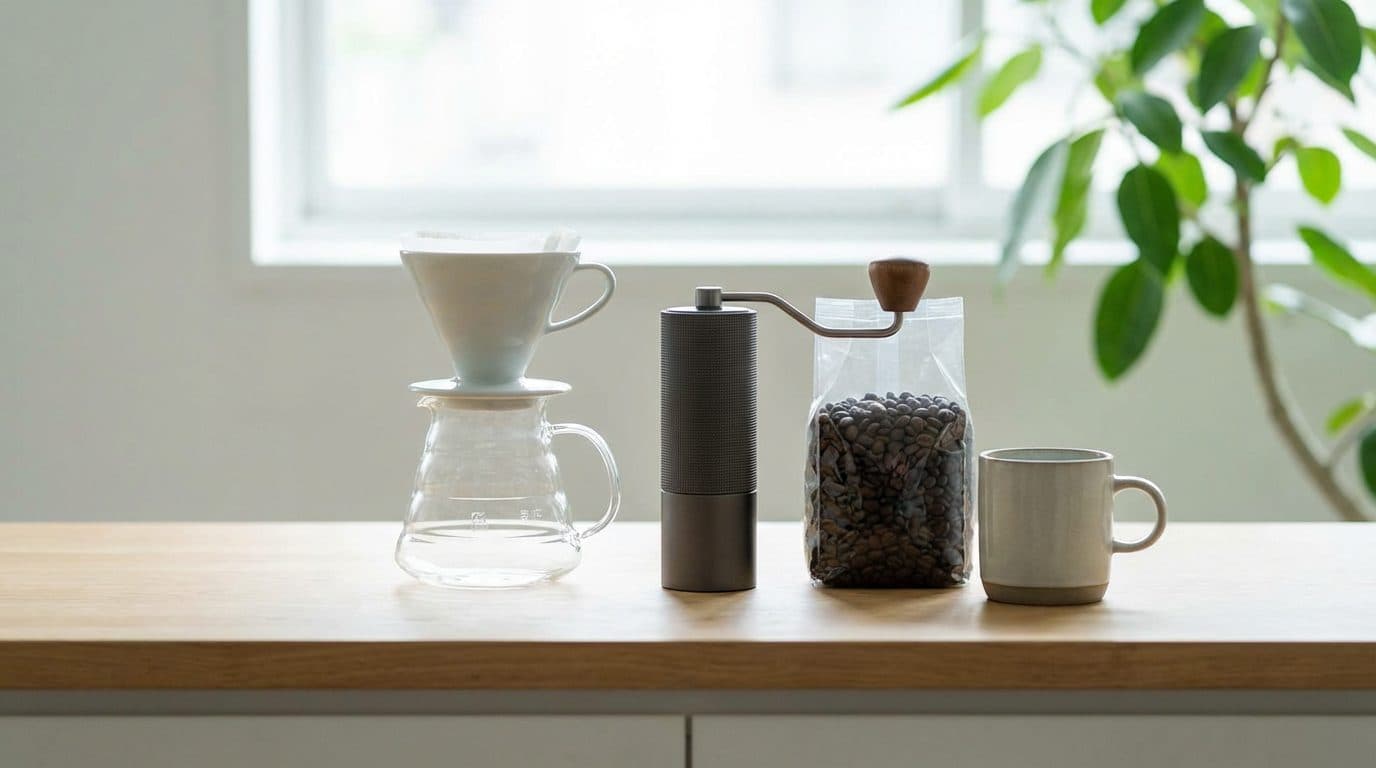
The best budget-friendly coffee gear bundle for a complete beginner is a burr hand grinder, one simple brewer, and a basic gram scale. Buy a gooseneck kettle later only if you choose pour-over. That order matters. Fresh grinding and repeatable measurements improve coffee more than a pretty kettle, extra drippers, or accessories that look useful before you have a routine.
For most beginners, a sensible first setup is a $35-$70 manual burr grinder, a $10-$40 brewer, and a $10-$20 scale. The total can be about $55-$130 before beans and filters. French press, Clever Dripper, and AeroPress-style brewing work with a regular kettle. V60-style pour-over benefits more from a gooseneck, but it still does not need to be the first purchase.
This bundle is not for espresso. It is for learning grind size, coffee dose, water amount, brew time, and taste adjustment without overspending.
Quick Answer: What Should a Beginner Buy First?
- Buy a burr grinder first. Freshly ground whole beans are the biggest quality jump for the money.
- Choose one forgiving brewer. French press, Clever Dripper, AeroPress, and plastic V60 all work, but they suit different routines.
- Add a gram scale early. A cheap scale makes your coffee repeatable instead of random.
- Delay the gooseneck kettle unless you make pour-over. It helps V60 control; it is much less important for immersion brewing.
- Skip extra accessories at first. Servers, stands, premium scales, bean vaults, and multiple brewers can wait.
The practical order is grinder first, brewer second, scale third, kettle fourth. Beans and filters also count; the setup only stays cheap if the monthly costs fit your habit.
The Exact Budget Bundle I Would Build
- Manual burr grinder: $40-$70
- One brewer: $10-$40 for a plastic V60-style dripper, Clever Dripper, French press, or AeroPress-style brewer
- Basic digital scale: $10-$20, with grams and tare
- Filters: a few dollars per pack if your brewer uses paper
- Gooseneck kettle: $0 if you use your current kettle, or $25-$60 later for pour-over control
If I had $60, I would buy a manual burr grinder and either a French press or basic plastic dripper, then measure consistently until I could add a scale. At $90, I would add the scale. At $120-$150, I would add a basic gooseneck only if I was committed to V60-style pour-over.
Buy First, Buy Later, or Skip
| Item | Typical Budget | Buy When | Why It Matters |
|---|---|---|---|
| Burr hand grinder | $35-$70 | Buy first | Fresh grinding gives the biggest flavor improvement for the money. |
| One simple brewer | $10-$40 | Buy first | Choose one method and learn it before adding more gear. |
| Digital scale | $10-$20 | Buy first if possible | Consistent coffee and water amounts make bad cups easier to fix. |
| Gooseneck kettle | $25-$60 | Buy later for pour-over | Very helpful for V60 pouring, less important for French press, Clever, or AeroPress. |
| Temperature-control kettle | $40-$100+ | Buy later | Convenient, but boiled water rested briefly is usually close enough to start. |
| Premium coffee scale | $40-$200 | Skip at first | A basic gram scale is enough unless you need fast response and a built-in timer. |
| Blade grinder | $15-$30 | Skip | It chops unevenly and makes bitter-sour cups harder to diagnose. |
| Extra drippers and servers | $15-$80 | Skip at first | More gear does not help until you know what you want to change. |
Who This Bundle Is For
This setup fits someone who wants better home coffee without building a full coffee station. It works well for one or two cups, small kitchens, dorm rooms, and people who want to stop guessing every morning.
It is not ideal if you need a large pot, push-button convenience, or milk drinks like cafe lattes. This guide is about affordable brewed coffee.
Grinder: Spend Carefully, Not Blindly
The grinder is where going too cheap can backfire. A burr grinder crushes beans more evenly than a blade grinder, but some low-cost hand grinders are slow, wobbly, hard to adjust, or inconsistent. Then you cannot tell whether the problem is your recipe or the tool.
You do not need a luxury grinder. Avoid the very cheapest no-name models if reviews mention loose handles, plastic burr carriers, drifting settings, or very slow grinding. A basic conical burr hand grinder is enough if it holds adjustment and feels usable.
What to Look For in a Budget Hand Grinder
- Burrs, not blades: conical burrs are fine for beginner brewed coffee.
- Stable adjustment: the grind setting should stay where you set it.
- Enough capacity: 20-30 grams is enough for one or two small cups.
- Reasonable effort: coarse French press grinding is easier than finer AeroPress or V60 grinding.
- Serviceable parts: replaceable jars, handles, or burrs can extend the grinder’s life.
Be realistic about manual grinding. One cup can take about 30-90 seconds. Light roasts can feel harder than dark roasts. If you have wrist pain, low hand strength, or rushed mornings, a manual grinder may be the wrong place to save money.
Brewer Choice: V60, Clever, French Press, or AeroPress?
The best beginner brewer is the one you will use on a tired weekday. Each option can make good coffee, but the workflow is different.
Plastic V60-Style Dripper
A plastic V60-style dripper is cheap, compact, durable, and good for clean, bright coffee. The tradeoff is technique: pour speed, grind size, and water distribution matter.
Choose V60 if you like a lighter cup and do not mind practicing. A gooseneck kettle helps with slower, more controlled pouring. You can start with a regular kettle, but V60 is where the kettle upgrade is easiest to justify.
Clever Dripper
A Clever Dripper is more forgiving. Coffee and water steep together, then drain through a paper filter. It gives a cleaner cup than French press without requiring perfect pouring.
For many beginners, Clever is more budget-aware than buying a V60 and kettle immediately. The brewer may cost more than a basic dripper, but it can delay the kettle purchase.
French Press
A French press is simple, affordable, and good for a heavier cup. It needs no paper filters and works with a regular kettle. Add coffee, add hot water, wait about four minutes, press gently, and pour.
The downsides are sediment, more oils, and cleanup. Do not rinse a lot of grounds down the sink. Scoop them into compost or trash, then wash the press.
AeroPress-Style Brewer
An AeroPress-style brewer is compact, durable, and forgiving for one cup at a time. It can make strong coffee without a gooseneck kettle and uses small paper filters unless you buy a metal filter.
The limitation is batch size. For one person, it is easy to live with. For several people, repeating the process can get annoying.
Scale: Cheap Is Fine, But Know the Limits
A basic kitchen scale is enough if it measures in grams and has a tare button. A recipe like 15 grams of coffee to 250 grams of water is easier to repeat than “two scoops and a mugful.”
Cheap scales can respond slowly, shut off too quickly, or claim 0.1 gram precision without being stable. For brewed coffee, that is usually fine. Stability, tare, and staying on during brewing matter more than extra decimal places.
If the budget is extremely tight, use the same spoon, mug, and dose each time. Still, make the scale one of the first upgrades. It helps you identify whether a bad cup came from dose, water, grind size, or brew time.
Kettle: Useful, But Not Always Urgent
A gooseneck kettle gives better pour control. For V60-style pour-over, that can make extraction more even. For French press, Clever, and AeroPress-style brewing, it matters much less.
You also do not need perfect temperature control on day one. Boil water, take it off heat, wait about 30-60 seconds, and brew. If coffee tastes harsh and dry, try cooler water or a coarser grind. If it tastes sour and thin, use hotter water, grind finer, or brew longer.
Buy a temperature-control gooseneck later if you keep making pour-over and want less guesswork. It is a convenience upgrade, not the foundation.
Recurring Costs Beginners Forget
- Beans: fresh whole beans often cost more than basic supermarket coffee, but they are where the flavor comes from.
- Filters: V60, Clever, and AeroPress-style brewers use paper filters unless you buy reusable metal options.
- Water: if your tap water tastes bad, filtered water can improve coffee more than another gadget.
- Cleaning: French press screens, travel mugs, and grinders need occasional cleaning to avoid stale oils.
- Replacement parts: glass French press beakers can break; grinder parts and rubber seals can wear.
A 12-ounce bag of decent whole beans might cost $12-$20 or more and often makes about 18-25 cups. One daily cup can still be cheaper than cafe coffee, but beans become the real monthly cost.
Three Practical Budget Builds
Lowest-Cost Sensible Build
- Manual burr grinder: about $35-$50
- Plastic V60-style dripper or French press: about $10-$25
- Use your existing kettle
- Measure consistently until you can add a scale
This is the bare minimum I would still recommend. Choose French press for easier brewing, or the dripper for cleaner coffee and more practice.
Best Value Beginner Build
- Manual burr grinder: about $45-$70
- Clever Dripper, French press, AeroPress-style brewer, or plastic V60: about $20-$40
- Basic gram scale: about $10-$20
- Filters if your brewer needs them
This is the setup I would point most beginners toward. It avoids buying a kettle before you can measure your coffee.
Pour-Over Learning Build
- Manual burr grinder: about $50-$80
- Plastic V60-style dripper: about $10-$15
- Basic gram scale: about $10-$20
- Gooseneck kettle: about $25-$60
- Paper filters: a few dollars per pack
This build is only for someone who specifically wants to learn pour-over. It costs more because the kettle supports the method. If you are unsure, start with a regular kettle and upgrade only if the process sticks.
Common Mistakes That Waste Money
Buying a Blade Grinder Because It Is Cheap
A blade grinder creates dust, chunks, and everything between. Dust can taste bitter; large pieces can taste sour or thin. If you cannot afford a burr grinder yet, consider buying small amounts of coffee ground fresh at a local shop while you save.
Buying Too Many Brewers at Once
A dripper, French press, moka pot, cold brew jar, and AeroPress-style brewer can all look inexpensive alone. Together they become clutter. Pick one method for a few weeks. Buy the next tool only when you can explain what you want to change.
Ignoring the Coffee Itself
Gear cannot rescue stale beans. Look for whole beans with a roast date when possible. You do not need the most expensive coffee, but fresher beans from a reliable seller make the setup feel worthwhile.
Chasing Precision Before Consistency
Exact temperature and complicated recipes can help later. At the start, repeat one simple recipe and change one thing at a time. That teaches you more than switching recipes every morning.
A Simple Starter Recipe
- Coffee: 15 grams
- Water: 250 grams
- Ratio: about 1:16.7
- Temperature: just off boil for most medium roasts
- Adjustment: sour and weak usually means grind finer or brew longer; bitter and dry usually means grind coarser or brew shorter
For French press, try a medium-coarse grind and about four minutes. For Clever Dripper, try a medium grind and drain after two to three minutes. For V60-style pour-over, try a medium-fine grind and aim for two and a half to three and a half minutes total. Treat these as starting points, not rules.
Frequently Asked Questions
Can I start with pre-ground coffee?
Yes, but it is a compromise. Use what you already have while you learn the brewer. For the biggest improvement, move to whole beans and a burr grinder when the budget allows.
Is a cheap hand grinder always better than a cheap electric grinder?
Not always, but often at the same low price. With a hand grinder, more of the price goes into burrs instead of a motor. The tradeoff is effort, so check reviews for consistency, speed, and build quality.
Should I choose V60 or French press first?
Choose V60 for a clean, lighter cup and a little practice. Choose French press for a fuller cup, easier brewing, and no paper filter cost. Choose Clever for a forgiving middle ground with a cleaner paper-filtered cup.
Do I need 0.1 gram scale precision?
No. It is nice, but whole-gram measurement is already much better than guessing. A cheap scale that tares reliably and stays on during brewing is more useful than a flaky scale with extra decimal places.
Is a gooseneck kettle worth buying?
For V60-style pour-over, yes, eventually. For French press, Clever Dripper, and AeroPress-style brewing, it can wait. A regular kettle works well enough because pouring precision is less central to those methods.
How much should I budget for beans each month?
If you use 15-18 grams per cup and drink one cup per day, a 12-ounce bag may last around three weeks. If the bag costs $15, that is roughly $20 per month. More cups, larger doses, or pricier beans raise the cost quickly.
Bottom Line
A good beginner coffee bundle should solve the right problems in the right order. Buy a burr grinder, choose one brewer, add a scale, and delay the kettle unless your method needs precise pouring.
The honest budget answer is simple: spend less on accessories and more attention on fresh beans, consistent grinding, measured water, and one repeatable recipe. That is where the cup improves without turning the setup into a shopping habit.



Comments