


Table of Contents
- Quick Verdict: Mid-Range Burr Grinders Offer the Best Value
- What Makes Expensive Coffee Grinders Different?
- Burr Quality and Material
- Grind Consistency
- Build Quality and Longevity
- Budget vs. Mid-Range vs. Premium: A Practical Comparison
- Budget Grinders: The Entry Point
- Mid-Range Grinders: The Sweet Spot
- Premium Grinders: For the Dedicated Enthusiast
- Who Should Invest in an Expensive Coffee Grinder?
- Who Is This For?
- Who Is This NOT For?
- The Real Cost of Cheap Grinders
- Key Takeaway: Match Your Grinder to Your Goals
- Conclusion: Invest Wisely, Grind Happily
You’re standing in front of a wall of coffee grinders, prices ranging from $20 to $2,000, and you’re wondering: is there really that much difference? After all, they all do the same thing—turn whole beans into ground coffee. But here’s the thing: the grinder you choose has more impact on your cup quality than almost any other piece of equipment in your coffee setup. I’ve spent years testing grinders across every price range, and I can tell you the answer isn’t as simple as “expensive equals better.” Let’s break down exactly what you’re paying for and whether it’s worth opening your wallet wider.
In this guide, you’ll discover what separates budget grinders from premium models, which features actually matter for taste, and most importantly—whether an expensive coffee grinder is worth it for your specific brewing style and goals.
Quick Verdict: Mid-Range Burr Grinders Offer the Best Value
Here’s my honest take after years of grinding beans: for most home baristas, a quality mid-range burr grinder (typically $100–$300) hits the sweet spot between performance and price. You’ll get consistent grind size, decent build quality, and noticeably better coffee than budget options—without the diminishing returns of ultra-premium models.
However, if you’re serious about espresso, the investment in a higher-end grinder ($300–$600+) becomes much more justifiable. Espresso demands precision that cheaper grinders simply can’t deliver consistently.
What Makes Expensive Coffee Grinders Different?
Before we dive into whether the price tag is justified, let’s understand what you’re actually paying for when you upgrade your grinder.
Burr Quality and Material
The heart of any grinder is its burrs—the two abrasive surfaces that crush your beans. Budget grinders typically use ceramic or lower-grade steel burrs, while premium models feature precision-machined steel or even titanium-coated burrs. Better burrs mean more consistent particle size, which translates directly to better extraction and flavor.
In my experience, the jump from blade grinders to entry-level burr grinders is massive. The jump from entry-level to mid-range burrs is noticeable. The jump from mid-range to premium? It’s there, but you need a trained palate to appreciate it fully.
Grind Consistency
This is where expensive grinders truly shine. When coffee experts talk about grind quality, they’re really talking about consistency—how uniform the particle sizes are. Inconsistent grinds mean some particles over-extract (bitter) while others under-extract (sour), creating a muddled cup.
Premium grinders produce remarkably uniform particles with minimal “fines” (dust-like particles) and “boulders” (oversized chunks). According to recent reviews and testing, high-end grinders can achieve particle consistency rates above 90%, while budget options often hover around 60-70%.
Build Quality and Longevity
Expensive grinders are built to last. We’re talking commercial-grade motors, metal housings instead of plastic, and burrs that stay sharp for years. A quality grinder purchased today could easily serve you for a decade or more with proper care.
Budget grinders? They work, but expect plastic gears, weaker motors, and burrs that dull faster. You might replace a cheap grinder two or three times in the lifespan of one premium model.
Budget vs. Mid-Range vs. Premium: A Practical Comparison
Let me break down what you can expect at each price tier based on current market offerings and real-world performance.
| Price Range | Grind Consistency | Best For | Typical Lifespan |
|---|---|---|---|
| Budget ($20–$100) | Moderate | Drip, French Press | 2–4 years |
| Mid-Range ($100–$300) | Good to Excellent | Pour-over, Aeropress, Some Espresso | 5–10 years |
| Premium ($300–$600+) | Excellent | Espresso, All Methods | 10+ years |
Budget Grinders: The Entry Point
Pros:
- Affordable entry into fresh-ground coffee
- Significant upgrade from pre-ground beans
- Adequate for forgiving brew methods like French press
- Low risk for beginners still exploring their preferences
Cons:
- Inconsistent grind sizes create uneven extraction
- Limited grind settings (often stepped, not stepless)
- Plastic components wear out faster
- Struggle with fine grinds needed for espresso
- Motors can overheat with extended use
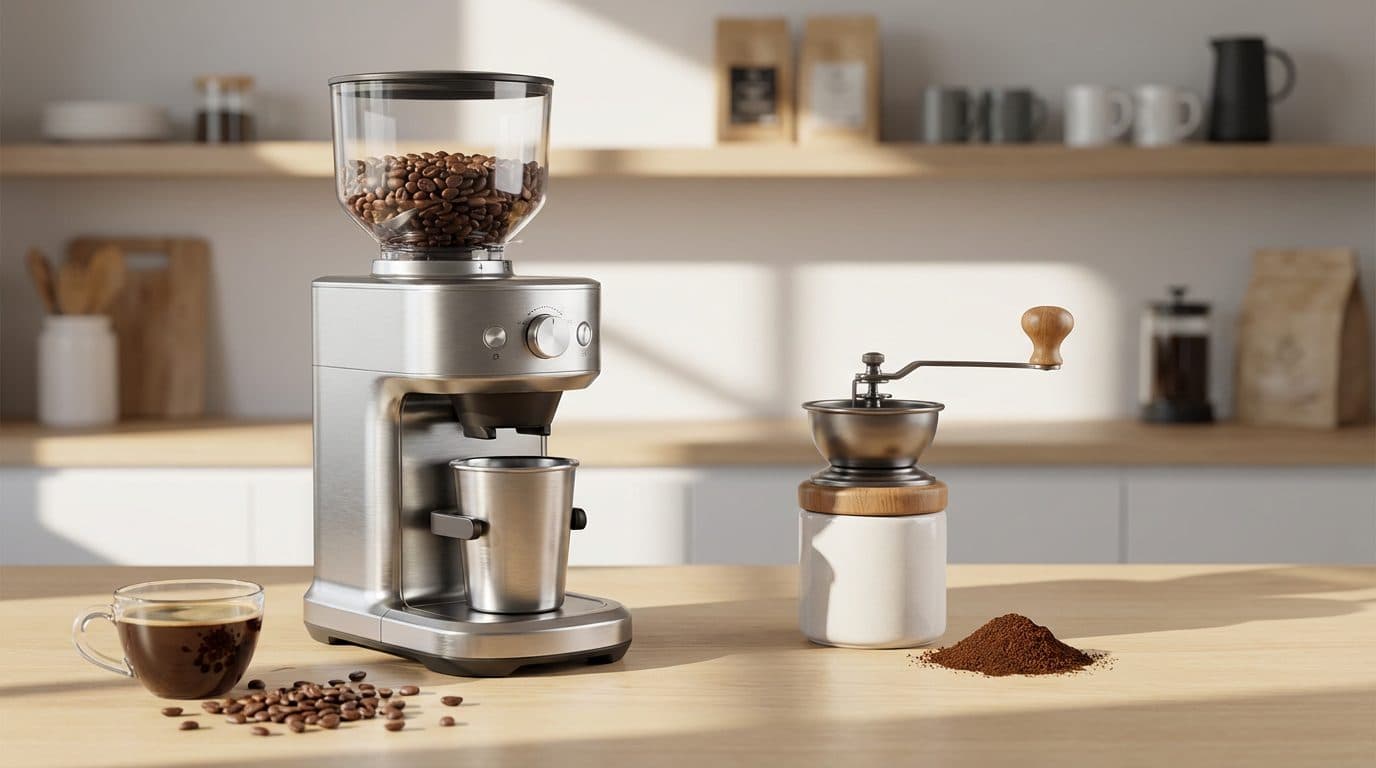
Real-world scenario: You’re making a French press every morning before work. A budget burr grinder will serve you well—French press is forgiving of slight inconsistencies, and you’ll still taste a massive improvement over pre-ground coffee.
Mid-Range Grinders: The Sweet Spot
Pros:
- Noticeably better grind consistency
- More grind settings for dialing in your brew
- Sturdier construction with better motors
- Can handle most brewing methods competently
- Often include features like timers and dosing options
Cons:
- May still struggle with ultra-fine espresso grinds
- Some retention (grounds stuck in the chamber)
- Not quite café-quality for demanding applications
Real-world scenario: You’ve fallen down the pour-over rabbit hole and want to experiment with different beans and recipes. A mid-range grinder gives you the consistency and adjustability to actually taste the differences between brewing variables. This is where coffee gets fun.
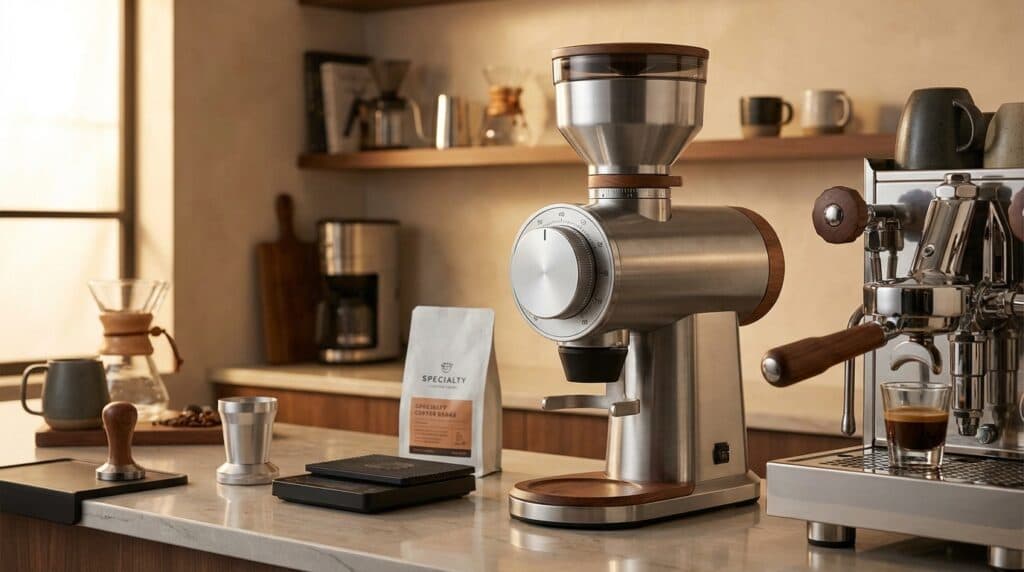
Premium Grinders: For the Dedicated Enthusiast
Pros:
- Exceptional grind consistency across all settings
- Minimal retention for single-dosing
- Stepless adjustment for micro-tuning
- Built like tanks—expect decades of service
- Quiet, cool-running motors
- Often beautiful designs that enhance your coffee corner
Cons:
- Significant investment
- Diminishing returns for casual drinkers
- Overkill for simple brewing methods
- Can be complex to dial in initially
Real-world scenario: You’ve invested in a quality espresso machine and you’re chasing that perfect shot. Here’s where premium grinders become almost necessary—espresso requires such precise grind adjustments that cheaper grinders simply can’t keep up. The difference between a good and great espresso often comes down to grind quality.
Who Should Invest in an Expensive Coffee Grinder?
Who Is This For?
- Espresso enthusiasts: If you’re pulling shots at home, grind quality is non-negotiable. A premium grinder paired with even a modest espresso machine will outperform an expensive machine with a cheap grinder.
- Flavor chasers: You buy single-origin beans, you notice tasting notes, and you want to extract every nuance from your coffee.
- Daily drinkers who value longevity: If you grind beans every day, investing in quality makes financial sense over time.
- Those who’ve outgrown their current setup: You’ve hit a ceiling with your current grinder and can taste the limitations.
Who Is This NOT For?
- Casual coffee drinkers: If you just want a decent cup to wake up, a budget burr grinder will serve you fine.
- Those who primarily use forgiving brew methods: French press, cold brew, and basic drip coffee don’t demand premium grind consistency.
- Beginners still exploring: Start affordable, learn what you like, then upgrade intentionally.
- Anyone on a tight budget: A cheap burr grinder plus great beans beats an expensive grinder with mediocre beans every time.
The Real Cost of Cheap Grinders
Here’s something most people don’t consider: a bad grinder wastes coffee. When your grind is inconsistent, you’re not extracting properly, which means you’re literally throwing flavor (and money) away with every brew.
Let’s do some quick math. Say you buy specialty beans at $18 per bag and go through two bags monthly. That’s $432 per year on beans. If a cheap grinder extracts 15-20% less flavor due to inconsistency, you’re effectively wasting $65-85 worth of coffee annually. Over five years, that’s $325-425—enough to have bought a significantly better grinder.
Barista Tip: If you’re budget-conscious but want quality, consider a manual hand grinder. Modern manual grinders in the $50-150 range often outperform electric grinders at twice the price. The trade-off is effort—you’ll spend 30-60 seconds grinding by hand. For many home baristas, it’s a worthwhile compromise.
Key Takeaway: Match Your Grinder to Your Goals
The question isn’t really “are expensive coffee grinders worth it?” but rather “is an expensive grinder worth it for you?” Here’s my framework for deciding:
- Brewing drip or French press daily? A solid budget burr grinder ($50-100) will serve you well.
- Exploring pour-over, Aeropress, or Moka pot? Step up to mid-range ($150-300) for better consistency and adjustability.
- Serious about espresso? Budget at least $300-500 for a grinder that can keep up with your machine.
- Want the best possible cup regardless of method? Premium grinders ($500+) deliver, but expect diminishing returns.
Conclusion: Invest Wisely, Grind Happily
So, are expensive coffee grinders worth it? For the right person, absolutely. The grinder is arguably the most important piece of equipment in your coffee setup—more important than your brewer, your kettle, or your fancy scale. A quality grinder unlocks the full potential of great beans and makes every cup more enjoyable.
That said, “expensive” is relative. You don’t need to spend $2,000 to make excellent coffee at home. For most home baristas, a mid-range burr grinder offers the best balance of performance, durability, and value. Start there, learn your preferences, and upgrade only when you’ve genuinely outgrown your equipment.
Life’s too short for bad coffee—but it’s also too short to stress over gear. Find the grinder that fits your brewing style and budget, dial it in, and enjoy the journey. Your perfect cup is waiting.

Comments